Saturday, October 04, 2008

Global Circulation Following the Markets – Going Down

The views expressed are those of the author and do not necessarily represent those of the National Weather Service.”


Please keep in mind the ESRL/PSD GSDM web link, below, while reading this discussion.


http://www.cdc.noaa.gov/map/clim/gsdm.composites.shtml


The 91-day signal to noise ratio (snr) anomaly composites are now updated daily, centered on the date shown. Please see product descriptions.


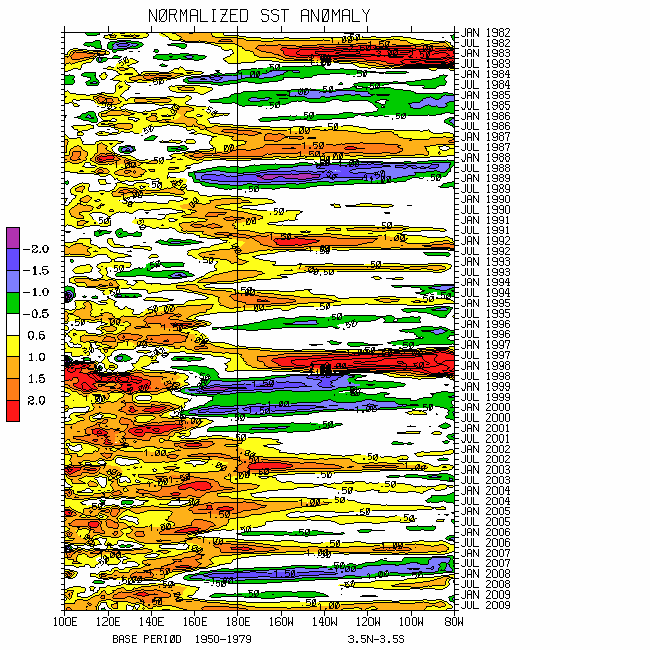
Writing like the record that never stops playing, overall spatial patterns of global SSTs, tropical and extratropical, have changed little during the past several weeks. However, some warming has recently occurred across the equatorial west central and southwest Pacific Ocean, with totals in excess of 30C and anomalies ~plus 1C. In fact, latest 5-day averaged TAO buoy data suggest these "moderate" warm anomalies extend to a depth of around 150m from the Dateline to 140E. The warming was a response to, at best; a modest equatorial westerly wind event (~5m/s anomalies) forced by both GWO and MJO-related positive convection anomalies. Stated previously, an important subseasonal monitoring issue going into this upcoming boreal cold season is the occurrence of additional equatorial westerly wind events tied to convection shifting into the west Pacific Ocean.


The anomalous warmth across the equatorial Indian Ocean has expanded during the last week, with totals in excess of 29C and anomalies at least plus 0.5-1C (large for the Indian Ocean). As discussed below, it is only a matter of short time before tropical convection becomes widespread in that part of the world. I will give my Nino 3.4 and ENSO neutral comments “a rest”, for now.


http://www.wmo.int/pages/prog/wcp/wcasp/enso_update_latest.html


http://iri.columbia.edu/climate/ENSO/currentinfo/technical.html


http://www.pmel.noaa.gov/tao/jsdisplay/


http://www.cdc.noaa.gov/forecast1/IndoPacific.frcst.html (note the initial projection)


http://www.cpc.ncep.noaa.gov/products/precip/CWlink/MJO/index.primjo.html (link 18).


http://www.cdc.noaa.gov/map/images/sst/sst.long.time.gif


Following through from my last discussion, 27 September, the tropics and extratropics appear to be getting back in sync. However, I think this dynamical process is occurring in the Western Hemisphere, perhaps from the Americas into Africa. This is farther west than I would have thought a couple of weeks ago; nevertheless, my notion of expecting it appears to be correct. Full disk satellite imagery shows enhanced tropical rainfall from the East Pacific Ocean extending through the Atlantic into Africa. In fact, an intense rainfall event may be setting up for portions of northwest Africa.


There have been several complicated dynamical processes that I have been observing leading to the current tropical-extratropical circulation coupling. It is nearly impossible for me to explain that level of detail in these discussions. In summary, these included 1) fast ~10-20 day global mountain-frictional torque index “cycles” since about 10 September, with roughly 10-20 Hadley variations for the global mountain torque; 2) meridional momentum transports, including a recent rapid quadrapole of zonal mean sinks and sources, forced by the eddies; 3) a slower ~50-day variation of the global frictional torque linked to the tropical convective forcing and dissipation of extratropical westerly wind flow anomalies in the storm track regions; and 4) Rossby wave energy dispersions (RWDs) excited by the tropical convective forcing. Inter-hemispheric meridional symmetry involving these processes has become quite robust.


The bottom line is that the WB (2008) measure of the GWO, a dynamical representation of the global circulation which considers the MJO, best explains the physical processes forcing the atmosphere. Interactions of the zonally oriented RWDs have literally dragged any MJO component of tropical forcing into the Western Hemisphere. For instance, the upper tropospheric anomalous twin tropical anticyclones that were ~120E a week ago have shifted to about 90W. Stating that convectively coupled Kelvin waves led to most of the Western Hemisphere tropical forcing (and anywhere else) is not a scientifically complete statement, and overly simplified thinking. The empirical WH (2004) measure of the MJO, keying on the equatorial wind signal, shows a less than 1 sigma projection in octant 8 of phase space through 3 October. Leaving in the interannual signal gives a larger than 1 standard deviation projection in octant 1 of phase space, which is more representative.


All of these complicated processes have worked to bring global relative AAM down to about 1 sigma below the R1 data climatology through 2 October. With a computed tendency of ~minus 15 Hadleys, the WB (2008) GWO has done a rapid orbit to roughly octant 1 of phase space, following a slower evolving similar trajectory. Anomalous zonal mean easterly wind flow; for example, greater than 5m/s at 200mb ~15S, is returning to the tropical and subtropical atmospheres. The anomalous zonal mean westerly wind flow that propagated into the midlatitudes a few weeks ago is undergoing frictional dissipation (per above). The latter is why there was the large orbit in GWO phase space, from octants 4-5 to 8-1, during September. Furthermore, the decided ~1 sigma shift toward the low AAM portion of GWO phase space is a response to the tropical-extratropical coupling including a persistent negative global frictional torque since about mid-September.


Summing up, the global circulation has returned to a weakly low AAM base state. I have concerns that as tropical convective forcing becomes anomalously intense across the Indian Ocean into Indonesia the next few weeks, the low AAM situation may intensify. Additionally, trade wind surges in the region of the Dateline have been stronger than any equatorial westerly events thus far. Hence, from a global tropical ocean and circulation perspective (not Nino 3.4), the odds may be tipping toward a La-Nina situation this upcoming boreal cold season. Regardless of what happens, subseasonal activity may continue to be quite robust (ex., perhaps simultaneous west Pacific and Indian Ocean tropical forcing) suggesting an increased risk of global high impact weather during the next several months.


Regionally for the PNA sector, GWO phases 8-1 of the 250mb psi snr composite anomaly plots best depicts the current circulation, while phases 2-3 for the MJO 250mb psi composites depicts tropical circulation anomalies. Recall that the global circulation is still “getting back together”. By later week-2 into week-3, while the “usual” 8-1 to 4-5 variations continue, I like the phases 2-3 of the snr 250mb psi plots for both the MJO and GWO. In the longer term, the MJO may again tilt toward octants 3-5 with the GWO displaced toward octants 2-4 of their phase spaces.


Stronger than I would have thought a couple weeks ago (seasonal cycle issues), at least a “preview” of the barrage of western and central USA troughs may be starting. Week-1 is a response to the North Pacific Ocean jet collapsing, typical of a GWO 8-1 transition leading to zonal wave number transition. During weeks 2-3, while more western states troughs are probable (per many models), these may reach their maximum amplitudes in the middle of the country, as shown by the snr 250mb composite psi anomaly plots. As was observed during 2007-08, progressing into DJF, JFM and so forth, GWO and MJO snr phases 2-3 suggest troughs to deepen farther west, across western North America including the USA. The corresponding 2m air temperature snr plots for GWO phases 2-3 suggest a greater than climatology probability shift of anomalous cold in the middle of the country. That may mean the first freeze going into this cold season.


As already offered in past postings and implied above, a rendition of the weather-climate situation similar to the 2007-08 cold season may occur for 2008-09. That suggests more western and central USA troughs but with added (reduced) subtropical westerly (easterly) wind flow anomalies. This may mean a more variable storm track due to occasional positive PNA patterns. In any case, I would be concerned of a tilt toward a greater likelihood of high impact weather for December-March possibly affecting most of the lower 48 states.


Intense to severe tropical thunderstorm activity is likely to increase across Africa and the equatorial Indian Ocean ~weeks 1-2, and then expand east and northeast into Bay of Bengal, Indonesia and Southeast Asia during ~weeks 2-4. The TNWP Pacific Ocean should be relatively suppressed for approximately the next 1-2 weeks. However, the west central Pacific Ocean is a “wild card” until further notice. Keeping in mind the latter, the risk of Bay of Bengal tropical cyclogenesis may shift to slightly above climatology ~weeks 2-4.


The tropical cyclone risk for East Pacific Ocean should continue week-1 then diminish afterward. Focusing on the region of the Caribbean, at least a climatological risk of tropical cyclones may continue through at least week-2 given the possibility of hybrids.


Please see the latest official tropical cyclone forecasts for all basins. I trust the expertise of the appropriate meteorological centers to alert the public of additional weather hazards worldwide. There has been an increase during the last week.


Appendix


Links to CPC and PSD ENSO discussions:


http://www.cpc.ncep.noaa.gov/products/analysis_monitoring/enso_advisory/index.shtml


http://www.cdc.noaa.gov/people/klaus.wolter/MEI/


The following is a link to information about the stratosphere and other nice monitoring tools:


http://ds.data.jma.go.jp/tcc/tcc/products/clisys/index.html


The following is a link to NCEP model verifications (surf around for lots more).


http://www.cpc.ncep.noaa.gov/schemm/z500ac_wk2_na.html .


The following is a link discussing recent global weather and related events.


http://www.wmo.ch/pages/mediacentre/news/index_en.html


These are probabilistic statements. We hope that an opportunity will arise for us (soon) to allow our dedicated web page effort to mature, expediting objectively and accountability. This web page effort will hopefully include an objective predictive scheme for the GWO with hindcasts.


The WB (2007) paper on the GSDM has been published in the February issue of MWR. In addition, the first of a two-part paper, where WB formally introduce the GWO (WB (2008)), has been accepted for publication and resubmitted to MWR. A pdf version (before revision) can be downloaded from the following link:


http://www.cdc.noaa.gov/map/clim/wb08_final.pdf


Hopefully we can get the revised version posted soon.


Overlapping seasonally varying subseasonal composites for variables such as surface temperature, precipitation, geopotential height and streamfunction anomalies are planned on being posted on the web site mentioned above and presented in part-2 of our paper. We want to emphasize notions such as global-zonal mean-regional scale linkages as well as forcing-response-feedback (with subsequent interactions) relationships. An important purpose is to provide a dynamical weather-climate linkage framework to evaluate the numerical models in a sophisticated manner as part of a subseasonal (and any time scale) forecast process, in addition to a climate service for all users. Relying on the numerical models alone is a cookbook! I should be able to do a discussion next weekend, ~11-12 October.


Ed Berry

Saturday, September 27, 2008

Atmospheric Roulette – Numerical Models Tank

The views expressed are those of the author and do not necessarily represent those of the National Weather Service.”


Please keep in mind the ESRL/PSD GSDM web link, below, while reading this discussion.


http://www.cdc.noaa.gov/map/clim/gsdm.composites.shtml


The 91-day signal to noise ratio (snr) anomaly composites are now updated daily, centered on the date shown (see product descriptions). Most map room issues have been resolved.


The spatial patterns of global SSTs have not changed significantly during the past several weeks. The tropical Indian and west central Pacific Oceans remain well above normal with anomalies ~2C and widespread totals roughly 29-30C. The warmest SSTs, shifting south with the seasonal cycle, are from east of the Philippines to New Guinea with totals ~30-31C. Negative anomalies, ~1-2C, continue from the equatorial Dateline into portions of the east Pacific Ocean cold tongue, with totals well under 28C. Respectively, anomalous spatial horseshoes of warmth and coolness extend into the extratropical North and South Pacific Oceans from these regions (negative phase of the PDO understood). We generally consider 29C SSTs as a critical temperature for supporting persistent deep moist convection.


Latest TAO buoy data show a steeper than climatology equatorial Pacific Ocean thermocline leading to roughly minus 4C anomalies (five-day average) ~150m depth/140W. Previously discussed upwelling ocean Kelvin waves have been responsible for the latter.


Overall, there are many similarities to the SST patterns compared to a year ago. This in itself demonstrates the scientific incompleteness of just using Nino 3.4 to define not only ENSO, but the impacts of global tropical SSTs onto the atmospheric circulation.


http://www.wmo.int/pages/prog/wcp/wcasp/enso_update_latest.html


http://iri.columbia.edu/climate/ENSO/currentinfo/technical.html


http://www.pmel.noaa.gov/tao/jsdisplay/


http://www.cdc.noaa.gov/forecast1/IndoPacific.frcst.html (note the initial projection)


http://www.cpc.ncep.noaa.gov/products/precip/CWlink/MJO/index.primjo.html (link 18).


http://www.cdc.noaa.gov/map/images/sst/sst.long.time.gif


Tropical convective forcing is still enhanced across portions of the Tropical Northwest Pacific Ocean (TNWP; including Super Typhoon Jangmi approaching Taiwan) and the Western Hemisphere. In fact, a respectable surface westerly wind event has been occurring north of Indonesia off the equator. Strong suppression continues across the equatorial Indian Ocean into Indonesia. An important monitoring issue heading into boreal winter will be if westerly wind events accompanying any additional coherently eastward shifting tropical convection across the west Pacific Ocean occur on the equator.


Understanding this spatial pattern of tropical forcing is not trivial, and requires intense daily monitoring within the WB (2007) GSDM framework. An important point to stress is that numerical model performance has decreased substantially over the last few weeks. Subseasonal processes (linking model skill as a function of the WB (2008) measure of the Global Wind Oscillation (GWO) is on the list of efforts for WB to quantify at some point), in addition to seasonal transition, have been responsible. I do feel comfortable with what I think are the on-going global dynamical processes, and will do my best to summarize in the following.


Animations of upper tropospheric daily mean vector wind anomalies show generally zonally oriented chains of midlatitude Rossby wave energy dispersions (RWDs) during the last few weeks. This suggests, and is objectively shown by the real-time WB (2008) measure, that the GWO has been dominating. A major component has consisted of a robust global mountain-frictional torque index cycle during about the last couple weeks (see AAM plots). Around 11 September the global mountain torque involving most north-south massifs was greater then plus 20 Hadleys, followed by a negative event of similar magnitude a few days ago. The frictional torque has loosely been in quadrature. The last occurrence of this type of (weaker) behavior was ~ 1 August (see WB (2008) submitted paper for power spectra).


The point is that the variation discussed above, through processes tied to meridional momentum transports, helped to shift anomalous zonal mean westerly wind flow from the equatorial regions into the midlatitudes. As I type, anomalous easterly wind flow (~3-5 m/s at 200mb) is quickly returning to the equatorial and subtropical atmospheres. Additionally, loosely zonal mean subtropical AAM sinks with poleward source regions have become established in both hemispheres. Finally, updated through 25 September global relative AAM is already at least 1 sigma below the R1 data climatology (without the stratospheric QBO). These are all characteristics of the global circulation trying to return to a La-Nina base state, represented by phase 3 of the GWO 250mb psi snr composite anomaly plot (more said below).


The WB (2008) measure of the GWO and WH (2004) measure of the MJO remain out of sync, the former having a strong projection in octant 8 and the latter in octant 6 of their phase spaces. However, global tropical circulation anomalies are much better represented by the MJO phase 3 250mb psi snr plots, rather than phase 6. For instance, there are upper tropospheric twin tropical anticyclones across the Western Hemisphere, not cyclones. Again, this tells us that the WB (2008) GWO (which considers the MJO) is “calling the shots”. Our current Western Hemisphere signal of tropical forcing was initiated by the midlatitude RWDs linked to the positive global mountain torque per above roughly 2 weeks ago.


There is no change in my predictive thoughts from what I typed a week ago. Tropical convective forcing is already festering across the South Indian Ocean. I expect a rapid increase of enhanced rainfall across much of the equatorial Indian Ocean during the next 1-2 weeks. The WH (2004) measure of the MJO is probable to orbit into octants 2-3 over the next few weeks. The WB (2008) GWO is likely to continue its ~10-20 day circuits from phases 4-5 to 8-1, but weakly “spiral” closer to octant 3 of phase space, also during the next few weeks. Hence coupling between the tropics and extratropics could resume by about the middle of October, and the GWO and MJO phase 3 250mb psi snr plots may broadly represent the global circulation.


The current response developing across the PNA sector, shown by the GWO phase 5 250mb psi composite anomaly for the extratropics, is the result of a fast transient RWD forced by the TNWP enhanced convection. I like phases 8-1 of the GWO 250mb psi composites by week 2, meaning some form of troughs coming into to the western states. Afterwards, while GWO variations per above continue, on average (mid-late October?), the phase 3 GWO and MJO 250mb psi and temperature snr composite anomaly plots, typical of a “La-Nina like” low AAM base state, may be most representative. This means a probability shift toward ridging near the west coast and Caribbean, and a central states trough.


There are also seasonal cycle issues not addressed in this long discussion. Overall, an enhancement of the weather typical for October appears most likely across the USA during the next few weeks. Per previous postings and above, a rendition of the low AAM base state from 2007-08 may be returning. Synoptically this may mean western and central USA troughs but with added subtropical westerly wind flow. Hence the probability for high impact weather could increase centered on the Plains, Mississippi and Ohio Valleys going into this upcoming boreal winter.


The tropical cyclone risk should hopefully decrease across the TNWP after week-1, while staying at least climatology for the Western Hemisphere “until further notice”. In addition to cyclogenesis from the deep tropics, I have concerns for hybrids especially around the Caribbean. After weeks of flooding, etc, suppression (dryer weather) is probable to shift northeast into northern India and Southeast Asia ~weeks 2-3. Per above, intense to severe thunderstorm activity is probable to erupt across the equatorial Indian Ocean during the next 1-2 weeks, then propagate east afterward. The risk of Bay of Bengal and Arabian Sea tropical cyclogenesis should be at least climatology during October.


Please see the latest official tropical cyclone forecasts for all basins. I trust the expertise of the appropriate meteorological centers to alert the public of additional weather hazards worldwide.


Appendix


Links to CPC and PSD ENSO discussions:


http://www.cpc.ncep.noaa.gov/products/analysis_monitoring/enso_advisory/index.shtml


http://www.cdc.noaa.gov/people/klaus.wolter/MEI/


The following is a link to information about the stratosphere and other nice monitoring tools:


http://ds.data.jma.go.jp/tcc/tcc/products/clisys/index.html


The following is a link to NCEP model verifications (surf around for lots more)


http://www.cpc.ncep.noaa.gov/schemm/z500ac_wk2_na.html .


The following is a link discussing recent global weather and related events.


http://www.wmo.ch/pages/mediacentre/news/index_en.html


These are probabilistic statements. We hope that an opportunity will arise for us (soon) to allow our dedicated web page effort to mature, expediting objectively and accountability. This web page effort will hopefully include an objective predictive scheme for the GWO with hindcasts.


The WB (2007) paper on the GSDM has been published in the February issue of MWR. In addition, the first of a two-part paper, where WB formally introduce the GWO (WB (2008)), has been accepted for publication in MWR. The authors are in the process of resubmitting after a minor revision. A pdf version (before revision) can be downloaded from the following link:


http://www.cdc.noaa.gov/map/clim/wb08_final.pdf


Overlapping seasonally varying subseasonal composites for variables such as surface temperature, precipitation, geopotential height and streamfunction anomalies are planned on being posted on the web site mentioned above and presented in part-2 of our paper. We want to emphasize notions such as global-zonal mean-regional scale linkages as well as forcing-response-feedback (with subsequent interactions) relationships. An important purpose is to provide a dynamical weather-climate linkage framework to evaluate the numerical models in a sophisticated manner as part of a subseasonal (and any time scale) forecast process, in addition to a climate service for all users. Relying on the numerical models alone is a cookbook! I should be able to do a discussion next weekend, ~4-5 October.


Ed Berry

Saturday, September 20, 2008

Short Update

The views expressed are those of the author and do not necessarily represent those of the National Weather Service.”


Please keep in mind the ESRL/PSD GSDM web link, below, while reading this discussion.


http://www.cdc.noaa.gov/map/clim/gsdm.composites.shtml


The 91-day signal to noise ratio (snr) anomaly composites are now updated daily, centered on the date shown (see product descriptions). On-going map room issues causing missing data and unrepresentative plots are getting resolved.


There is little change in the global tropical SSTs from a week ago. Perhaps most notable is the warming of the equatorial and South Indian Ocean with totals in excess of 29C and anomalies ~plus 2C. See links below.


http://www.wmo.int/pages/prog/wcp/wcasp/enso_update_latest.html


http://iri.columbia.edu/climate/ENSO/currentinfo/technical.html


http://www.pmel.noaa.gov/tao/jsdisplay/


http://www.cdc.noaa.gov/forecast1/IndoPacific.frcst.html (note the initial projection)


http://www.cpc.ncep.noaa.gov/products/precip/CWlink/MJO/index.primjo.html (link 18).


http://www.cdc.noaa.gov/map/images/sst/sst.long.time.gif


Decoupling of signals defined by the WH (2004) measure of the MJO and WB (2008) measure of the GWO has occurred. Interactions between tropical convective forcing shifting into the TNWP, extratropical processes involving the eddies and global mountains have removed subtropical easterly wind flow anomalies. Through 18 September global relative AAM was near the R1 data climatology.


A recent strong positive global mountain torque event, ~20 Hadleys largely from the Andes, has forced the WB (2008) GWO signal to propagate rapidly through the Western Hemisphere. In fact, the zonally oriented RWDs, characteristic of the GWO, led to a rapid increase of tropical convection around the Americas this past week. Through 18 September the GWO was in octant 8 of phase space, and the corresponding snr composite anomalies of air temperature and 250mb psi are representative for North America.


Meanwhile, the weakening WH (2004) MJO signal was in octants 5-6 of phase space (~1 sigma projection). However, leaving the interannual component in, the projection was much weaker and drifting toward Phase 3. Hence phase 3 of the MJO 250mb psi and 2m air temperature composites may best represent current tropical circulation and North American 2m air temperature anomalies, respectively.


During the next several weeks (exact timing is noise), the WB (2008) GWO should continue ~10-20 day orbits in phase space, from octants 8-1 to 4-5. I expect the GWO signal mentioned above, already coming back into the Eastern Hemisphere, to contribute to a rapid increase of equatorial Indian Ocean tropical convection by roughly the end of week-2. I also think the tropics and extratropics are probable to sync up once again. The WH (2004) MJO signal should shift back into octants 3-4 of phase space. While stochastic processes maintain the 10-20 day GWO orbits, a drift toward “the low AAM portion (La-Nina like) of GWO phase space” may also occur.


For North America, I like phases 8-1 of the GWO snr composite anomaly 250mb psi and 2m air temperature depictions for week-1, then plots 4-5 for ~week-2. Synoptically this translates to a North Pacific Ocean jet extension after next week leading to ridging across the western USA. A return to phases 8-1 is possible weeks 3-4, but perhaps with troughs extending farther south across the western and central portions of the country. Weather ramifications should be understood. There is no change in my thinking going into boreal winter.


Tropical cyclone risks will continue from the TNWP into the Western Hemisphere basins weeks 1-2. In fact, the tropical cyclone risk may be greatest from the Gulf of Mexico and Caribbean into the Atlantic Ocean weeks 2-3. Intense to severe thunderstorm activity is probable to increase from equatorial Africa into the Indian Ocean the next 1-2 weeks, with convection shifting east-northeast into India and the Maritime Continent afterward. The risk of Arabian Sea and Bay of Bengal tropical cyclones may increase by weeks 2-4.


Please see the latest official tropical cyclone forecasts for all basins. I trust the expertise of the appropriate meteorological centers to alert the public of additional weather hazards worldwide (high impact weather events are still continuing).


Appendix


Links to CPC and PSD ENSO discussions:


http://www.cpc.ncep.noaa.gov/products/analysis_monitoring/enso_advisory/index.shtml


http://www.cdc.noaa.gov/people/klaus.wolter/MEI/


The following is a link to information about the stratosphere and other nice monitoring tools:


http://ds.data.jma.go.jp/tcc/tcc/products/clisys/index.html


The following is a link to NCEP model verifications (surf around for lots more).


http://www.cpc.ncep.noaa.gov/schemm/z500ac_wk2_na.html .


The following is a link discussing recent global weather and related events.


http://www.wmo.ch/pages/mediacentre/news/index_en.html


These are probabilistic statements. We hope that an opportunity will arise for us (soon) to allow our dedicated web page effort to mature, expediting objectively and accountability. This web page effort will hopefully include an objective predictive scheme for the GWO with hindcasts.


The WB (2007) paper on the GSDM has been published in the February issue of MWR. In addition, the first of a two-part paper, where WB formally introduce the GWO (WB (2008)), has been accepted for publication in MWR. The authors are in the process of resubmitting after a minor revision. A pdf version (before revision) can be downloaded from the following link:


http://www.cdc.noaa.gov/map/clim/wb08_final.pdf


Overlapping seasonally varying subseasonal composites for variables such as surface temperature, precipitation, geopotential height and streamfunction anomalies are planned on being posted on the web site mentioned above and presented in part-2 of our paper. We want to emphasize notions such as global-zonal mean-regional scale linkages as well as forcing-response-feedback (with subsequent interactions) relationships. An important purpose is to provide a dynamical weather-climate linkage framework to evaluate the numerical models in a sophisticated manner as part of a subseasonal (and any time scale) forecast process, in addition to a climate service for all users. Relying on the numerical models alone is a cookbook! I should be able to do a complete discussion next weekend, ~27-28 September.


Ed Berry

Saturday, September 13, 2008

The Great Wall has Risen

The views expressed are those of the author and do not necessarily represent those of the National Weather Service.”


Please keep in mind the ESRL/PSD GSDM web link, below, while reading this discussion.


http://www.cdc.noaa.gov/map/clim/gsdm.composites.shtml


The 91-day signal to noise ratio (snr) anomaly composites are now updated daily, centered on the date shown (see product descriptions). On-going map room issues causing missing data and unrepresentative plots continue.


The Tropical Northwest Pacific Ocean (TNWP) still has the warmest SSTs globally, with totals ~30-31C east of Philippines and anomalies at least plus 1-2C. The equatorial Indian Ocean is also warmer than climatology, as are portions of the Caribbean into the Tropical Atlantic Ocean.


Somewhat characteristic of a mature La-Nina, well defined spatial horseshoes of anomalous SST warmth and coolness emanate from the equatorial west central Pacific Ocean and Dateline regions, respectively, into the extratropics (PDO notions understood). Negative SST anomalies across the latter are at least 2C, having totals cooler than 28C. Thus there is an enhanced east-west SST gradient from the Dateline into the Indian Ocean. Additionally, the equatorial central and east Pacific Ocean thermocline continues to be anomalously shallow allowing subsurface anomalies of less than minus 3C at ~150m deep/155W per TAO buoy data. In fact,this observation is similar to about a year ago.


It appears probable that additional episodes of trade wind surges around the equatorial Dateline generating upwelling oceanic Kelvin waves will continue going into the boreal 2008-09 winter. Hence, while the official ENSO discussion acknowledges that a return to a weak La-Nina is possible, I do not think ENSO-neutral conditions are expected to continue through the end of 2008” is a scientifically complete statement. As mentioned previously, it is the global tropical SSTs that must be considered when discussing circulation dynamics, not just “Nino 3.4”. Furthermore, the coupled global weather-climate system is already in “a non-lingering La-Nina mode” (more said below).


http://www.wmo.int/pages/prog/wcp/wcasp/enso_update_latest.html


http://iri.columbia.edu/climate/ENSO/currentinfo/technical.html


http://www.pmel.noaa.gov/tao/jsdisplay/


http://www.cdc.noaa.gov/forecast1/IndoPacific.frcst.html (note the initial projection)


http://www.cpc.ncep.noaa.gov/products/precip/CWlink/MJO/index.primjo.html (link 18).


http://www.cdc.noaa.gov/map/images/sst/sst.long.time.gif


Full disk satellite imagery and other tools show tropical convection remains enhanced across the Eastern Hemisphere. The latter is centered ~10-15N/120E, extending from the Bay of Bengal east-southeast to New Guinea and on into the SPCZ. Projection onto a MJO per the WH (2004) methodology is quite strong, roughly 2 sigma in octant 5 of phase space through 12 September. Phase 5 of the OLR composite anomaly snr done on the WH (2004) MJO index reasonably depicts the spatial pattern of tropical convection. The projection reduces to about 1.5 standard deviations in phase 4 retaining the interannual component. However, consisting of 3 subseasonal events since June, there has been at least a 1 standard deviation shift toward the Indian Ocean/Maritime Continent. This is suggestive of a base state returning to “La-Nina”.


Consistent with the above, the Eastern Hemisphere tropical forcing has significantly slowed its eastward propagation, while shifting much more toward the north. While I do expect a weaker MJO signal to propagate into the Western Hemisphere during the next few weeks, our current subseasonal event is likely to be truncated. Tropical forcing is probable to become somewhat enhanced around the Americas ~weeks 1-2, then particularly so from the Atlantic into the Indian Oceans perhaps weeks 2-3.


Relative to WH (2004) phase space, I think the MJO signal will orbit through the “1 sigma circle” and emerge into phases 8-1-2 by roughly late this month. Again, timing and details are noise, especially given recent Western Hemisphere issues, and uncertainty remains non-trivial. However, summing up: 1) centered on 10 September, phase 5 of the MJO streamfunction (psi) composite anomaly snr plot currently depicts the tropical and PNA circulation characteristics; and 2) roughly phase 1 is probable ~days 10-20 for all fields, essentially bypassing phases 6-7. Interestingly, there is some numerical and statistical model support for (2).


Observationally, animations of upper tropospheric daily mean vector wind anomalies do show twin anticyclones ~150E and rapidly decaying cyclones just east of the Dateline. In fact, around 9 September there were ~20-30m/s westerly wind anomalies at 150mb near the Dateline. As these westerlies attempted to propagate eastward, they literally hit a downstream “wall of anomalous easterly wind flow anomalies”. Outflow from Hurricane “Ike” (pointed out by Weickmann) was involved with these easterlies. This is the second observation of this type of behavior during the last few months. I do think there are some complicated feedback issues between the interannual component of the global circulation base state and on-going subseasonal activity. While the WB (2008) GWO captures some of these dynamical processes, there is much work to be done to completely understand them.


In any event, the anomalous equatorial westerly wind flow from 9 September is propagating rapidly into the midlatitudes via dynamical processes explained by the WB (2008) GWO. More specifically, Rossby wave energy dispersions (RWDs) linked to a recent strong positive clustered global mountain torque event (~30 Hadleys) have interacted with these westerlies. A regional-scale response has been the (expected) return of the “western USA (wicked) ridge from Hell” PNA pattern, shown by the GWO phase 5 psi composite.


Cutting to the chase, forced by the mountains and tropical convection, global relative AAM tendency spiked to ~plus 30 Hadleys a few days ago, causing the actual AAM to peak near the R1 data climatology. The response in the WB (2008) GWO phase space was for an orbit to octants 4-5 having ~1.5 sigma projection. Consistent with the equatorially confined empirical WH (2004) MJO signal (due to tropical-extratropical coupling), the WB (2008) GWO is probable to collapse toward octants 8-1-2 during the next 1-3 weeks as AAM tendency becomes negative. Hence it is probable that phases 8-1-2 of the WB (2008) GWO composite anomaly psi snr plots will be representative of the global circulation by ~weeks 2-3. Synoptically, that means the North Pacific Ocean jet should anomalously expand then collapse into some form of a western and central USA trough(s) during the next few weeks.


All of these notions are consistent with my last 2 postings, and are starting to remind me of what I wrote during the 2007-08 boreal cold season. In general, until I “see something different”, it is looking more likely that a “weaker rendition” of our low AAM “La-Nina” base state is coming back for this upcoming (2008-09) cold season. The WB (2008) dynamical global measure of the atmospheric circulation, GWO, may continue its ~10 to 20-day orbits while drifting toward a state shown by the phase 3 GWO psi composite anomaly, representative of a positive Branstator (2002) circumglobal teleconnection. This suggests western and central USA troughs, but with added subtropical westerly wind flow compared to last winter. Weather ramifications should be understood; however, hopefully the southern High Plains will get some decent precipitation this cold season, instead of drought.


Much of the lower 48 states will see a break next week from the recent extremely intense high-impact weather. Per above, a more active regime focusing on the western and central states may return particularly later week-2 and week-3, especially if tropical moisture transport through the Gulf of Mexico improves. GWO phases 8-1-2-of the 2m air temperature composite anomaly snr plots give a nice evolution of that parameter across the USA during the next 1-3 weeks.


While the equatorial Indian Ocean is likely to remain suppressed through at least week-1, much of Southeast Asia and the TNWP should have enhanced rainfall. Included is a risk for more northwest Pacific Ocean tropical cyclones. At some point attention will also need to be paid to the Bay of Bengal.


Next week, the tropical Atlantic Ocean will continue to “sputter” in terms of tropical convection including possible cyclones. Per above, weeks 2-3 should see a return to intense to severe clusters of thunderstorms perhaps focusing on Africa and the equatorial Indian Ocean, while lesser activity hangs around the TNWP and Americas. Relative to climatology, the risk of Atlantic Ocean tropical cyclones may increase weeks 2-3. Further, hybrid systems may become an increasing concern, especially in the region of the Caribbean, as boreal autumn progresses.


Please see the latest official tropical cyclone forecasts for all basins. I trust the expertise of the appropriate meteorological centers to alert the public of additional weather hazards worldwide (high impact weather events are still continuing).


Appendix


Links to CPC and PSD ENSO discussions:


http://www.cpc.ncep.noaa.gov/products/analysis_monitoring/enso_advisory/index.shtml


http://www.cdc.noaa.gov/people/klaus.wolter/MEI/


The following is a link to information about the stratosphere and other nice monitoring tools:


http://ds.data.jma.go.jp/tcc/tcc/products/clisys/index.html


The following is a link to NCEP model verifications (surf around for lots more).


http://www.cpc.ncep.noaa.gov/schemm/z500ac_wk2_na.html .


The following is a link discussing recent global weather and related events.


http://www.wmo.ch/pages/mediacentre/news/index_en.html


These are probabilistic statements. We hope that an opportunity will arise for us (soon) to allow our dedicated web page effort to mature, expediting objectively and accountability. This web page effort will hopefully include an objective predictive scheme for the GWO with hindcasts.


The WB (2007) paper on the GSDM has been published in the February issue of MWR. In addition, the first of a two-part paper, where WB formally introduce the GWO (WB(2008)), has been accepted for publication in MWR. The authors are in the process of resubmitting after minor revisions. A pdf version (before revision) can be downloaded from the following link:


http://www.cdc.noaa.gov/map/clim/wb08_final.pdf


Overlapping seasonally varying subseasonal composites for variables such as surface temperature, precipitation, geopotential height and streamfunction anomalies are planned on being posted on the web site mentioned above and presented in part-2 of our paper. We want to emphasize notions such as global-zonal mean-regional scale linkages as well as forcing-response-feedback (with subsequent interactions) relationships. An important purpose is to provide a dynamical weather-climate linkage framework to evaluate the numerical models in a sophisticated manner as part of a subseasonal (and any time scale) forecast process, in addition to a climate service for all users. Relying on the numerical models alone is a cookbook! I will probably not be able to do another complete discussion the weekend of ~27-28 September.


Ed Berry