Saturday, January 26, 2008

El-Veijo Getting Juiced

There is relatively little change in the spatial distribution of global tropical SSTs (I am not forgetting the Atlantic Ocean) since the 17 January posting. Mature basin-wide cold event SST conditions prevail across the Indo-Pacific sector, with anomaly magnitudes as low as ~minus 3C (totals ~24C) around 0/150-160W per TAO array buoy data. Tied to moist tropical forcing returning to the Indian Ocean (discussed below), a recent trade wind surge has led to renewed cooling along the equatorial central and eastern Pacific Ocean. The cold anomalies extend to roughly 150-200m deep, with magnitudes ~minus 5C (100m) at 120W.

Warmer than normal waters having similar anomalies as their La-Nina counterpart prevail generally along and south of the equator from the Indian Ocean-northwest Australia. SST totals in this region are ~29-30C. There is still the well-pronounced warm SST anomaly horseshoe extending from the far equatorial west Pacific Ocean into especially the Northern Hemisphere. Finally, responding to a recent westerly wind burst south of the equator, positive anomalies (5-day mean) in excess of 4C have developed ~200m at 165E. Together with the cold anomalies farther east, this is a strong signal of a steeper than normal equatorial oceanic thermocline, typical of La-Nina. Whether or not a coherent oceanic Kelvin wave gets (or already is) generated is unclear.


Full-disk satellite imagery and other diagnostic monitoring tools indicate renewed strong-severe tropical convective forcing from South Africa-central equatorial Indian Ocean (as expected per past discussions). Sporadic thunderstorm activity has been recently occurring across Indonesia while a remnant cluster attempts to develop into a South Pacific Ocean tropical cyclone. WH(2004) phase space plots support the notion that the strong MJO signal since early-mid December 2007 has returned to the Indian Ocean. Again, it is dynamical interactions with the extratropics such as Rossby wave energy dispersion (RWD) processes that allow this kind of behavior to occur. Model predictive schemes of the MJO utilizing the WH(2004) methodology were generally mixed about the signal returning to the Indian Ocean.


MJO tropical variability thus far has been the strongest since the boreal 2004-05 cold season, and this is unusual for a strong La-Nina such as the one currently in progress. Whether or not the start of MJO#3 for the boreal 2007-08 is in progress remains unclear. However, the west central-South Pacific Ocean tropical forcing finally weakening suggests that it is, as do some other tools.


As was the case for MJOs #1-2 constructively and destructively interfering with our La-Nina base state, the redevelopment of Indian Ocean tropical forcing is probable to enhance/amplify it. Keep in mind that dynamical processes in the atmosphere cannot be “shoe-horned” into simple "recipes". For example, it is not accurate to attribute the intense USA west coast winter storm ~3-4 January 2008 simply to the MJO. In reality the moist MJO tropical convective forcing centered on Indonesia amplified an already existing La-Nina base state allowing a cold trough to slam the west coast. There is no short cut to understanding the dynamics of physical atmospheric processes involving forcing-response-feedback-subsequent interactions impacting multiple time and space scales. The latter is important if we are to improve to making predictions of especially, for instance, high impact weather events weeks 1-3. Numerical models will struggle when there are rapid and complex changes involving tropical convective forcing with subsequent extratropical interactions, no matter how much bias correction is employed.


Since early-mid December 2007, responding to MJO#2, well defined poleward propagation of zonal mean easterly wind flow anomalies occurred from the equatorial into the subtropical/mid-latitude atmospheres of both hemispheres. Currently there are westerly wind flow anomalies shifting off the equator into the subtropics, particularly the Northern Hemisphere (~10m/s at 200mb). That is why there are several low-latitude closed lows with subtropical jets, globally.


With the added subtropical westerly wind flow from the last MJO, global relative AAM continues to hang around ~minus 1 standard deviation below the R1 data climatology through 23 January. Also helping to keep global AAM from plunging like the financial markets have done so far this year is a ~10-15 Hadley positive frictional torque. The latter is a direct response to the poleward and downward propagation of the zonal mean easterly wind flow anomalies discussed above, especially to around 20-40N (weaker ~15-30S).


A strong zonal mean poleward AAM transport signal has appeared ~50N while weakly equatorward ~20N, meaning midlatitude split flows that have regionally been across the oceans and roughly central Asia. Finally, also consistent is a strong positive zonal mean earth AAM signal of ~1 AMU centered ~45N suggesting a lot of surface high pressure across the Northern Hemisphere midlatitudes (weaker Southern Hemisphere). The point is that in the presence of the strong MJO variability, typical of a mature La-Nina, a loose equilibrium now exists between processes wanting to remove and add angular momentum to the atmosphere that are meridionally symmetric about the equator.


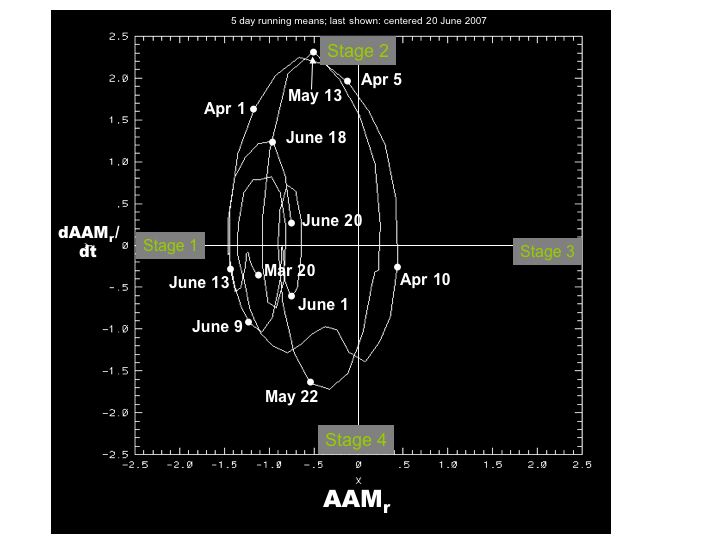
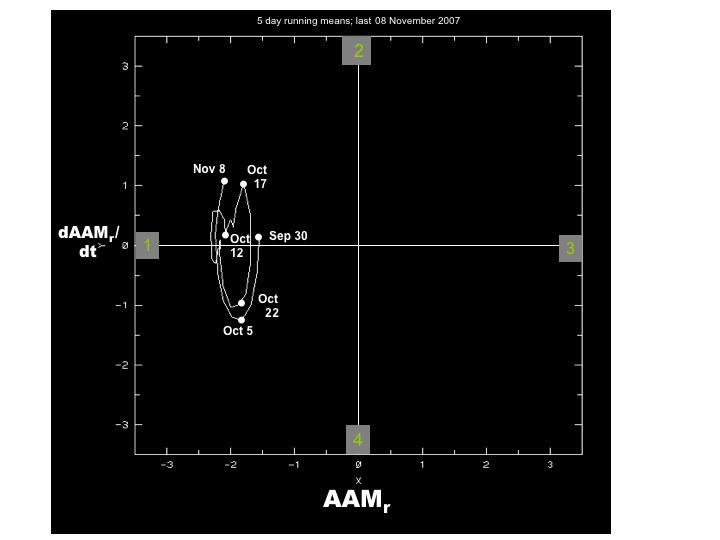
Also updated through 23 January, the GWO signal has orbited weakly to phases 4-5 in the daily mean. I suspect the orbit will shift a bit toward the left into the region of phase 3 (old GSDM Stage 1 – “La-Nina attractor”) during the next week or so. In fact, supportive of this notion, animations of upper tropospheric daily mean vector wind anomalies from ESRL/PSD already show twin tropical anticyclones developing across the Indian Ocean with cyclones shifting back toward the date line. Zonally and meridionally oriented RWDs forced by both the GWO (which considers the MJO) and MJO respectively have been leading to the expected retrogression (3-week lead time, before the numerical models caught on) of the midlatitude ridge back into the central Pacific Ocean.


Summarizing, it is still unclear whether or not MJO #3 is developing across the South Indian Ocean. However, given the warm SSTs it is probable to see the enhanced tropical forcing shift eastward into the region Indonesia-Australia (~80-140E south of the equator) by roughly week-2. Perhaps this will be another MJO with several “stops along the way (coupling with SSTs, etc.)” similar to the last one. El-Viejo is probable to get pumped once again, possibly similar to late December 2007 into earlier this month. Most numerical ensemble prediction schemes now show a PNA response typical of GWO/MJO phases 3-4 (GSDM Stage 1); that is, central Pacific Ocean ridge, trough from Alaska (good block never did develop per past posts) to the USA west coast-deep southeast states ridge. I speculate this whole pattern will drift east weeks 3-4 especially if there is another MJO (timing is always white noise). Weather ramifications of this pattern for the lower 48 states should be apparent by now (see 17 January discussion).


In the longer term, poleward shifting zonal mean easterly wind flow anomalies do increase the probability of anomalous midlatitude ridges. Where these ridges become established obviously has a lot to do where drought may occur say, for this upcoming boreal summer. Right now, that is unclear. Hence statements about possible drought centered on Iowa this upcoming warm season are very much premature. In fact, I can easily speculate an opposite scenario.


Internationally, a significant tropical cyclone risk exists from Madagascar into the South Indian Ocean week 1 likely shifting to the north coast of Australia weeks 2-3. The west central-South Pacific Ocean is going to be a bit of a “wild card” from now on (not discussed above) due to warm SSTs and other issues (stay tuned). One or two tropical cyclones may impact the paradise islands week 1 with hopefully some suppression weeks 2-3. The severe flooding rainfall events for South Africa should slowly diminish during the next couple of weeks. At least diurnal/frontal seasonal thunderstorm activity is probable week 1 for tropical South America including Brasil, with possible suppression starting weeks 2-3 should there be another MJO.


Appendix

An experimental quasi-phase space plot of the GSDM utilizing time series of normalized global relative AAM time tendency (Y-axis) and normalized global relative AAM anomaly (X-axis) can be found at

http://www.cdc.noaa.gov/map/clim/gsdm.shtml

We call the behavior of this plot the Global Wind Oscillation (GWO). While the intent of the legacy GSDM is to extend current thinking beyond the MJO, the GWO quantifies variations used to derive the original GSDM in a manner that is “user friendly” analogous t0 WH(2004) “convention”. In addition, the GWO plot does not have the ENSO signal removed.

Links to CPC and PSD ENSO discussions:

http://www.cpc.ncep.noaa.gov/products/analysis_monitoring/enso_advisory/index.shtml

http://www.cdc.noaa.gov/people/klaus.wolter/MEI/

These are probabilistic statements, and work is ongoing to quantify in future posts (for example, risk assessment maps, signal to noise ratio plots and shifts of probability). We hope that an opportunity will arise for us (soon) to have a dedicated web page effort to expedite more objectively, with rigor, thoroughness and verification. The WB (2007) paper on the GSDM has been published in the February issue of MWR. Work is on-going by Weickmann and Berry to submit a paper that will formally introduce the GWO. I will attempt another posting the weekend of 2-3 February.


Ed Berry

Thursday, January 17, 2008

Another Injection due for La-Nina; Update

The spatial pattern of global tropical SSTs is generally unchanged from at least a week ago. Above normal waters remain across the Indian Ocean while negative anomalies, including those with La-Nina, extend from north of Australia into the equatorial Pacific to the coast of South America. Anomaly magnitudes are around 1-3C, with the warmest across the South Indian Ocean (totals ~30C) and coolest in the region of the equatorial date line to 120W. Latest TAO array buoy data shows that the colder than normal equatorial Pacific SSTs are deep, extending to around 200m. A pronounced SST horseshoe of warmth extends into the extratropics from the west Pacific, with ~2C magnitudes around 30N/180. The bottom line is that El-Viejo ocean conditions are well pronounced and mature. Several of the latest dynamical and statistical models suggest La-Nina may continue most of this year.

Full disk satellite imagery and other monitoring tools indicate the strongest moist tropical convective forcing is in the region of the date line/South Pacific Ocean, with 3-day averaged OLRA ~minus 70-90 W/m**2. The latter is part of a loosely organized region of tropical rainfall that extends from the Philippines east-southeast crossing the equator near 160E into the South Pacific Ocean along the South Pacific Convergence Zone (SPCZ). I would not have expected this tropical forcing to have propagated into the west central Pacific Ocean along the equator a couple of weeks ago. An equally important region of convective suppression is across the Indian Ocean, leading to the warming SSTs there. Other regions of enhanced diurnal convection are over tropical South America and South Africa.

The MJO signal remains strong per WH(2004) methodology, having ~2.7 standard deviation projection in phase 7 on 16 January. Circulation wind flow anomalies (discussed below) along with the Indian Ocean suppression are contributing. Unlike the late boreal fall 2007 MJO occurrence, during the last week the current MJO event has stalled. Several forecast tools indicate the MJO signal will redevelop across the Indian Ocean during ~week 2-3. The very warm waters of the South Indian Ocean support this prediction, as does daily monitoring of other diagnostics (more said below).

There is, however, some concern the west central Pacific Ocean tropical forcing may persist longer than was earlier thought, possibly another ~1-2 weeks. The latter is a monitoring issue, and does add uncertainty to making predictive statements about probable circulation anomalies to evolve during the next few weeks. Stay tuned.

Updated through 12 January (there are once again data issues) global relative AAM was slightly below the R1 data climatology while its tendency was ~minus 20 Hadleys. Much of that negative tendency was a response to the removal of westerly wind flow by the mountains, particularly East Asia. The GWO signal was weakly in phase 2 (5-day average), after its circuit into phase 5 roughly two weeks ago. Even though the global AAM signal is relatively “benign” (near climatology), zonal mean anomalies remain robust. Strong negative anomalies (~1-2 AMUs), due to intense easterlies, dominate the subtropical atmospheres flanked by positive midlatitude AAM anomalies. Positive zonal mean AAM anomalies are also present in the equatorial band with a contribution coming from above average upper tropospheric westerly wind flow (~5 m/s at 200mb). This type of inter-hemispheric meridional symmetry of zonal mean AAM anomalies is a signature of the on-going strong tropical convective forcing and their distribution is generally consistent with the La-Nina composite.

Animations of upper tropospheric daily mean vector wind anomalies for about the last week loosely show stationary twin subtropical anticyclones (cyclones) around 140E (east of the date line). The stationarity of these wind flow anomalies at least partly explains the recent MJO behavior indicated by the WH(2004) phase space plot. The expected amplification across the PNA sector discussed in our 10 January posting can be seen. There are both meridionally and zonally oriented Rossby wave energy dispersions (RWDs) associated with dynamical processes explained by both the MJO and GWO. However, unlike around 1 December 2007 and also different than earlier thought, the circulation amplification has occurred in MJO phase 7, not phase 8.

Animations of additional fields including mean sea level pressures and surface temperatures show a significant cold air surge coming off of East Asia into the northwest Pacific at the time of this writing (17 January). I think, when updated, there will also be a strong positive mountain torque as a response to a ~1045 mb anticyclone east of the Tibetan Plateau associated with this cold outbreak. In fact, the R1 data AAM plots updated through 14 January “moments ago” support the assertion of a positive East Asian mountain torque. One consequence of this synoptic evolution will be an intensification of the East Asian jet (250mb anomalies ~40m/s 17 January) that will lead to additional amplification of the ridge near 140W. I also speculate (which can be verified observationally) that feedback processes from this synoptic evolution will lead to tropical convective forcing returning to the Indian Ocean weeks 2-3.

Summarizing, the eastward shift of the MJO tropical convective forcing into the west central-South Pacific Ocean has destructively interfered with the La-Nina atmospheric circulation by adding global westerly wind flow. The onset of the lower 48 states cold regime is a direct response. Once the tropical forcing returns to the Indian Ocean-Indonesia region (~100-140E), constructive interference with La-Nina is probable as easterly wind flow anomalies are added. The GWO should then orbit back to phase 3 (GSDM Stage 1) and current circulation anomalies across the PNA sector are probable to retrograde. In fact, latest week-2 ensemble means from various operational weather centers are now generally predicting this response as their initial conditions become more representative of the on-going circulation. However, timing and details of synoptic evolution are always unclear, especially now given the west Pacific forcing discussed above. One can only offer probabilistic statements based on signals like those given by the MJO and GWO (which considers the MJO), as well as the numerical models.

In the face of increasing uncertainty, we are still staying the course in regard to the North American outlooks discussed 5 and 10 January. Amplification across the PNA sector including the east Pacific Ocean ridge has already occurred (this possibility was first discussed on the 15 December 2007 posting, well before the models “caught on”). Additional amplification of this pattern is likely during the next several days, and most models currently predict this. We think these anomalies are probable (synoptic details are unclear) to shift west by ~late week 2/week 3 possibly leading to Alaska blocking tied to an anomalously strong north central Pacific anticyclone and cold troughs that would impact the USA west coast, before coming inland.

Weather ramifications of this pattern for the lower 48 states have already been detailed in past discussions. The Aleutian Islands of Alaska may get hammered by the strong ridge building cyclones mainly week-1 while Kona lows may become a concern for the Hawaiian Islands after week-1. In general, a west-southwest flow storm track across the central part of the country downstream from western USA troughs and upstream from a deep southeast states anticyclone, consistent with GWO phase 3 “amplifying” La-Nina, is probable for the next several weeks (~3-6 weeks). Most of the country may feel significant impacts (severe local storms warm sectors, blizzards cold sectors, etc.) from what could be a severe winter weather regime at times.

Internationally, the current westerly wind burst across the South Pacific Ocean will maintain a tropical cyclone hazard (possibly severe) for the paradise islands most likely week-1. That same but much lesser concern cannot be ruled out for locations around the Philippines. Portions of Brasil and South Africa may also experience enhanced frontal thunderstorm activity weeks 1-2. As moist tropical convective forcing returns to the South Indian Ocean-Indonesia regions weeks 2-3, the risk of tropical cyclones is probable to increase around the region of Madagascar. This may be start of MJO #3 for the 2007-08 boreal cold season.

Appendix

An experimental quasi-phase space plot of the GSDM utilizing time series of normalized global relative AAM time tendency (Y-axis) and normalized global relative AAM anomaly (X-axis) can be found at

http://www.cdc.noaa.gov/map/clim/gsdm.shtml

We call the behavior of this plot the Global Wind Oscillation (GWO). While the intent of the legacy GSDM is to extend current thinking beyond the MJO, the GWO quantifies variations used to derive the original GSDM in a manner that is “user friendly” analogous t0 WH(2004) “convention”. In addition, the GWO plot does not have the ENSO signal removed.

Links to CPC and PSD ENSO discussions:

http://www.cpc.ncep.noaa.gov/products/analysis_monitoring/enso_advisory/index.shtml

http://www.cdc.noaa.gov/people/klaus.wolter/MEI/

These are probabilistic statements, and work is ongoing to quantify in future posts (for example, risk assessment maps, signal to noise ratio plots and shifts of probability). We hope that an opportunity will arise for us (soon) to have a dedicated web page effort to expedite more objectively, with rigor, thoroughness and verification. The WB (2007) paper on the GSDM has been published in the February issue of MWR. Given travel, I am unclear when my next posting will be. Hopefully I will be able to post a discussion the weekend of 26-27 January. Please stay tuned.

Ed Berry

Thursday, January 10, 2008

La-Nina on Steroids; Severe USA Winter Weather Regime Coming???

Per latest 5-day averaged TAO buoy data, SST anomalies along the equatorial Pacific Ocean from 160E-South America remain strongly negative with magnitudes ~1-3C extending to ~100-150m depth. While significant cooling of SSTs has occurred during the last 1-2 weeks north of Australia due to recent intense convective rainfall, comparable warming has been in progress for the suppressed South Indian Ocean. Regardless of recent subseasonal weather events, well-pronounced mature La-Nina SSTs continue, as part of the global tropical SST system.

Although weakened, moist tropical convective forcing remains loosely consolidated across the Eastern Hemisphere centered ~0/140E. Per WH(2004) phase space plots; there is still a significant MJO projection, ~2 standard deviations located in phase 7. However, the eastward movement has again slowed. In fact, OLR/A Hovmoller plots suggest a portion of this tropical forcing has started to drift back to the west. Whether or not a weak dynamical signal will propagate into the Western Hemisphere is unclear. Recent full disk satellite imagery does show some enhancement of diurnal/frontal thunderstorm activity across tropical South America and perhaps South Africa. Although it is probable the MJO signal will re-emerge across the South Indian Ocean weeks 2-3, its exact path through phase space per WH(2004) methodology is unknown.

The MJO variability observed since boreal autumn 2007 is the strongest in at least 2 years per time series plots of the WH(2004) RMMs. What is so remarkable is to see this kind of tropical convective variability during a moderate-strong La-Nina, as is currently the case. Specifically, there have been 2 moderate-strong MJOs, including the on-going event. Depending on the MJO’s phase, these variations have alternately weakened or strengthened the La-Nina tropical convective forcing. As part of a shift by tropical convection to the west Pacific Ocean in late November, away from the typical La Nina location over Indonesia, a large amplification of the circulation occurred across the PNA sector. The response was an intense ridge from the east Pacific Ocean into Alaska and a deep western USA trough. These anomalies then retrograded as zonal mean tropical easterly wind flow anomalies developed, linked to a negative mountain torque and tropical convection returning to Africa and the western Indian Ocean.

Most recently, strong poleward fluxes of relative AAM ~35N during the last week of December dramatically increased the zonal mean westerly wind flow across the Northern Hemisphere midlatitudes. In fact, wind speed anomalies were ~70m/s at 250mb on 31 December 2007 north of a central Pacific Ocean anticyclone, the latter a response to the phasing of the MJO and the preferred region of La Nina convection over Indonesia. The point is through cooperative dynamical interactions involving the La-Nina base state, MJO variability and Rossby wave energy dispersions, the global circulation during the first week of January 2008 can be thought of as an “amplified La-Nina response”. Thus we attribute the west coast storm of ~3-5 January 2008 to “El-Viejo on steroids”!

Updated through 7 January, global relative AAM is near normal. In addition to the MJO, GWO processes such as possibly the strongest North American positive mountain torque of (~30-40 Hadleys) on record which occurred around 3 January also led to the AAM increase. Synoptically, the large and intense ~1045 hPa anticyclone that plunged across the Southern Plains and Mexico contributed to this torque. The rapid moisture return in the Plains in its wake was a needed ingredient to the severe local storm outbreak in that region a few days ago. Through eddy exchange processes linked to a negative global frictional torque (~10 Hadleys) and what will soon be a negative global mountain torque, AAM tendency is probable to become strongly negative again. In fact, the negative AAM tendency may be comparable to that observed in early December. We do expect global AAM to again drop substantially during the next few weeks, especially as subtropical zonal mean easterly wind flow anomalies remain strong. After a brief circuit through GWO phases 5-8, phase 3 is most probable by ~week 2. Again, timing is always an issue.

There is no change to the North American weeks 1-3 outlooks discussed 5 January. Similar to December 2007, a large amplification across the PNA sector is probable within the next 10 days. As more models are showing, ridge amplification from the east Pacific Ocean into Alaska with a downstream central/eastern USA trough is a likely outcome. We think these anomalies will shift west leading to Alaska blocking and a western states trough weeks 3-4. This will allow the delivery of Arctic air into the lower 48 states, along with increasing southwest flow storm track activity across the Plains. Later weeks 2-3 the west coast may again be hammered by cold troughs as circulation anomalies retrograde. Again, timing and details about the upcoming circulation evolution are still unclear. Most of the country may feel significant impacts (severe local storms warm sectors, blizzards cold sectors, etc.) from what could be a severe winter weather regime.

Internationally, at least enhanced possibly severe diurnal thunderstorm activity is probable weeks 1-2 for locations such as tropical South America and west central-South Africa. Tropical cyclone activity (including Elisa) should continue across the South Pacific Ocean mainly week-1. We think consolidation of tropical forcing should occur by about week-3 from the South Indian Ocean into western Indonesia. This may be start of MJO #3 for the 2007-08 boreal cold season.

Appendix

An experimental quasi-phase space plot of the GSDM utilizing time series of normalized global relative AAM time tendency (Y-axis) and normalized global relative AAM anomaly (X-axis) can be found at

http://www.cdc.noaa.gov/map/clim/gsdm.shtml

We call the behavior of this plot the Global Wind Oscillation (GWO). While the intent of the legacy GSDM is to extend current thinking beyond the MJO, the GWO quantifies variations used to derive the original GSDM in a manner that is “user friendly” analogous t0 WH(2004) “convention”. In addition, the GWO plot does not have the ENSO signal removed. Links to CPC and PSD ENSO discussions:

http://www.cpc.ncep.noaa.gov/products/analysis_monitoring/enso_advisory/index.shtml

http://www.cdc.noaa.gov/people/klaus.wolter/MEI/

These are probabilistic statements, and work is ongoing to quantify in future posts (for example, risk assessment maps, signal to noise ratio plots and shifts of probability). We hope that an opportunity will arise for us (soon) to have a dedicated web page effort to expedite more objectively, with rigor, thoroughness and verification. The WB (2007) paper on the GSDM has been published in the February issue of MWR. Given travel, I am unclear when my next posting will be. Please stay tuned.

Ed Berry and Klaus Weickmann

Saturday, January 05, 2008

El-Viejo Circulation Phase Space Rules

The spatial pattern of global tropical and even extratropical SST anomalies remains similar to a week ago. Some changes include cooling of the ocean waters generally north of Australia having anomalies ~minus 1-2C as a response to persistent enhanced rainfall, and corresponding warming across the suppressed Indian Ocean. Nevertheless, SST totals in excess of 28C dominate most of the Eastern Hemisphere equatorial and southern tropics extending well into the South Pacific Ocean.

Significant cold anomalies of ~minus 1-3C remain across the equatorial Pacific Ocean from ~155E-west coast of South America. In fact, recent anomalously strong trade winds have expanded and intensified these El-Viejo SST anomalies during the last couple of weeks. These below normal waters extend to at least 100m deep per latest 5-day averaged TAO buoy data (see http://www.pmel.noaa.gov/tao/jsdisplay and other relevant links for SST details). Subsurface warmth is still present ~150m depth in the region of the equatorial date line. The weak oceanic Kelvin wave discussed in the last few postings has lost coherence, likely a response to the enhanced trades.

I again want to make the point the La-Nina SSTs are only a component of the global tropical SSTs forcing (and responding with feedbacks) the atmospheric circulation. In fact, speculation suggests to me that the very warm Eastern Hemisphere tropical SSTs observed for the past several years may have recently tilted the odds toward La-Nina rather than El-Nino. The latter goes back to subseasonal weather events during boreal autumn 2006 which led to a La-Nina global circulation state (as seen from an understanding of the earth-atmosphere AAM budget). An abrupt and unpredicted end to the El-Nino SSTs subsequently occurred.

I can further speculate the warm SSTs discussed above may be a response to the global warming signal “everyone talks about”. Make no mistake; the recent global warming trend is real (started ~1960). So, can we suggest this La-Nina is a response to global warming as a feedback??? Whatever the case, there is lots of uncertainty crossing multiple time and space scales out there. As may be case investing in the financial markets these days, the same may be said about making weather forecasts.

There has not been any substantial change in the character of the tropical convective forcing discussed a week ago. Full disk satellite imagery and other monitoring tools show strong-severe clusters of tropical thunderstorm activity extending from Indonesia-South Pacific Ocean. Consistent with La-Nina, the latter is along a southwestward shifted South Pacific Convergence Zone (SPCZ). However, I think there is a component propagating southeast toward the region of ~20S/180. Recent 3-day averages of OLRA have been less than minus 70W/m**2 in that part of the world (with suppression along the equatorial date line). My own off the cuff phase speed calculation suggests an eastward movement of ~7 m/s within the convective envelope discussed above. I think the latter represents a dynamical signal that will quickly move through the Western Hemisphere during the next 1-3 weeks. Again, who knows about the timing?

The WH(2004) phase space plots show a significant phase 6 MJO signal through 4 January 2008. The MJO partition along with the rest of the Eastern Hemisphere tropical forcing slowed its eastward propagation considerably during the last few weeks due to the atmosphere-ocean coupling discussed in my 30 December 2007 edition. Continuing on my path, I would expect "some" tropical forcing to persist in the region of 120-140E with attendant circulation anomalies while perhaps a MJO dynamical signal moves through the Western Hemisphere south of the equator given the La-Nina SSTs. How the WH(2004) real-time multivariate MJO (RMM) phase space plots maintained by several weather centers show this speculative behavior is unclear.

Animations of upper tropospheric daily mean vector wind anomalies show a strong signal of what would be expected given the spatial distribution of the tropical forcing discussed above. Twin subtropical anticyclones (cyclones) have shifted east to ~120-140E (east of the date line) with 150mb anomaly magnitudes in excess of 40m/s for the equatorial Pacific westerlies. In fact, this Western Hemisphere equatorial anomalous westerly wind flow is now coming back around into the Eastern Hemisphere (more said below). Finally, there is strong cross-equatorial wind flow around the date line from the Southern Hemisphere, tied to the convection passing south of the equator.

Worth repeating from a week ago, there have been several episodes of meridionally oriented Rossby wave energy dispersions (RWDs) into the extratropics tied to circulation features such as these for the last several weeks. For the PNA sector these RWDs have led to robust cyclonic circulation anomalies around Alaska poleward of a central Pacific Ocean anticyclone. Several strong troughs have impacted the USA west coast on into the Plains as a result. The recent (~4 January 2008) severe cyclonic winter weather event that impacted the USA west coast was an extreme manifestation of these RWDs. In fact, daily mean 250mb wind speed anomalies associated with the central Pacific anticyclone was in excess of 70m/s with this event.

Having good initial condition information largely from the extratropics (ex., blocking around Scandinavia), most models did a superb job advertising this extreme weather event starting around Christmas. Of course, the magnitude of the anomalies was underestimated particularly at longer leads given the role of the tropical forcing. Additionally, as shown in the WB ((200?); publication is planned) composites for both the GWO and MJO, extreme USA west coast precipitation events are most probable to occur in GWO phases 7-8 and to a lesser degree MJO phases 7-8. However, the recent storm occurred with GWO phase 3 and MJO phase 5. The latter again emphasizes the roles played by the dynamics of non-linear feedback processes that I can only wish the resources existed for us to demonstrate in real-time. I should also add that discussion was presented in the 18 November 2007 posting of suspicion that a higher probability existed for these kinds of non-linear feedbacks within our 2007-08 La-Nina base state.

Global relative AAM remains low ~minus 1.5 standard deviations below the R1 data climatology updated through 1 January 2008. Since mid-December 2007, in the wake of the earlier MJO, there has been substantial poleward propagation of anomalous zonal mean easterly wind flow anomalies into the subtropical atmospheres. At 200mb zonal mean anomaly magnitudes are ~10m/s poleward of similar anomalies for the equatorial westerlies. These subtropical easterly wind flow anomalies have been contributing to intense midlatitude ridges, particularly across the North Pacific Ocean.

Although slightly positive ~20 December 2007, a strong East Asian Mountain torque did not occur as speculated a week ago. It was, instead, a perturbation in a low AAM base state. However, largely from the strong subtropical Northern Hemisphere trades, the global friction torque has peaked to plus 20 Hadleys. The latter is ~50-60 days after the last big frictional torque event, consistent with the GWO.

Since late December 2007 an intense sink-source transport signal has appeared ~10-40N with flux convergence of this transport ~40N. The dynamics responsible for this poleward transport signal were another contributor to the recent severe USA west coast storm. AAM tendency has been slightly positive since early December largely from processes tied to the friction and Coriolis torques. The point is we have a mature La-Nina base state where secondary processes in the atmosphere are trying to generate westerly flow to offset it. The GWO updated through 31 December shows the atmosphere “drifting” in phase 3 (legacy GSDM Stage 1). I again emphasize that measured in terms of the AAM budget, the global circulation has been strongly La-Nina, nothing moderate about it.

Uncertainty remains HUGE (above whatever climatology anyone chooses) for any subseasonal, etc., prediction. I do think there will be a weak GWO circuit possibly through phases 5-8 during the next 2-3 weeks. Per above, a weak MJO dynamical signal appears probable to propagate through the Western Hemisphere, only to come back around before the end of this month. Most models are suggesting some form of east Pacific Ocean ridge amplification by around week-2. Given the cross equatorial wind flow per above that notion is reasonable. However, systematic bias issues with the NCEP GFS ensemble tell me to favor the slightly farther west solutions of other models such as the ESRL/PSD week-2 ensemble mean. I also think that during ~weeks 2-3 more strong cold storms/troughs are once again probable to slam the USA west coast.

Hence I remain a broken record for any week 1-3 USA outlooks. After relatively warm and weak systems week-1, a colder and wetter regime appears probable from the Desert Southwest (bucking the composite La-Nina signal) into the Plains and east week-2. I would expect a westward shift of this situation weeks 3-4. I also think it is only a matter of time before blocking develops in the region of the Gulf of Alaska allowing Arctic airmasses to interact with a southwest flow storm track across the Plains. With very low confidence, I offer this synoptic evolution is possible around week 3 (~19-26 January). In addition to the winter weather hazards, concerns also must be expressed for an above average occurrence of severe local storms for locations such as the lower Mississippi into perhaps the Ohio Valleys not only weeks 1-3, but perhaps the rest of this cold season.

Internationally, heavy-severe rainfall/thunderstorms (including tropical cyclones) will be a concern for Eastern Hemisphere-South Pacific Ocean areas already discussed above for weeks 1-2. Heavy rainfall and severe thunderstorms may impact much of Brasil and South Africa by week-3, if not much sooner. Bitterly cold Arctic air will continue to dominate much of Siberia into Alaska. Alaska will see significant warming once the blocking develops.

Appendix

An experimental quasi-phase space plot of the GSDM utilizing time series of normalized global relative AAM time tendency (Y-axis) and normalized global relative AAM anomaly (X-axis) can be found at

http://www.cdc.noaa.gov/map/clim/gsdm.shtml

We call the behavior of this plot the Global Wind Oscillation (GWO). While the intent of the legacy GSDM is to extend current thinking beyond the MJO, the GWO quantifies variations used to derive the original GSDM in a manner that is “user friendly” analogous the WH(2004) “convention”. In addition, the GWO plot does not have the ENSO signal removed.

Links to CPC and PSD ENSO discussions:

http://www.cpc.ncep.noaa.gov/products/analysis_monitoring/enso_advisory/index.shtml

http://www.cdc.noaa.gov/people/klaus.wolter/MEI/

These are probabilistic statements, and work is ongoing to quantify in future posts (for example, risk assessment maps, signal to noise ratio plots and shifts of probability). We hope that an opportunity will arise for us (soon) to have a dedicated web page effort to expedite more objectively, with rigor, thoroughness and verification. The WB (2007) paper on the GSDM has been published in the February issue of MWR. Given travel, I am unclear when my next posting will be. Please stay tuned.

Ed Berry

Sunday, December 30, 2007

Getting What was "Expected"???

Continuing data issues limit a complete discussion of the current global weather-climate situation. I will only be able to speculate about components involving the earth-atmosphere AAM budget (torques, transports, etc.) as well as the GWO.

Global tropical SSTs have been relatively “steady state” since my posting nearly 10 days ago. Very warm ocean waters (high heat content) extend from north of Australia into the South Pacific, having anomaly magnitudes in excess of 2C and totals greater than 30C especially ~10S. The latter have been shifting slowly south with the seasonal/annual cycle. SST anomalies remain well below normal in all Nino regions (~160E-South America), with magnitudes less than minus 3C extending to depths ~100m east of 140W. The weak oceanic Kelvin wave continues to propagate east at around 150m depth per latest 5-day averaged TAO buoy data having reached about 150W. Finally, monitoring suggests the convectively suppressed Indian Ocean is slowly warming while much of the tropical and North Atlantic Ocean remains warmer than climatology.

So what is the point to giving a quick overview of the global tropical SSTs, at least for this posting (see http://www.pmel.noaa.gov/tao/jsdisplay and other relevant links for details)? Although I can just offer speculation here not having objective data sets, the on-going circulation response cannot be attributed to El-Viejo alone. In fact, this is often (always?) the case where the ENSO variability is only a component. Simple monitoring of the global circulation for the last several years in itself demonstrates that Eastern Hemisphere/west Pacific Ocean warm pool SSTAs have had significant impacts onto the global circulation (including right now).

Strong-severe tropical convection currently extends from the central equatorial Indian Ocean east-southeast to just north of Australia into a southwestward shifted South Pacific Convergence Zone (SPCZ). The core of this tropical convective forcing is ~10S/130E, also shifting south with the seasonal cycle. Suppression exists across the region of the equatorial date line. OLR anomaly magnitudes are in excess of 50 W/m**2.

There is a significant MJO component to this tropical forcing, located in phase 5 per WH(2004) phase space plots updated through 29 December. However, as suggested in my last posting, atmosphere-ocean coupling involving the very warm SSTs north of Australia appears to have been in progress for at least the last week. Not only has the WH(2004) MJO signal slowed down, other plots such as Hovmollers of OLR/A and velocity potential suggest a recent stationary signal. However, I do think a relatively fast MJO dynamical signal will emerge into the Western Hemisphere during the next few weeks. Again, there is HUGE uncertainty about timing and other details.

Animations of upper tropospheric daily mean vector wind anomalies show the classic expected response given the spatial distribution of the tropical forcing discussed above. Twin subtropical anticyclones (cyclones) are centered ~110E (~date line) with anomaly magnitudes in excess of 40m/s for the equatorial Pacific westerlies. There have been several episodes of meridionally oriented Rossby wave energy dispersions (RWDs) into the extratropics tied to circulation features such as these for the last several weeks. For the PNA sector these RWDs have led to robust cyclonic circulation anomalies around Alaska poleward of a central Pacific Ocean anticyclone. Several strong troughs have impacted the USA west coast on into the Plains as a result, accompanied by high impact weather events including ice and snowstorms.

For the Asian-North American extratropics, this response fits ~phases 3-4 for the WB(200?) DJF MJO composite (a component of the GWO; publication is planned), but it is somewhat different for the tropics. The point is there are highly complex non-linear dynamical feedback processes involving the extratropics and particularly the synoptic eddies going on. For instance, during the last ~5 days a fast baroclinic wave packet tied to presumably a positive East Asian mountain torque (explained by the GWO) has been aimed at North America. This will lead to the west coast ridge amplification and anomalous cold for the central/eastern USA the models have been predicting. However, this is a transient event and when updated, all that is probable to be observed is at least one circuit around GWO phase 3 (old GSDM Stage 1).

The East Asian jet extension as a response to the positive mountain torque will strongly impact the USA west coast by the end of this upcoming week per all models. As shown by DJF GWO and MJO composites WB are working on, the MJO itself does not generate enough extratropical westerly wind flow to allow the East Asian jet to impact the USA west coast. A strong positive East Asian mountain torque needs to be involved, on average.

Uncertainty is huge where the global circulation goes from here, especially when lack of resources denies me much needed data sets (latter speaking for myself). I think GWO phase 3 best describes the current global weather-climate situation. As long as the tropical convective forcing stays coupled north of Australia, I do not think this subseasonal base state (La-Nina understood) will change. However, these coupling events have recently lasted ~2 weeks, and several tropical cyclones are developing/occurring with the convection. As mentioned above, I do think a MJO component will continue into the Western Hemisphere during the next several weeks. Support for this notion are an intense westerly wind burst (WWB) north of Australia heading into the South Pacific, as well as the strong upper tropospheric equatorial westerly wind flow anomalies also mentioned above. Whether or not this WWB will be close enough to the equator (may be too far south) to generate another downwelling oceanic Kelvin wave is unclear.

Similar to about the first half of December 2007, I suspect any larger GWO orbit through phases 5-8 that may occur ~mid/late January 2008 will be relatively fast. Hence, for the lower 48 states, weeks 2-3 may have similar weather to that observed during much of December. Delivery of Arctic airmasses will be limited as long as large cyclonic circulation anomalies persist near Alaska. Nevertheless, particularly given January climatology, extreme winter weather may occur from the west coast-central/southern Rockies into the Plains. Heavy rainfall and even severe local storms may be a concern for especially the lower Mississippi and Ohio Valleys. Should phases 5-6 of the GWO occur, say by ~ week 3, Arctic air may spill into the USA. Predicting the latter involves daily monitoring; accept it!!! Finally, on more of a seasonal time scale, “bucking” the La-Nina composite signal, my subseasonal monitoring tells me not to be so pessimistic in regard to dryness across the southwestern states into the Central/Southern Plains for JFM. In fact, precipitation anomalies for portions of California through Desert Southwest and Central/Southern Plains may end up being positive for JFM if on-going feedback processes do not change.

Internationally, heavy-severe rainfall/thunderstorms will be a concern for Eastern Hemisphere areas already discussed above for weeks 1-2. These impacts may spread into the South Pacific Islands and eventually tropical South America ~ weeks 2-4 (could be sooner). Yes, the sprit of “Gabrielle” is currently festering west of Africa.

Appendix

An experimental quasi-phase space plot of the GSDM utilizing a time series of normalized relative AAM tendency anomaly (Y-axis) and normalized relative AAM anomaly time series (X-axis) can be found at

http://www.cdc.noaa.gov/map/images/gcm/gsdm_95d.jpg

http://www.cdc.noaa.gov/map/images/gcm/gsdm_40d.jpg

http://www.cdc.noaa.gov/map/clim/gsdm.shtml

We call the behavior of this plot the Global Wind Oscillation (GWO). While the intent of the legacy GSDM is to extend current thinking beyond the MJO, the GWO quantifies variations used to derive the original GSDM in a manner that is “user friendly” analogous the WH(2004) “convention”. In addition, the GWO plot does not have the ENSO signal removed.

Links to CPC and PSD ENSO discussions:

http://www.cpc.ncep.noaa.gov/products/analysis_monitoring/enso_advisory/index.shtml

http://www.cdc.noaa.gov/people/klaus.wolter/MEI/

These are probabilistic statements, and work is ongoing to quantify in future posts (for example, risk assessment maps, signal to noise ratio plots and shifts of probability). We hope that an opportunity will arise for us (soon) to have a dedicated web page effort to expedite more objectively, with rigor, thoroughness and verification. The WB (2007) paper on the GSDM has been published in the February issue of MWR. I will attempt another discussion next weekend.

Ed Berry

Friday, December 21, 2007

Typical El-Viejo??? - Update

There has been no significant change to the distribution of global tropical SSTs since my 15 December post, particularly across the Indo-Pacific region. All Nino regions have well below normal SSTs ~minus 1-3C extending to at least 100-150m deep, flanked by the warm Pacific Ocean horseshoe. An oceanic Kelvin wave with anomalies roughly plus 1-3C continues to propagate east (~2.5 m/s) through the region of 180-160W at around 150m depth per 5-day averaged TAO buoy data. While much of the equatorial and southern Indian Ocean has cooled to less than 28C (anomalies ~minus 1-2C) due to recent moist convection, the very warm waters from north of Australia to the South Pacific Ocean remain. Totals in excess of 30C are common across the latter region.

The Eastern Hemisphere tropical convective forcing has become somewhat better organized during the last few days. Full disk satellite imagery shows this large region of intense anomalous and at times severe tropical rainfall extending from the Arabian Sea to a concentrated area over central Indonesia (~0/120E) into the South Pacific Ocean. Various monitoring tools indicate there have been several components contributing to this tropical forcing. However, as shown by the WH2004 phase space and coherent modes Hovmoller plots, there is a significant MJO contribution (currently MJO phase 3-4). My own back of the envelop phase speed calculation has this convective region shifting east at ~4-5m/s since early this month. I am expecting a roughly 1-2 week period of coupling to the very warm 120E-180 SSTs by early January, before a MJO signal in all likelihood propagates into the Western Hemisphere. Again, I remind the readers there is always LARGE uncertainty about timing.

The global circulation is very much La-Nina like, which can be thought of as an enhanced climatological base state. Global relative AAM is roughly 2 standard deviations below the R1 data climatology (through 18 December) having well above average zonal mean easterly wind flow anomalies across the equatorial and subtropical atmospheres. The GWO is essentially orbiting around phase 3 (old GSDM Stage 1). However, there are always issues of non-linear dynamical feedbacks involving the extratropical eddies. For instance, per animations of daily mean upper tropospheric vector wind anomalies, while twin subtropical anticyclones (cyclones) have become established ~100-120E (~date line), there has been strong Rossby wave energy dispersions (RWDs) into the global extratropics. These RWDs have been very fast (~30m/s) not only leading to the barrage of western USA troughs, but also feeding blocking structures over Scandinavia and very recently northeast Asia. The latter will lead to a build-up of bitterly cold Arctic across Alaska during the next few weeks.

A strong zonal mean poleward AAM transport signal has become evident around 30N during the last few days, with flux divergence from the subtropics and convergence ~35N. In addition to the eddies, this transport signal has also been adding anomalous westerly flow to the northern extratropics (including the North Pacific Ocean). My point is the appearance of an AAM transport signal such as this adds support (through exchange processes involving the surface torques) to the predicted PNA synoptic evolutions I discussed a week ago.

I think there will be ~couple roughly 10-day circuits around GWO phase 3 until early-mid January when a large push to GWO phase 5 (GSDM Stage 2) may occur. That would be most probable after the period of atmosphere-ocean coupling discussed above. An evolution through GWO phases 6-8 (GSDM Stages 3-4) is possible afterwards (~weeks 4-6). Should the latter occur, more significant precipitation for locations such as California and the Desert Southwest may occur.

Hence there is no change to the predictive insights I offered in my 15 December discussion. Several troughs riding a strong North Pacific jet stream (yes, this can happen during a La-Nina) will continue to impact most of the country through early January 2008. I do think it is probable to see large ridge amplification from the east Pacific/off the USA west coast into Alaska by ~mid January 2008. Interestingly, the ESRL/PSD week-2 ensemble mean of 500mb height anomalies suggests this possibility while the NCEP GFS ensemble mean does not. However, even though the week-2 models have been “all over the place” recently, I think there will be upcoming better agreement on this GWO phase 5 scenario. If this happens, severe Arctic air may impact the Plains and eventually the eastern USA by ~mid January, after possibly initially spilling into the Pacific Northwest.

Internationally, severe rainfall and thunderstorms are probable to continue across portions of Australia and Indonesia and even into the Southwest Pacific during the next couple weeks. The north and northeast coast of Australia may become vulnerable to tropical cyclones weeks 2-3. Europe should become active as the Scandinavian blocking breaks down while bitterly cold air even by Siberia standards dominates northeast Asia. Again, some of the latter airmass may plunge into the USA via western Canada by ~mid January 2008.

Appendix

An experimental quasi-phase space plot of the GSDM utilizing a time series of normalized relative AAM tendency anomaly (Y-axis) and normalized relative AAM anomaly time series (X-axis) can be found at

http://www.cdc.noaa.gov/map/images/gcm/gsdm_95d.jpg

http://www.cdc.noaa.gov/map/images/gcm/gsdm_40d.jpg

http://www.cdc.noaa.gov/map/clim/gsdm.shtml

We call the behavior of this plot the Global Wind Oscillation (GWO). While the intent of the legacy GSDM is to extend current thinking beyond the MJO, the GWO quantifies variations used to derive the original GSDM in a manner that is “user friendly” analogous the WH2004 “convention”.

Links to CPC and PSD ENSO discussions:

http://www.cpc.ncep.noaa.gov/products/analysis_monitoring/enso_advisory/index.shtml

http://www.cdc.noaa.gov/people/klaus.wolter/MEI/

These are probabilistic statements, and work is ongoing to quantify in future posts (for example, risk assessment maps, signal to noise ratio plots and shifts of probability). We hope that an opportunity will arise for us (soon) to have a dedicated web page effort to expedite more objectively, with rigor, thoroughness and verification. The WB (2007) paper on the GSDM has been published in the February issue of MWR. I will not be able to post another discussion until late next weekend at the soonest.

Ed Berry

Saturday, December 15, 2007

AAM Trend Still in Sync with the Financial Markets

I wish the upward trend in the USA financial markets a week ago would have continued this last work week. This makes me wonder if any statistically significant correlations exist between subseasonal-interannual atmospheric variability and the world markets. The former would be in regard to the GWO and MJO while the latter would relate to ENSO.

This posting only updates what I have been writing during the last few weeks. The spatial pattern of tropical SSTs across the Indo-Pacific sector is consistent with a mature La-Nina. Anomalies along the equator from 160E-South America remain negative with magnitudes at least minus 2.5C starting at 140W (per TAO buoy data). At depth these negative anomalies are at least 150-200m deep while comparable positive anomalies (~3C) remain in the region of the equatorial date line. The latter is a response to a deepening of the oceanic thermocline forced by a Kelvin wave initiated by the recent past MJO.

While the equatorial Indian Ocean has cooled during the last week from increased tropical convective rainfall, very warm SSTs are present from about the north coast of Australia to Indonesia into the South Pacific Ocean. SST anomalies are ~plus 1-2C from around 120E-180 south of the equator with totals generally in excess of 30C (86F). These very warm Eastern Hemisphere tropical SSTs will have an important contribution to the evolution of the global circulation during the next several weeks.

Per full disk satellite imagery tropical convective forcing has become very intense across the Indian Ocean centered ~5S/80-90E having OLRA less than minus 70W/m**2 per 3-day averaged BMRC plots. Compensating strong suppression exists downstream from Indonesia-date line. This forcing is tied to the MJO, with latest WH2004 plots projecting onto phase 3 due to RMM2 being strongly negative. For the time being, the MJO signal has stalled. The GWO (which also captures the circulation responses due to the MJO in addition to extratropical non-oscillatory forcing) has remained in-sync with the tropical convective forcing returning to the Indian Ocean. Phase 3 (old GSDM Stage 1) best describes the projection of the current global circulation onto the GWO. Anomalous trades from Indonesia-date line downstream from the convection are reinvigorating La-Nina.

About a week ago global relative AAM tendency crashed to ~minus 50 Hadleys (3-day average/R1 data climatology). As of 13 December this tendency did spike to ~minus 5 Hadleys with a large component coming from a renewed positive global frictional torque. The latter was ~plus 10 Hadleys, seemingly exhibiting a recent periodicity of ~60 days (consistent with the GWO). Strengthening trades throughout the global subtropics have contributed. However, global relative AAM has again become quite low ~minus 2 standard deviations with the redevelopment of intense zonal mean easterly wind flow anomalies (~5m/s at 200mb) throughout the global equatorial and subtropical atmospheres. Also helping to remove westerly flow from the atmosphere are the large north-south mountains, with the global mountain torque ~minus 15 Hadleys having a large component from East Asia.

Animations of upper tropospheric daily mean vector wind anomalies show the expected circulation characteristics per above. Twin subtropical anticyclones are getting better defined ~90-120E with downstream cyclones in the region of the equatorial date line. Westerly wind flow anomalies (~10-20m/s) are developing across the Western Hemisphere particularly across the Pacific Ocean. In fact, some of this upper tropospheric westerly wind flow is being directed toward the southwestern USA.

Zonally oriented rapid Rossby wave energy dispersions (RWDs) directed toward the USA emanating from the Indian Ocean tropical forcing have been a dynamical component to the recent stormy winter weather pattern across the country. Per EMC/NCEP web site visual verification of predicted NCEP/GFS week-2 ensemble means of 500mb height anomalies valid roughly the last 7 days verses observed did not capture the RWDs leading to the recent negative height anomalies across the Desert Southwest. The latter is not only a systematic bias issue, but also the inability of global models to accurately predict tropical convective forcing after about day 5. I speculate that numerical model performance at lead times greater than ~3 days may remain "unusually problematic" for roughly the next 1-3 weeks.

I suspect the GWO may exhibit one or two small roughly 5-10 day circuits around phase 3 (consistent with El-Viejo) before resuming its large orbit toward phase 5 (GSDM Stage 2) and beyond. The WH2004 MJO phase space plot will likely do the same before showing an eastward propagation signal once again. One reason I feel this way is that I think the Indian Ocean tropical convective forcing is likely to shift east-southeast toward the very warm SSTs north of Australia during the next few weeks.

Of course, as always there are large uncertainties about timing and synoptic details. However, I think it is probable for both the GWO and MJO to be in roughly phase 5 by early January 2008, as I discussed a week ago. The seasonal cycle will also have “its say in this matter”, since climatologically SSTs 29C and greater become covered with tropical convection during the first part of January. So, are we going to have a period of ocean-atmosphere coupling ~120E-180 south of the equator in about 3 weeks (with the onset of the Australian monsoon)? Are we going to see another decent GWO/MJO circuit afterwards? The answers to these types of predictability questions are unclear; however, I speculate yes.

A generally active weather regime is probable to continue for most of the country through at least the end of 2007. As I typed a week ago, the period from around Christmas-early January 2008 may be exceptionally stormy focusing on the Rockies and Plains in the presence of an Arctic cold air source. However, both coasts and Alaska are probable to have impacts from our active regime. I also think it is probable to see strong ridge amplification (greater than climatology) from just west of North America-Alaska by mid January per above reasoning. The latter would suggest an anomalous cold regime from east of the Rockies-east coast with the possible exception of the Deep South.

Internationally, the main tropical cyclone hazard should shift from the South Indian Ocean (Bay of Bengal understood) toward the region of Australia and eventually southwest Pacific Ocean weeks 2-3. Surface westerly wind anomalies ~10-15m/s in that region certainly support this notion. By that time the Australian monsoon should be on-going. Indonesia and even the Philippines are also probable to have possibly severe rainfall events by weeks 2-3. I would think the current Scandinavian blocking pattern should break down by week 3, possibly retrograding into the North Atlantic Ocean. In any case, cool/wet conditions seem probable for much of the Mediterranean region through week-2. Arctic air will continue to build up and expand across particularly Siberia as well as Alaska and much of Canada during the next few weeks. Finally, I hope the spirit of Gabrielle will rest for the warm North Atlantic basin until boreal summer 2008.

Appendix

An experimental quasi-phase space plot of the GSDM utilizing a time series of normalized relative AAM tendency anomaly (Y-axis) and normalized relative AAM anomaly time series (X-axis) can be found at

http://www.cdc.noaa.gov/map/images/gcm/gsdm_95d.jpg

http://www.cdc.noaa.gov/map/images/gcm/gsdm_40d.jpg

http://www.cdc.noaa.gov/map/clim/gsdm.shtml

We call the behavior of this plot the Global Wind Oscillation (GWO). While the intent of the legacy GSDM is to extend current thinking beyond the MJO, the GWO quantifies variations used to derive the original GSDM in a manner that is “user friendly” analogous the WH2004 “convention”.

Links to CPC and PSD ENSO discussions:

http://www.cpc.ncep.noaa.gov/products/analysis_monitoring/enso_advisory/index.shtml

http://www.cdc.noaa.gov/people/klaus.wolter/MEI/

These are probabilistic statements, and work is ongoing to quantify in future posts (for example, risk assessment maps, signal to noise ratio plots and shifts of probability). We hope that an opportunity will arise for us (soon) to have a dedicated web page effort to expedite more objectively, with rigor, thoroughness and verification. The WB (2007) paper on the GSDM has been published in the February issue of MWR. I may not be able to post another discussion for at least a couple weeks; stay tuned.

Ed Berry

Saturday, December 08, 2007

AAM Crashing (like the recent finacial markets)

Yes, there has been a rebound in the USA stock markets recently especially last week. I hope this trend continues.

There is no change to my reasoning from a week ago; hence some brevity is appropriate for this discussion. The spatial distribution of global tropical SSTs remain essentially the same, with minus 1-3C anomalies along the equator from 160E-west coast of South America. Warmest SSTs across the Indo-Pacific sector are located from the north coast of Australia to Indonesia with totals in excess of 30C in places. Increasing trades from the equatorial date line into the west central Pacific Ocean (anomalies ~5-10m/s) may add some re-invigoration to the on-going El-Viejo.

An oceanic Kelvin wave was generated by the westerly wind burst forced by the recent MJO. Per latest five-day averaged TAO buoy data anomalies in excess of 3C at ~150m depth in the region of the equatorial date line are associated with this Kelvin wave. The impacts of this and additional Kelvin waves onto our basin wide moderate cold event (in terms of SSTs) is a monitoring issue. However, I speculate that the early stages of a transition to El-Nino are in progress, especially given the biennial character of ENSO over the last several years.

The dynamical signal with the MJO is quickly returning to the Eastern Hemisphere. In fact, a back of the envelope calculation from near equatorial velocity potential Hovmoller plots gives me a phase speed of ~30m/s as this signal propagated through the Western Hemisphere. Interactions with the extratropics along with decoupling between the atmosphere and tropical convection allow for these kinds of fast phase speeds as the MJO response moves through the Western Hemisphere.

Full disk satellite imagery shows tropical convective forcing rapidly increasing across the equatorial Indian Ocean during the last several days, with enhanced rainfall still present across portions of tropical South America and South Africa. WH2004 phase space plots support this observation, suggesting that the MJO signal is currently in phase 1. Animations of upper tropospheric daily mean vector wind anomalies not only show twin anticyclones developing in the region of the Indian Ocean, but also easterly wind flow returning to the equatorial atmosphere. In the zonal mean equatorial wind anomalies are already negative, and what is left of the westerly wind flow anomalies has propagated poleward well into the subtropics and midlatitudes of both hemispheres (through eddy feedbacks).

The combination of frictional dissipation, eddy dynamical processes and the tropical forcing returning to the Eastern Hemisphere is rapidly putting the brakes on the global atmosphere (and speeding up the earth shortening the length of day by a few milliseconds) as I type. In other words, easterly wind flow anomalies are quickly being added back to the equatorial and subtropical atmospheres creating a momentum sink. Given our La-Nina base state this circulation response was expected once the MJO returned to the Eastern Hemisphere.

Per ESRL/PSD AAM plots updated through 6 December using the R1 data climatology, 3-day averaged global relative AAM tendency is at least minus 40 Hadleys. The surface torques as well as the Coriolis torque are contributing to this big AAM tendency. Actual global relative AAM will crash very soon, if it is not already doing so. The expected large circuit of the GWO is occurring, currently entering phase 1. During big subseasonal events such as what has been occurring over the last several weeks, both the MJO and GWO are probable to be in similar phases.

My feeling is that another large GWO orbit and respectable MJO are probable during the next ~50 days. Of course, uncertainties about timing, synoptic details, etc., are always an issue. The GWO should circuit to phase 3 (old GSDM Stage 1) by the end of week-2 and perhaps phase 5 (Stage 2) by the end of week-4 (~ 5 January 2008). Thus my USA outlook from a week ago remains the same. I think there will be a bit of a respite from the currently active western/central USA winter regime week-2 as troughs initially deepen along/off the west coast during that period. Most week-2 ensemble means now show this response. While the USA west coast (and Alaska at times) receives several rounds of possibly intense/severe precipitation during week-2, the rest of the country east of the Divide should be milder. More “Kona Lows” may also be probable for Hawaii.

Starting around Christmas and continuing well into January a cold and active regime appears probable especially if the tropical forcing initially couples to the warm SSTs north of Australia. Troughs would again be favored across the western states with an active southwest flow storm track across the Plains. Sparing details, this pattern may shift ~10-20 degrees of longitude farther east during mid-late January bringing possibly intense cold for particularly the northeast states while extending back into the central USA. At that time ridge amplification may occur from just off the USA west coast into Alaska.

Internationally, an increasing tropical cyclone hazard across the South Indian Ocean especially by week-2 is probable. Locations from the Philippines into the west central Pacific should enjoy some quieter weather at least week-1. Cold Arctic air will continue to build up across Siberia as well as Canada during the next several weeks.

Appendix

An experimental quasi-phase space plot of the GSDM utilizing a time series of normalized relative AAM tendency anomaly (Y-axis) and normalized relative AAM anomaly time series (X-axis) can be found at

http://www.cdc.noaa.gov/map/images/gcm/gsdm_95d.jpg

http://www.cdc.noaa.gov/map/images/gcm/gsdm_40d.jpg

http://www.cdc.noaa.gov/map/clim/gsdm.shtml

We call the behavior of this plot the Global Wind Oscillation (GWO). While the intent of the legacy GSDM is to extend current thinking beyond the MJO, the GWO quantifies variations used to derive the original GSDM in a manner that is “user friendly” analogous the WH2004 “convention”.

Links to CPC and PSD ENSO discussions:

http://www.cpc.ncep.noaa.gov/products/analysis_monitoring/enso_advisory/index.shtml

http://www.cdc.noaa.gov/people/klaus.wolter/MEI/

These are probabilistic statements, and work is ongoing to quantify in future posts (for example, risk assessment maps, signal to noise ratio plots and shifts of probability). We hope that an opportunity will arise for us (soon) to have a dedicated web page effort to expedite more objectively, with rigor, thoroughness and verification. The WB (2007) paper on the GSDM has been published in the February issue of MWR. I will try to post another discussion around next weekend or early week-2.

Ed Berry

Saturday, December 01, 2007

Subprime Woes for the AAM Budget?

Other titles for this posting might have been, “The Horrors of Making Weather Predictions”, and “Spinning Wheel”. The latter is a song by Blood, Sweat and Tears a number of years ago, and it had a lyric something to the effect of, “what goes up must come down”. The point is we are in a global circulation state that is extremely difficult to understand (and write about), let alone forecast it. In other words, stochastic forcing rules. Hey, yet another title to use for later discussions. I offer below what some would simply view as an opinion (worth something, anyway).

The spatial distribution of equatorial and tropical SSTs across the Indo-Pacific sector remains consistent with a mature La-Nina (a.k.a. a cold event and El-Viejo). Negative anomalies are present in a wide equatorial band (~ +- 10 deg latitude of zero latitude) from 160E-west coast of South America, with anomalies lower than minus 2C in places extending to depths ~150m. Per 5-day averaged TAO buoy data ending 30 November, anomalies even less than minus -3C were observed ~150m/140W. Also noteworthy is that west of 160W a warm anomaly of ~plus 3C has recently developed at 150m. More said below about the possible importance of this feature.

The large scale character of these below normal El-Viejo SSTs was exasperated by a recent trade wind surge. Positive SST anomalies have become well defined from ~20S/180-north of Australia into the equatorial Indian Ocean, the latter a region of convective suppression during the last few weeks. Contributing to these warm SST anomalies has been the southward shift with the seasonal cycle, having SST totals in excess of 30C in places. Much of the equatorial and northern Atlantic Ocean basin remains above average, as does the North Pacific Ocean basin. In fact, there is still some signal of the warm extratropical horseshoe pattern of SSTs across the Pacific Ocean. Recent East Asian jet extensions and associated cold outbreaks and accompanying baroclinic storm developments across the North Pacific have led to cooling centered around the extratropical date line. The latter is an example of the atmosphere forcing the ocean, typical for the extratropics.

A strong signal of the MJO has emerged during the last several days. This was not expected by me, even though various statistical predictions of the WH2004 phase space diagrams did indicate this possibility. One reason I disagreed (and there were others) is that it is somewhat atypical during a moderate-strong La-Nina to have a coherent eastward propagating MJO globally. I should not be surprised given all the other “craziness” I have had to discuss in these postings during the last couple years. For example, behaviors I have termed as “The New World Atmosphere” and “Nemesis”.

The eastward propagation initiated ~80E along the equator during about mid-October. An intense tropical convective flare-up occurred ~140-160E during roughly 9-26 November, associated with the MJO signal along with extratropical forcing. Currently, the moist convective signal is centered ~15S/160W, but with other convection increasing across tropical South America and Africa. Full disk satellite imagery and coherent modes Hovmollers support this observation. My back of the envelop phase speed computation gives me ~3-4m/s eastward movement for the convective signal during about the last 45 days. Interestingly, there was a weaker but significant tropical convective flare-up ~150E during mid-late September, which is also on the time scale of ~50-60 days. The point is perhaps greater attention should have been paid to those “New World Atmosphere” SSTs across the west central Pacific Ocean.

The strong MJO projection onto the WH2004 RMM phase space plots has been coming from the second EOF, RMM2. Contributions to this ~3 standard deviation signal have been from the convectively suppressed Indian Ocean (positive OLRA) along with the equatorial vertical wind structure. The statistical RMM tools indicate the MJO dynamical signal to return into the equatorial Indian Ocean by the end of week 3. Hey, I have to go with it.

Now comes the portion discussing the AAM budget and GWO. The earth-atmosphere budget is about as complicated as it gets; however, I do think I can make some sense of it. I want to be relative brief about it.

Tied to the ~160E tropical flare-up discussed above along with a largely Southern Hemisphere forced friction-mountain torque (yes, the Northern Hemisphere also helped out) index cycle, a non-trivial amount of westerly wind flow was added to the atmosphere. Since early November ~3 AMUs was added to the global circulation, focusing not only across the equatorial regions, but also the northern and southern midlatitudes, in terms of the zonal mean. The midlatitude contribution was a response to eddy feedback dynamics that much research still needs to be done to understand it. There has been a recent peak of global relative AAM to slightly above the R1 data climatology. Just as the low AAM base state observed much of boreal autumn was an extreme weather event, this sudden increase was also the same.

The GWO presents this signal nicely, very weakly in the phase 7 (legacy GSDM Stage 3) plane through 28 November (5-day averaged). Even though the GWO projection is near zero, the variation is also a 2-3 standard deviation event. So, we have experienced 2-3 sigma events of both the GWO and MJO. The GWO signal can be seen in terms of broad zonal mean westerly wind anomalies from ~30N-30S with magnitudes ~5m/s. A true MJO would be more equatorially confined before propagating poleward. The punch line to all this will be to see if global relative AAM goes down as fast as it came up during the next few weeks. Now you know where analogies to the recent subprime woes of the financial markets come in, etc.

Currently the global surface torques have become weakly negative (through 29 November) as seen by lowering mean sea level pressures along north-south mountain ranges and anomalous surface westerly wind flow across the tropical and extratropical Pacific Ocean. The latter represents frictional dissipation of the westerly flow. In fact, a strong westerly wind burst at ~150E accompanied the MJO convection discussed above, and I think a down welling oceanic Kelvin wave may have been initiated leading to the subsurface warming also mentioned above.

The AAM transport signal is incredibly complicated. However, there is a decent poleward transport signal at centered ~45N and 50S (roughly 10 Hadleys for Northern Hemisphere). There is evidence that these transports (flux divergence of AAM transport) are leading to meriodional propagation of zonal mean zonal wind anomalies. For instance, zonal mean anomalous easterlies (tied to La-Nina) are shifting into the midlatitude atmospheres while the equatorial westerlies also come off. The midlatitude westerly anomalies are also shifting poleward. Again, there is strong inter-hemispheric symmetry of both zonal mean and regional-scale circulation anomalies due to the strong tropical forcing.

Cutting to the chase of this mess, should the tropical convective forcing shift into the Indian Ocean/Maritime Continent during weeks 2-3, while anomalous ridging may be favored at the higher latitudes, anomalous westerly wind flow may be probable from the subtropics-lower midlatitudes. The latter would be a response to anomalous easterly wind flow anomalies returning to the equatorial regions of the atmosphere (more said below).

Animations of fields such as upper tropospheric daily mean vector wind anomalies present one of the best Rossby wave energy dispersions (RWD) across the PNA sector I have seen in a while. Linked to twin subtropical anticyclones along/west of the date line, a low-high-low-high pressure great circle arc including the deep western USA trough can be seen 1 December 2007. A large anticyclone is also bursting into the Arctic, which could help build up more bitterly cold air. Wind anomalies in excess of 50m/s have occurred with this RWD during the last several days. This situation serves as an example of an extreme synoptic weather event linked to the slower processes involving both the GWO and MJO per above. Another point is that we have experienced an extreme event of subseasonal atmospheric variability that already has and will impact multiple time scales until further notice. For instance, are we beginning the slow process of transitioning from El-Viejo to El-Nino?

Let’s move onto insights for weeks 1-4. I can only wish for the day others can observe and appreciate the variations from the GWO (GSDM) perspective that we try to share. As stated above, phase 7 of the GWO best describes the current weather-climate situation. Any predictive information I offer here is likely to going to be “wrong” anyway (low confidence, seriously), so I may as well “go for it”. Again, stochastic forcing rules, and any objective prediction schemes will likely suffer more than usual during the next few weeks.

Most models already suggest some form of amplification weeks 1-2, including the possibility of Plains storm development ~10-14 December. This is a response to the likely collapse of the strong North Pacific jet. In any case, my feeling would be expect a situation of a deep east Asian trough-central/east Pacific ridge (into Alaska and polar latitudes at times) leading to at times an anomalous trough focused across the western/central USA by weeks 3-4. That option would be an opinion to respect should AAM crash and the GWO strongly circuits to ~phase 3 (old GSDM Stage 1) particularly if westerly flow remains strong across the subtropics. Ramifications for the USA may be sporadic episodes of “winter” weeks 1-2 (Pacific Northwest wetness, cold across the northern states, etc), followed by a significant cold and wet regime weeks 3-4. The most intense cold and storm track activity by that time may focus on the Rockies and Plains; however, locations such as the northeast states may be impacted as well. I think other USA concerns are apparent.

Internationally, in addition to an increasing tropical cyclone hazard across the South Indian Ocean weeks 1-2, there should be some concern for this hazard across the South Pacific Ocean paradise islands as well. Much of Europe is likely to remain active while portions of tropical South America get beneficial rainfall. Finally, at least seasonable cold is probable for Siberia (to come into the USA by around Christmas?).

Appendix

An experimental quasi-phase space plot of the GSDM utilizing a time series of normalized relative AAM tendency anomaly (Y-axis) and normalized relative AAM anomaly time series (X-axis) can be found at

http://www.cdc.noaa.gov/map/images/gcm/gsdm_95d.jpg

http://www.cdc.noaa.gov/map/images/gcm/gsdm_40d.jpg

http://www.cdc.noaa.gov/map/clim/gsdm.shtml

We call the behavior of this plot the Global Wind Oscillation (GWO). While the intent of the legacy GSDM is to extend current thinking beyond the MJO, the GWO quantifies variations used to derive the original GSDM in a manner that is “user friendly” analogous the WH2004 "convention”.

Links to CPC and PSD ENSO discussions:

http://www.cpc.ncep.noaa.gov/products/analysis_monitoring/enso_advisory/index.shtml

http://www.cdc.noaa.gov/people/klaus.wolter/MEI/

These are probabilistic statements, and work is ongoing to quantify in future posts (for example, risk assessment maps, signal to noise ratio plots and shifts of probability). We hope that an opportunity will arise for us (soon) to have a dedicated web page effort to expedite more objectively, with rigor, thoroughness and verification. The WB (2007) paper on the GSDM has been published in the February issue of MWR. I will try to post another discussion around next weekend or early week-2.

Ed Berry

Sunday, November 25, 2007

Postponed again

It is unlikely I will write another complete discussion for this Blog until next weekend at the soonest. Briefly, the change to the USA cold regime I discussed roughly a week ago is generally on track. However, globally westerly wind flow throughout the atmosphere has increased dramatically over the last 7-10 days. Global relative AAM is currently near to slightly above average, up ~3AMUs. The eastward shift of tropical convective forcing to ~0/160E, strong positive surface torques and suspected eddy feedbacks have led to the rapid increase in westerly flow. Largest zonal mean contributions have been from the equatorial and midlatitude atmospheres of both hemispheres.

Phase 5 of the GWO best describes the global weather-climate situation. I think we are in the process of a having a large circuit of the GWO. A wind signal from the MJO is contributing. An important monitoring issue will be to see how far west the tropical convective forcing redevelops across the Eastern Hemisphere during the next few weeks. I speculate that the current extension of the East Asian jet will "break through" the eastern Pacific ridge ~week 2, followed by re-amplification of existing PNA circulation anomalies ~20-30 deg of longitude farther west weeks 3-4.

Appendix

An experimental quasi-phase space plot of the GSDM utilizing a time series of normalized relative AAM tendency anomaly (Y-axis) and normalized relative AAM anomaly time series (X-axis) can be found at


http://www.cdc.noaa.gov/map/clim/gsdm.shtml

We call the behavior of this plot the Global Wind Oscillation (GWO). While the intent of the legacy GSDM is to extend current thinking beyond the MJO, the GWO quantifies variations used to derive the original GSDM in a manner that is “user friendly” analogous the WH2004 “convention”. In addition, the GWO plot does not have the ENSO signal removed.

Links to CPC and PSD ENSO discussions:

http://www.cpc.ncep.noaa.gov/products/analysis_monitoring/enso_advisory/index.shtml


These are probabilistic statements, and work is ongoing to quantify in future posts (for example, risk assessment composite maps, composite signal to noise ratio plots and shifts of probability). We hope that an opportunity will arise for us (soon) to have a dedicated web page effort to expedite more objectively, with rigor, thoroughness and verification. The WB (2007) paper on the GSDM has been published in the February issue of MWR. I will try to post a complete discussion next weekend.

Ed Berry

Sunday, November 18, 2007

El-Viejo Update

This posting will be short. One motivation for attempting to “get something out” is my concern for a change to a significant to perhaps severe winter regime focusing on the USA Rockies and Plains by week-3 (roughly the first week in December). Of course, there are always timing issues, and the above statement is made from my conservative perspective when it comes to making any kind of weather predictions.

The same weather-climate issues discussed on my 10 November, 2007, posting remain. The dominate tropical convective forcing has shifted east to ~0/140E during the past week. This was more of an eastward push than I expected a week ago; however, not surprising. Several tropical cyclones have been and still are occurring across the Indo-Pacific region. I am optimistic that the Bay of Bengal tropical cyclone season is “over with”. The low confidence amplification across the Asian-North American sector I also offered a week ago is in progress as I type. Numerical ensemble prediction schemes have been “playing catch-up” to this initial first regional scale response to La-Nina and tropical convective forcing.

Global relative AAM has risen slightly to ~minus 2 standard deviations below the R1 data climatology (14 November last update) with the recent development of equatorial zonal mean upper tropospheric westerly wind flow anomalies. The latter are most robust west of South America, having magnitudes ~20-30m/s. Anomalous twin upper tropospheric subtropical anticyclones have redeveloped ~120-140E, forced by the tropical convection. Rossby wave energy dispersions from these anticyclones will deepen a trough into the Rockies and Plains by the middle of this upcoming week, leading to what may be this cold season’s first winter storm for the Upper Mississippi Valley and Great Lakes regions.

The punch line is that the above mentioned tropical forcing may be the final step for mature coupling to La-Nina. Typically for the ENSO “cycle”, often a MJO or other tropical convective forcing leads to mature coupling during January of the annual cycle. We are concerned this process is starting sooner. Zonal mean subtropical easterly wind flow anomalies remain very intense poleward of the equatorial westerlies already discussed across both hemispheres. At this time, an evolution toward phase 5 of the Global Wind Oscillation (GWO; legacy GSDM Stage 2) appears to be in progress. Updated through 14 November global relative AAM tendency was ~plus 20 Hadleys with the calculated tendency ~plus 30 Hadleys.

Even though statistical tools such as the WH2004 RMMs already indicate and predict a robust MJO during the next couple of weeks, I disagree with that notion. One important point to remember is that these types of techniques do remove the ENSO signal, and that is a problem given the current situation. I do think it is probable for a fast dynamical signal to propagate through the Western Hemisphere over the next couple of weeks. However, as already indicated by satellite imagery, the tropical convective forcing ~140E is starting to “break apart”. One portion should retreat back to the west-northwest while the other enhances a westward shifted South Pacific Converge Zone (SPCZ). Additionally, tropical convection is re-firing across the warm Indian Ocean just south of the equator. Bottom line is tropical forcing should re-intensify back to west ~80-120E during the next few weeks, forcing the GWO back to ~phase 3 (legacy GSDM Stage 1).

For the PNA sector, I think there is a real possibility for a corresponding westward shift of circulation anomalies by early December, perhaps leading to a blocking ridge into Alaska ~140-150W and extratropical cold lows even impacting the USA west coast before coming inland. Cold Arctic air has been recently building up across portions of Siberia into northern Canada. If there is any correctness to these notions, this Arctic air may dump into the USA including locations west of the Continental Divide starting week-2. Weeks 3-4 may see the classic moist southwest flow storm track across the Plains, with intense cold focusing on the Rockies and Northern Plains while the Deep South has above normal temperatures. Areas such as the Desert Southwest and the southwest High Plains may also have decent precipitation in spite of the La-Nina signal. Other weather impacts may include snowfall for Pacific Northwest cities such as Seattle and severe local storms and heavy rainfall from the lower Mississippi Valley into the Ohio Valley.

Finally, any seasonal mean DJF 2007-08 anomalous cold air surface temperature signal which could in reality occur for portions of the USA may be dominated by December. It will be interesting to observe subseasonal activity starting January as tropical convective forcing shifts toward the very warm west central and southwest Pacific Ocean. Will we start to see our "Nemesis"? Is El-Nino in the cards for 2008-09, perhaps even a strong one???

Please see the latest statements from the NOAA/NWS/Tropical Prediction Center and other international centers for tropical cyclone statements. Areas including the Northwest Pacific Ocean around the Philippines, as well as from the South Indian into the Southwest Pacific Oceans including the "paradise islands" may have concerns for tropical cyclones through week-2. Finally, episodes of strong/severe synoptic baroclinic cyclonic systems hammering at least portions of Scandinavia, Europe into the Mediterranean countries/northwest Africa remain probable through week-2.

Appendix

An experimental quasi-phase space plot of the GSDM utilizing a time series of normalized relative AAM tendency anomaly (Y-axis) and normalized relative AAM anomaly time series (X-axis) can be found at


http://www.cdc.noaa.gov/map/clim/gsdm.shtml

We call the behavior of this plot the Global Wind Oscillation (GWO). While the intent of the legacy GSDM is to extend current thinking beyond the MJO, the GWO quantifies variations used to derive the original GSDM in a manner that is “user friendly” analogous the WH2004 “convention”. In addition, the GWO plot does not have the ENSO signal removed.

Links to CPC and PSD ENSO discussions:

http://www.cpc.ncep.noaa.gov/products/analysis_monitoring/enso_advisory/index.shtml


These are probabilistic statements, and work is ongoing to quantify in future posts (for example, risk assessment composite maps, composite signal to noise ratio plots and shifts of probability). We hope that an opportunity will arise for us (soon) to have a dedicated web page effort to expedite more objectively, with rigor, thoroughness and verification. The WB (2007) paper on the GSDM has been published in the February issue of MWR. I will try to post another discussion around late next weekend or early week-2.

Ed Berry