Sunday, November 25, 2007

Postponed again

It is unlikely I will write another complete discussion for this Blog until next weekend at the soonest. Briefly, the change to the USA cold regime I discussed roughly a week ago is generally on track. However, globally westerly wind flow throughout the atmosphere has increased dramatically over the last 7-10 days. Global relative AAM is currently near to slightly above average, up ~3AMUs. The eastward shift of tropical convective forcing to ~0/160E, strong positive surface torques and suspected eddy feedbacks have led to the rapid increase in westerly flow. Largest zonal mean contributions have been from the equatorial and midlatitude atmospheres of both hemispheres.

Phase 5 of the GWO best describes the global weather-climate situation. I think we are in the process of a having a large circuit of the GWO. A wind signal from the MJO is contributing. An important monitoring issue will be to see how far west the tropical convective forcing redevelops across the Eastern Hemisphere during the next few weeks. I speculate that the current extension of the East Asian jet will "break through" the eastern Pacific ridge ~week 2, followed by re-amplification of existing PNA circulation anomalies ~20-30 deg of longitude farther west weeks 3-4.

Appendix

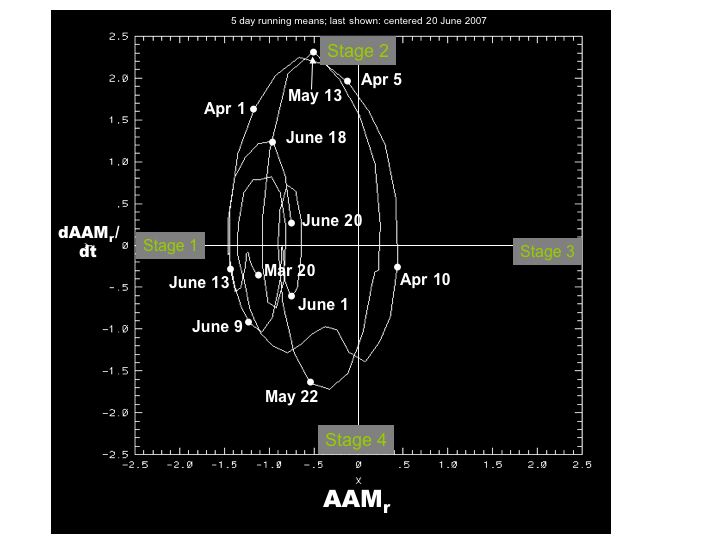
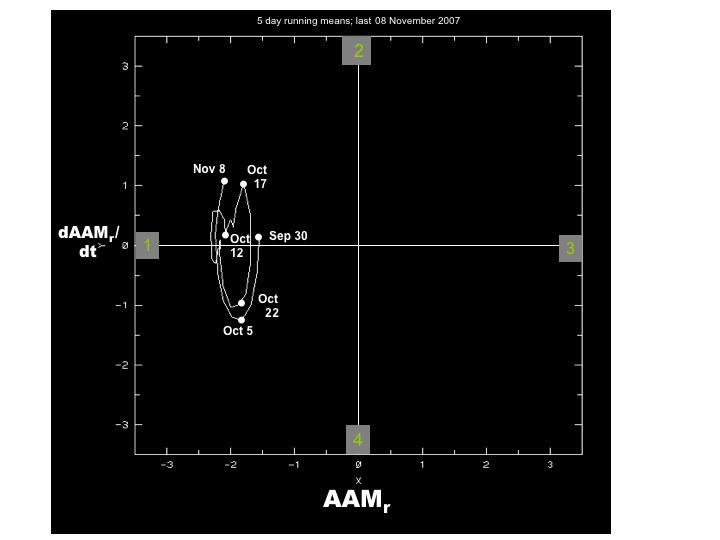
An experimental quasi-phase space plot of the GSDM utilizing a time series of normalized relative AAM tendency anomaly (Y-axis) and normalized relative AAM anomaly time series (X-axis) can be found at


http://www.cdc.noaa.gov/map/clim/gsdm.shtml

We call the behavior of this plot the Global Wind Oscillation (GWO). While the intent of the legacy GSDM is to extend current thinking beyond the MJO, the GWO quantifies variations used to derive the original GSDM in a manner that is “user friendly” analogous the WH2004 “convention”. In addition, the GWO plot does not have the ENSO signal removed.

Links to CPC and PSD ENSO discussions:

http://www.cpc.ncep.noaa.gov/products/analysis_monitoring/enso_advisory/index.shtml


These are probabilistic statements, and work is ongoing to quantify in future posts (for example, risk assessment composite maps, composite signal to noise ratio plots and shifts of probability). We hope that an opportunity will arise for us (soon) to have a dedicated web page effort to expedite more objectively, with rigor, thoroughness and verification. The WB (2007) paper on the GSDM has been published in the February issue of MWR. I will try to post a complete discussion next weekend.

Ed Berry

Sunday, November 18, 2007

El-Viejo Update

This posting will be short. One motivation for attempting to “get something out” is my concern for a change to a significant to perhaps severe winter regime focusing on the USA Rockies and Plains by week-3 (roughly the first week in December). Of course, there are always timing issues, and the above statement is made from my conservative perspective when it comes to making any kind of weather predictions.

The same weather-climate issues discussed on my 10 November, 2007, posting remain. The dominate tropical convective forcing has shifted east to ~0/140E during the past week. This was more of an eastward push than I expected a week ago; however, not surprising. Several tropical cyclones have been and still are occurring across the Indo-Pacific region. I am optimistic that the Bay of Bengal tropical cyclone season is “over with”. The low confidence amplification across the Asian-North American sector I also offered a week ago is in progress as I type. Numerical ensemble prediction schemes have been “playing catch-up” to this initial first regional scale response to La-Nina and tropical convective forcing.

Global relative AAM has risen slightly to ~minus 2 standard deviations below the R1 data climatology (14 November last update) with the recent development of equatorial zonal mean upper tropospheric westerly wind flow anomalies. The latter are most robust west of South America, having magnitudes ~20-30m/s. Anomalous twin upper tropospheric subtropical anticyclones have redeveloped ~120-140E, forced by the tropical convection. Rossby wave energy dispersions from these anticyclones will deepen a trough into the Rockies and Plains by the middle of this upcoming week, leading to what may be this cold season’s first winter storm for the Upper Mississippi Valley and Great Lakes regions.

The punch line is that the above mentioned tropical forcing may be the final step for mature coupling to La-Nina. Typically for the ENSO “cycle”, often a MJO or other tropical convective forcing leads to mature coupling during January of the annual cycle. We are concerned this process is starting sooner. Zonal mean subtropical easterly wind flow anomalies remain very intense poleward of the equatorial westerlies already discussed across both hemispheres. At this time, an evolution toward phase 5 of the Global Wind Oscillation (GWO; legacy GSDM Stage 2) appears to be in progress. Updated through 14 November global relative AAM tendency was ~plus 20 Hadleys with the calculated tendency ~plus 30 Hadleys.

Even though statistical tools such as the WH2004 RMMs already indicate and predict a robust MJO during the next couple of weeks, I disagree with that notion. One important point to remember is that these types of techniques do remove the ENSO signal, and that is a problem given the current situation. I do think it is probable for a fast dynamical signal to propagate through the Western Hemisphere over the next couple of weeks. However, as already indicated by satellite imagery, the tropical convective forcing ~140E is starting to “break apart”. One portion should retreat back to the west-northwest while the other enhances a westward shifted South Pacific Converge Zone (SPCZ). Additionally, tropical convection is re-firing across the warm Indian Ocean just south of the equator. Bottom line is tropical forcing should re-intensify back to west ~80-120E during the next few weeks, forcing the GWO back to ~phase 3 (legacy GSDM Stage 1).

For the PNA sector, I think there is a real possibility for a corresponding westward shift of circulation anomalies by early December, perhaps leading to a blocking ridge into Alaska ~140-150W and extratropical cold lows even impacting the USA west coast before coming inland. Cold Arctic air has been recently building up across portions of Siberia into northern Canada. If there is any correctness to these notions, this Arctic air may dump into the USA including locations west of the Continental Divide starting week-2. Weeks 3-4 may see the classic moist southwest flow storm track across the Plains, with intense cold focusing on the Rockies and Northern Plains while the Deep South has above normal temperatures. Areas such as the Desert Southwest and the southwest High Plains may also have decent precipitation in spite of the La-Nina signal. Other weather impacts may include snowfall for Pacific Northwest cities such as Seattle and severe local storms and heavy rainfall from the lower Mississippi Valley into the Ohio Valley.

Finally, any seasonal mean DJF 2007-08 anomalous cold air surface temperature signal which could in reality occur for portions of the USA may be dominated by December. It will be interesting to observe subseasonal activity starting January as tropical convective forcing shifts toward the very warm west central and southwest Pacific Ocean. Will we start to see our "Nemesis"? Is El-Nino in the cards for 2008-09, perhaps even a strong one???

Please see the latest statements from the NOAA/NWS/Tropical Prediction Center and other international centers for tropical cyclone statements. Areas including the Northwest Pacific Ocean around the Philippines, as well as from the South Indian into the Southwest Pacific Oceans including the "paradise islands" may have concerns for tropical cyclones through week-2. Finally, episodes of strong/severe synoptic baroclinic cyclonic systems hammering at least portions of Scandinavia, Europe into the Mediterranean countries/northwest Africa remain probable through week-2.

Appendix

An experimental quasi-phase space plot of the GSDM utilizing a time series of normalized relative AAM tendency anomaly (Y-axis) and normalized relative AAM anomaly time series (X-axis) can be found at


http://www.cdc.noaa.gov/map/clim/gsdm.shtml

We call the behavior of this plot the Global Wind Oscillation (GWO). While the intent of the legacy GSDM is to extend current thinking beyond the MJO, the GWO quantifies variations used to derive the original GSDM in a manner that is “user friendly” analogous the WH2004 “convention”. In addition, the GWO plot does not have the ENSO signal removed.

Links to CPC and PSD ENSO discussions:

http://www.cpc.ncep.noaa.gov/products/analysis_monitoring/enso_advisory/index.shtml


These are probabilistic statements, and work is ongoing to quantify in future posts (for example, risk assessment composite maps, composite signal to noise ratio plots and shifts of probability). We hope that an opportunity will arise for us (soon) to have a dedicated web page effort to expedite more objectively, with rigor, thoroughness and verification. The WB (2007) paper on the GSDM has been published in the February issue of MWR. I will try to post another discussion around late next weekend or early week-2.

Ed Berry

Saturday, November 10, 2007

El-Viejo Keeps Rocking

There has not been a lot of change to the tropical global SST pattern during the past week. Equatorial Pacific Ocean cold anomalies remain from the west coast of South America to ~160E, with the greatest magnitudes ~minus 3C at about 120W. There is some possibility this cold event may be nearing maturity since the coldest subsurface anomalies have apparently surfaced and magnitudes only around minus 1-2C exist just below the surface east of 150W. Plus 0.5-1C subsurface anomalies (as deep as 150m) remain along the equator from 160W to at least 140E. It is probable for the western tropical Pacific Ocean to remain relatively convectively suppressed thorough at least December (Nemesis is still around), meaning SST anomalies across the warm pool region may increase.

The west central Pacific Ocean still has totals in excess of 30C currently just south of the equator at 140E slowly shifting into the Southern Hemisphere with the annual cycle, linking to a well pronounced positive SST horseshoe into the global midlatitudes. In fact, in the regions of 30-40N and S latitudes, Pacific Ocean SST anomalies are well in excess of plus 3C (totals 22C and colder) as a response to persistent intense subtropical anticyclones. This is a situation of the atmosphere forcing the ocean, unlike the ocean forcing the atmosphere as typically occurs across the deep tropics. Many will argue feedbacks occur from extratropical SSTAs such as these; however, they are only secondary. For instance, should the current intense North Pacific Ocean jet persist, significant SST cooling will occur across that region.

There is once again the warm-cool-warm Indian Ocean to west central Pacific SSTA distribution, with totals in excess of 28C across the equatorial Indian Ocean. I am not going to “go there” in regard to Indian Ocean Dipole (IOD) issues. The Atlantic basin is still warmer than climatology, with a bit of an increase during the past week. Should we start talking about the 2008 North Atlantic tropical cyclone season? Who knows, there may be one or two “Gabrielle-like” systems across the South Atlantic around March 2008.

Repeating from a week ago, the following link is to the WMO news page where a nice discussion about the evolution of this cold event is posted. I recommend reading it, paying attention to the “unusual” characteristics noted.

http://www.wmo.ch/pages/mediacentre/news/index_en.html

Full disk satellite imagery and other diagnostic monitoring tools present a nice signal of consolidation of tropical convective forcing ~0/90-100E during the last week. The eastward shift into the west central Pacific Ocean discussed last posting has lost coherence. What is left of it is centered ~0/140-150E, while drifting west. I think a combination of these two regions of tropical convective rainfall centered ~0/120E is probable during the next week (or less). Generally diurnal rainfall is present around central/South Africa with some suppression over tropical South America.

I think we are starting to observe the “composite La-Nina” response of tropical convective forcing. However, I do expect this Eastern Hemisphere region of tropical convection to shift east into portions of the west central and even South Pacific (along the SPCZ) especially early 2008, within envelops of other subseasonal variations. There is little, if any, signal of a MJO at this time. Attention needs to be paid if the above convection starts to move east coherently during the next few weeks.

The global circulation has essentially coupled to La-Nina in terns of SST forcing, tropical convective and circulation responses. Animations of daily mean upper tropospheric vector wind anomalies give a decent signal of twin tropical/subtropical anticylones centered ~110E with twin cyclones near the International Date Line. Anomalous zonal mean easterly wind flow anomalies (~5-10m/s at 200mb) persist across the subtropical atmospheres while weak equatorial westerly wind anomalies have become better defined over the Western Hemisphere. In fact, the latter are coming around into portions of Africa (implications are a monitoring issue). Within this coupled base state (GSDM Stage 1), a fairly well pronounced transient evolution partly linked to global topography has contributed to a strong (daily mean anomalies ~50m/s at 250mb) extended North Pacific jet about the slam the USA Pacific Northwest (more said below).

Global relative AAM remains extremely low, ~2.5-3 standard deviations (precisely AMUs) below the R1 data climatology through 7 November. This situation has been observed since about mid August 2007. While the equatorial Pacific SST pattern suggests the current La-Nina is best described as “moderate”, the global circulation is strongly La-Nina like (which could be viewed as seasonal-time scale extreme weather event). In fact, a defensible argument may be made that the tropical SSTs have been catching up to the atmosphere particularly since August. Other terms of the AAM budget also support the notion of a strong La-Nina circulation, including the inter-hemispheric symmetry of poleward AAM transports across the subtropics, and the mass term. The relatively persistent global positive frictional torque of roughly 10 Hadleys is coming from enhanced Northern Hemisphere trades trying to add angular momentum to the atmosphere from the earth. Typical of a cold event, the atmosphere continues to rotate slower than the earth.

The global weather-climate situation is solidly in GSDM Stage 1 as indicated by the Global Wind Oscillation (GWO) updated through 29 October. The GWO continues to orbit around La-Nina. While we can attribute the larger GWO orbits to non-oscillatory slow processes such as friction-mountain torque index cycles, the faster smaller circuits remain a topic of our research. The recent positive AAM tendency of ~20 Hadleys is coming from the tropics and lower midlatitudes. In addition to the current positive global mountain torque of ~15 Hadleys with East Asia leading, I think there has also been a contribution to the positive AAM tendency from the weak eastward shift of tropical forcing discussed a week ago. The strong North Pacific jet is a response from these combined tropical and midlatitude dynamics (bottom line). In any case, when updated, I think there will be another one of those “smaller orbits” of the GWO.

Instead of stating in the Appendix, we are continuing to rework the GSDM and use terminology similar to that of the WH2004 8-section phase space plots of the MJO. In other words, we will be getting way from terms such as “stages” and use phraseology such as “phases” instead. Stages may be used in reference to what will be referred to a the “legacy WB(2007) GSDM”. Hence GSDM Stage 1 will be “GWO phase 3”,GSDM Stage 3 will be referred to as “GWO phase 7”, etc. I know this seems very confusing; however, stay tuned, it will become much easier to understand. We are making these modifications partly in response to users who do not like the word “stages”.

Worth restating, I think the USA seasonal outlooks recently prepared by the Climate Prediction Center (CPC) are the “correct forecast” given La-Nina, keeping in mind to remain diligent for important subseasonal events. The subseasonal evolutions during November-December-January 2006-07 putting an unexpected demise to El-Nino serves as an excellent example. I also want to make clear that blanket statements about the roles of the North Atlantic Oscillation and/or Arctic Oscillation (NAO/AO) for a cold seasonal mean USA outlook are not scientifically defensible. From a subseasonal viewpoint the latter are responses to at times very complex dynamical forcing onto the global circulation and not that predictable especially beyond a few weeks.

Continuing thoughts from the previous posting, the extended North Pacific Ocean jet is likely to collapse during the next 1-2 weeks. Simplistically, it is not unusual to observe jets outrunning Eastern Hemisphere tropical convective forcing, especially boreal autumn. With the exception of episodes of high winds/heavy rainfall across the Pacific Northwest and perhaps portions of Alaska at times, a generally mild and tranquil weather pattern can be expected roughly week-1 for the USA. There will be some trough amplification east of the Mississippi River meaning opportunities for some precipitation and cooler air.

Perhaps most importantly, given the La-Nina coupling and upcoming probable collapse of the North Pacific Ocean jet, I think the possibility of significant amplification across the Pacific North American sector exists roughly days 10-20. Probabilistically, this would lead to blocking around Alaska and a western USA trough. I am making this statement with extremely low confidence, especially since my predictive insights have ____ recently. In fact, I am more confident about the amplification occurring then the synoptic pattern. For example, if the trough ends up across the east Pacific Ocean, while the USA west coast gets possibly hammered with cold systems the rest of the country may stay “boring” (yes, this scenario may also be good for ski resorts west of the Continental Divide). In any event, we need to monitor. If there is actually any truth to this possibility, people planning travel around Thanksgiving may have to deal with possibly intense winter weather should a southwest flow storm track develop across the Plains with an Arctic cold air source. Hopefully, the numerical models will start to support this synoptic evolution (not trying to “monger” winter).

I do think it is highly probable there will be several occurrences of the “classic” legacy GSDM Stage 1 (GWO phase 3) this cold season. Even with that circulation response, cyclonic baroclinic developments across the southwest High Plains may be too progressive for decent precipitation for locations such as the Desert Southwest into western Texas and eastern Colorado/western Kansas unless strong anticyclonic wave breaking of the lows can occur, say, around "4-corners".

Please see the latest statements from the NOAA/NWS/Tropical Prediction Center for tropical cyclone statements. Locations including the Bay of Bengal and the Northwest Pacific Ocean around the Philippines may have concerns for tropical cyclones week-1 and perhaps through week-2. I think flooding rainfall remains a concern for portions of Central America week-1. Finally, episodes of strong/severe synoptic baroclinic cyclonic systems hammering at least portions of Scandinavia, Europe into the Mediterranean countries are probable through week-2.

Appendix

An experimental quasi-phase space plot of the GSDM utilizing a time series of normalized relative AAM tendency anomaly (Y-axis) and normalized relative AAM anomaly time series (X-axis) can be found at

http://www.cdc.noaa.gov/map/images/gcm/gsdm_95d.jpg

http://www.cdc.noaa.gov/map/images/gcm/gsdm_40d.jpg

http://www.cdc.noaa.gov/map/clim/gsdm.shtml

We call the behavior of this plot the Global Wind Oscillation (GWO). While the intent of the GSDM is to extend current thinking beyond the MJO, the purpose of the GWO is to illustrate the non-oscillatory stochastically forced component of the GSDM.

Links to CPC and PSD ENSO discussions:

http://www.cpc.ncep.noaa.gov/products/analysis_monitoring/enso_advisory/index.shtml

http://www.cdc.noaa.gov/people/klaus.wolter/MEI/

These are probabilistic statements, and work is ongoing to quantify in future posts (for example, risk assessment maps, signal to noise ratio plots and shifts of probability). We hope that an opportunity will arise for us to have a dedicated web page effort to expedite more objectively, with rigor, thoroughness and verification. The WB (2007) paper on the GSDM has been published in the February issue of MWR. I will try to post another discussion late next weekend or early the following week after travel.

Ed Berry

Saturday, November 03, 2007

The Devil (El-Viejo?) Reigns Supreme

Basin wide (within 5 deg of the equator) moderate La-Nina SST anomalies have intensified slightly during the past week with magnitudes ~minus 1-3C with the coldest along the equator at ~125W per recent 5-day averaged TAO buoy data. These kind of negative SST anomalies along the equatorial Pacific Ocean cold tongue are quite impressive in the presence of the seasonal cooling cycle. The cold anomalies extend down to roughly 200m deep west of South America and as far west at the surface to at least 160E. Strengthening of the near equatorial trades has assisted with the cooling SSTs around and west of the date line.

The west central Pacific Ocean still has totals in excess of 30C along the equator at 140E slowly shifting south with the annual cycle, linking to a well pronounced positive SST horseshoe into the global midlatitudes. Interestingly, weak cool anomalies have recently appeared across the North Indian Ocean, while the Atlantic basin is still warmer than climatology.

The following link is to the WMO news page where a nice discussion about the evolution of this cold event is posted. I recommend reading it, paying attention to the “unusual” characteristics noted.

http://www.wmo.ch/pages/mediacentre/news/index_en.html

Most dynamical and statistical forecast tools from global weather centers suggest this La-Nina to persist into at least early 2008. That notion is probable based on current subseasonal events (discussed below). However, the weak subsurface warming ~150-160W with anomalies ~plus 1C/150m, discussed last week, remains. Sparing lengthy details, I am unclear how this whole ENSO situation will behave during 2008. I would expect anomalous warmth to “build up” particularly west of the date line as boreal winter and austral summer take their course.

Monitoring satellite imagery and other diagnostic tools during the last few weeks tells me there has been a somewhat unexpected eastward shift of the Eastern Hemisphere tropical convective forcing from the Indian Ocean into Indonesia. Some projection onto a MJO was present, and this may have been, in fact, the truncated event I was expecting per past postings. However, I think the eastward movement has ceased, with consolidation and strengthening of the tropical forcing centered ~0/120-140E currently in progress. Other regions of enhanced tropical rainfall are also present across portions of west central-southeast South America/Brasil and Africa. There is also a weak flare-up across the west central Pacific responding to anticyclonically wave breaking cyclones from both hemispheres.

The gist is the global circulation is again coupling to La-Nina. I can see this even from plots such as Hovmoller representations of 250mb meridional wind anomalies in bands such as 10-40N. Global relative AAM is extremely low ~3 standard deviations below the R1 data climatology through 1 November. Since at least late September there have 2 “pulses” of poleward propagation of anomalous zonal mean easterly winds into the global subtropical atmospheres. Most recently zonal mean AAM anomalies ~minus 2 AMUs have appeared just south of 30N. This translates to zonal mean easterly wind flow anomalies as large as 10m/s at 200mb.

Staying on the topic of the AAM budget, a decent poleward transport signal has oscillated ~35N (weaker Southern Hemisphere signal) during the last week or so. This is why any astute synoptician would have been observing a lot of northeast-southwest (northwest-southeast) tilted eddies across the Northern Hemisphere (Southern Hemisphere) recently. The global frictional torque has increased to ~plus 10 Hadleys with a large source coming from the northern subtropics due to the intensifying trades. The global mountain torque has become slightly negative with a decent signal coming from the Andes Mountains.

In any case, I can very easily see how recent the AAM signals both globally and in the zonal mean are lining up nicely with the La-Nina coupling (SSTAs -> tropical convection-> circulation response, then subsequent interactions). The mass term in the AAM budget shows strong positive zonal mean anomalies (~.5 AMU) across the northern midlatitudes with the opposite over the tropics. This all translates to anomalously intense midlatitude ridges across the Northern Hemisphere. Another way to pitch this is that the atmosphere is currently rotating slower than the earth (increasing the length of the day by ~.005 seconds!).

The global weather-climate situation is solidly in GSDM Stage 1 as indicated by the Global Wind Oscillation (GWO) updated through 29 October. The GWO continues to orbit around La-Nina. While we can attribute the larger GWO orbits to non-oscillatory slow processes such as friction-mountain torque index cycles, the faster smaller circuits remain a topic of our research.

Animations of upper tropospheric daily mean vector wind anomalies give a nice signal of twin tropical/subtropical anticylones centered ~120E with twin cyclones just east of the date line. Anomaly magnitudes at 150mb are roughly 20-30m/s, including the equatorial westerlies across the Pacific west of South America. This is the typical baroclinic response to tropical convective forcing as part of the re-coupling to La-Nina.

The recent eastward shift of the Eastern Hemisphere tropical forcing is leading to an extension of the East Asian Jet as I type. This is an extratropical feedback response to zonally oriented Rossby wave energy dispersions interacting with the convection. Whether or not there will be a positive East Asian and global mountain torque with this event is unclear to me. However, not typical of GSDM Stage 1 and La-Nina is the upcoming development of an anomalous cyclonic circulation gyre across the central North Pacific Ocean per models (which I agree). This reminds a little of what we observed during November-December 2005 having a “Stage 3 circulation with Stage 1 forcing”. The Tropical Northwest Pacific Ocean (TNWP) was quite convectively active then. I speculate that since this La-Nina is stronger (and basin wide) than the 2005-06 event, and the TNWP SSTs do not appear as warm, we will not see our current North Pacific jet extension be as persistent and intense.

I think the USA seasonal outlooks recently prepared by the Climate Prediction Center (CPC) are the “correct forecast” given La-Nina, keeping in mind to remain diligent for important subseasonal events. The subseasonal evolutions during November-December-January 2006-07 putting an unexpected demise to El-Nino serves as an excellent example. I also want to make clear that blanket statements about the roles of the North Atlantic Oscillation and/or Arctic Oscillation (NAO/AO) for a cold seasonal mean USA outlook are not scientifically defensible. From a subseasonal viewpoint the latter are responses to at times very complex dynamical forcing onto the global circulation and not that predictable especially beyond a few weeks. Of course, once established, the decay time scales of the NAO/AO can provide some predictive information. Enough said!

As I stated a week ago, for especially the PNA sector, predictability has been VERY LOW for both myself (frustratingly) and the numerical models during the last couple weeks. In fact, week-two anomaly correlation coefficients (ACC) for both North America and the Northern Hemisphere for the NCEP ensemble mean have at times been near or below zero, per their web site. I think both the recent positive global mountain torque event discussed last week and the eastward shift of the tropical forcing discussed above have contributed to poor model performance. Yes, boreal autumn is also a tough time of the year for the numerical models, in general.

So what useful predictive insights can I offer today? I do think my “classic” GSDM Stage 1 response will occur “sometime”, favoring a western USA trough and southwest flow storm track across the Plains. However, that is not likely through at least well into week-two given the feedback issues discussed above, along with the seasonal cycle. The North Pacific Jet is very likely to blow across the northern part of the country by that time, in the presence of a low amplitude western states ridge and eastern USA trough. As the coupling strengthens, I can see a scenario of a brief GSDM Stage 3-Stage 4 evolution which may lead to a slower moving trough/closed low(s) across the southwest states perhaps later week 2-week 3. Until then, expect generally “boring” weather for the lower 48 states, except for those who enjoy dry weather and high fire dangers in places. As I have stated before, the latter is typical of autumn. Important exceptions are portions of Alaska and the Pacific Northwest where periods of very heavy rainfall and high winds are probable, and possibly the Great Lakes states for lake-effect snowfall and general "clipper systems".

Again, I emphasize the need for daily monitoring. To me, it is highly probable there will be several occurrences of the “classic” GSDM Stage 1 this cold season. Since timing is unclear, only monitoring may catch the evolution, and that may be before the models get it. Even with that circulation evolution, cyclonic baroclinic developments across the southwest High Plains may be too progressive for decent precipitation for that region unless strong anticyclonic wave breaking of the lows can occur over the Desert Southwest. During this upcoming cold season, given an Arctic cold air source, episodes of severe winter weather including substantial snowfall and blizzards may occur from the Northern Plains into the Upper Mississippi Valley while the Ohio Valley region has heavy rainfall and possibly severe thunderstorms.

Please see the latest statements from the NOAA/NWS/Tropical Prediction Center for tropical cyclone statements. Locations including the Bay of Bengal and the Northwest Pacific Ocean around the Philippines may have concerns for tropical cyclones through week 2. Heavy tropical rainfall may be probable for portions of South America and Africa also through week 2. I will let “Gabrielle” rest her soul.

Appendix

An experimental quasi-phase space plot of the GSDM utilizing a time series of normalized relative AAM tendency anomaly (Y-axis) and normalized relative AAM anomaly time series (X-axis) can be found at

http://www.cdc.noaa.gov/map/images/gcm/gsdm_95d.jpg

http://www.cdc.noaa.gov/map/images/gcm/gsdm_40d.jpg

http://www.cdc.noaa.gov/map/clim/gsdm.shtml

We call the behavior of this plot the Global Wind Oscillation (GWO). While the intent of the GSDM is to extend current thinking beyond the MJO, the purpose of the GWO is to illustrate the non-oscillatory stochastically forced component of the GSDM.

Links to CPC and PSD ENSO discussions:

http://www.cpc.ncep.noaa.gov/products/analysis_monitoring/enso_advisory/index.shtml

http://www.cdc.noaa.gov/people/klaus.wolter/MEI/

These are probabilistic statements, and work is ongoing to quantify in future posts (for example, risk assessment maps, signal to noise ratio plots and shifts of probability). We hope that an opportunity will arise for us to have a dedicated web page effort to expedite more objectively, with rigor, thoroughness and verification. The WB (2007) paper on the GSDM has been published in the February issue of MWR. I will try to post another discussion around next weekend after travel, and before another trip the following week. I did fail to keep this discussion short!

Ed Berry

Saturday, October 27, 2007

Back to Dealing with the Devil

I want to use this posting as a “precedent” to shortening (still need to work on that!) these discussions given time issues. Interested readers should know where to look on the web to examine details such as, for example, SSTs. There may also be “obvious features” and issues that will be skipped over.

Basin wide (within 5 deg of the equator) moderate La-Nina SST anomalies remain having magnitudes colder than minus 2C near the equator at ~125W per TAO buoy data. The west central Pacific Ocean still has totals in excess of 30C along the equator at 140E slowly shifting south with the annual cycle. Weak warm anomalies remain across the Indian Ocean while the Atlantic basin is still warmer than climatology.

Even though it is probable for this moderate cold event to persist at least through December 2007, I am unclear afterwards. Understanding the seasonal cycle, there is actually weak subsurface warming occurring to at least 150W with anomalies ~plus 1C/150m. This may be a response to equatorial westerly wind events in the region of Indonesia to the date line late September and again about 10 days ago (anybody want to call this an oceanic Kelvin wave?). Trades are again intensifying around the date line in response to tropical convective forcing increasing back to the west. Stay tuned.

Satellite imagery and other diagnostic monitoring tools do give a signal of tropical convective forcing intensifying and organizing in the region the equatorial central Indian Ocean into northern Indonesia. Per animations of upper tropospheric velocity potential fields, the Western Hemisphere dynamical signal is propagating into Africa and the Indian Ocean, enhancing tropical forcing across those regions. The latter was forced by interactions with the extratropics.

Animations of upper tropospheric daily mean vector wind anomalies present an improving signal of twin tropical/subtropical anticyclones ~60-100E with cyclones near 170E. In fact, equatorial westerly wind anomalies having magnitudes ~25m/s have responded over the Western Hemisphere Pacific Ocean. Finally, there are lower level twin cyclonic circulation anomalies ~60-90E which may develop into tropical cyclones. In any case, at least a weak MJO may be in the early stages of formation given the baroclinic structure. The WH (2004) RMM phase space plots present ~1 standard deviation MJO signal across the Eastern Hemisphere with no clear sense of what it will do. My own feeling is we will see at least a truncated weak MJO during the next few weeks, having eastward propagation to ~140-150E where tropical SSTs are the warmest. This may be similar to what happened late September, except that situation not a “true” MJO.

Through 24 October, global relative AAM has dipped to ~minus 2.5-3 standard deviations (approximately AMUs) below the R1 data climatology, after our positive global mountain torque (mostly East Asian; ~25 Hadleys) roughly 10-14 days ago. The Global Wind Oscillation (GWO) which takes into consideration non-oscillatory extratropical dynamics linked to the surface torques and AAM transports, has orbited to ~minus 1.5-2 standard deviations into the phase plane of GSDM Stage 4-1 through 22 October. Zonal mean easterly wind flow anomalies (~5-10m/s at 200mb) have re-intensified throughout the global subtropics. In summary, ocean-atmosphere coupling to La-Nina appears to be once again strengthening, including a poleward AAM transport signal, with perhaps a MJO perturbation.

For the PNA sector, predictability has been VERY LOW for both myself and the numerical models during the last couple weeks. In retrospect, speculation suggests a mountain torque enhanced North Pacific jet (which we had) collapsing in a base state favoring anticyclonic wave breaking (AWB) may not be very predictable even at "short" lead times in regard to synoptic details, particularly during boreal fall. In fact, the above sequence of events greatly contributed to the severity of the wild fires across California. I do think a “classic” GSDM Stage 1 cold season response meaning tilting the odds toward an anomalous western USA trough (with synoptic variations) is in the near future. In the meantime, seasonal strengthening of the westerlies has finally led to a relatively tranquil weather pattern across much of the USA.

Going into week 2, I do have a concern the trough that most models suggest to come into the western USA will be slower and deeper, with even another one of those __________ AWB closed lows. In fact, these kinds of synoptic situations may be probable this cold season, as the southwest flow storm track presumably becomes established across the central states.

Please see the latest statements from the NOAA/NWS/Tropical Prediction Center for tropical cyclone statements. There is evidence at this time a tropical depression may be forming across the southeast Caribbean. Locations including the Arabian Sea, Bay of Bengal and even the South Indian Ocean may need to deal with at least 1 tropical cyclone week 1. The Northwest Pacific Ocean around the Philippines may be a concern for tropical cyclone development through at least week 2. While dryness returns to tropical South America for at least week 1, portions of equatorial Africa may remain quite wet. Will there be another “Gabrielle” across the North Atlantic Ocean sometime soon?

Appendix

An experimental quasi-phase space plot of the GSDM utilizing a time series of normalized relative AAM tendency anomaly (Y-axis) and normalized relative AAM anomaly time series (X-axis) can be found at

http://www.cdc.noaa.gov/map/images/gcm/gsdm_95d.jpg

http://www.cdc.noaa.gov/map/images/gcm/gsdm_40d.jpg

http://www.cdc.noaa.gov/map/clim/gsdm.shtml

We call the behavior of this plot the Global Wind Oscillation (GWO). While the intent of the GSDM is to extend current thinking beyond the MJO, the purpose of the GWO is to illustrate the non-oscillatory stochastically forced component of the GSDM.

Links to CPC and PSD ENSO discussions:

http://www.cpc.ncep.noaa.gov/products/analysis_monitoring/enso_advisory/index.shtml

http://www.cdc.noaa.gov/people/klaus.wolter/MEI/

These are probabilistic statements, and work is ongoing to quantify in future posts (for example, risk assessment maps, signal to noise ratio plots and shifts of probability). We hope that an opportunity will arise for us to have a dedicated web page effort to expedite more objectively, with rigor, thoroughness and verification. The WB (2007) paper on the GSDM has been published in the February issue of MWR. I will try to post another discussion late next week ~ 2-4 November before travel the following week.

Ed Berry

Thursday, October 18, 2007

Major Delay

Travel and other obligations preclude me from comfortably writing a complete posting useful to others. In fact, much of the latter is strongly linked to an effort to implement “operationally” at some time (hopefully reasonably soon) the objective and quantification work discussed in the Appendix. I will try to do a complete discussion during the period of 28 October-3 November.


There is no change from the reasoning about the weather-climate situation discussed 13 October. Full-disk satellite imagery and other diagnostic monitoring tools indicate that the tropical convective forcing is returning to the warm Indian Ocean, while pockets of enhancement still persist across the very warm west Pacific Ocean and around the Americas. There is some possibility for a MJO to evolve from the Indian Ocean forcing during the next few weeks.


Global relative AAM remains very low, ~2.5 AMUs per R1 data through 15 October, and a coupled GSDM Stage 1 base state to La-Nina persists. In the zonal mean anomalous easterly wind flow continues throughout the subtropical atmospheres of both hemispheres, having weekly mean magnitudes of ~3-6m/s. I think it is likely for this GSDM Stage 1 regime to continue (at least on average) through the rest of 2007, possibly longer. Hence our circulation state tilts the odds toward life cycle-1 anticyclonic wave breaking baroclinic development, including the next trough to impact the western USA (addressed below). As discussed in past postings, we need to monitor tropical convective forcing across the west central Pacific Ocean.


Regionally for the PNA sector, the positive East Asian mountain torque (~20 Hadleys) enhanced North Pacific Ocean jet is collapsing as I type. One major synoptic cyclonic baroclinic development event is currently in progress across the Upper Mississippi Valley, and I definitely favor the notion of a second development across the Southern Rockies and Plains by the end of this upcoming weekend. Models have been struggling with this second storm, and the slower and deeper solution is most probable. After a period of respite ~later week 1 into week 2 from active weather across the USA, I think this type of situation is again more likely than climatology by ~ week 3 (1-8 November).


I will be monitoring to see if a more robust western USA trough-southeast states ridge pattern becomes established by later November into December (with synoptic variations). Ramifications for particularly the central USA should be straight forward (to meteorologists) especially if there exists an Arctic cold air source and decent tropical moisture transport from the Gulf of Mexico. Translation is a stormy pattern favoring possibly significant/extreme winter weather from the Rockies into the Northern/Central Plains with heavy rainfall and thunderstorms focusing on the Ohio Valley.


Appendix


An experimental quasi-phase space plot of the GSDM utilizing a time series of normalized relative AAM tendency anomaly (Y-axis) and normalized relative AAM anomaly time series (X-axis) can be found at

http://www.cdc.noaa.gov/map/images/gcm/gsdm_95d.jpg

http://www.cdc.noaa.gov/map/images/gcm/gsdm_40d.jpg

http://www.cdc.noaa.gov/map/clim/gsdm.shtml

We call the behavior of this plot the Global Wind Oscillation (GWO). While the intent of the GSDM is to extend current thinking beyond the MJO, the purpose of the GWO is to illustrate the non-oscillatory stochastically forced component of the GSDM.

Links to CPC and PSD ENSO discussions:

http://www.cpc.ncep.noaa.gov/products/analysis_monitoring/enso_advisory/index.shtml

http://www.cdc.noaa.gov/people/klaus.wolter/MEI/

These are probabilistic statements, and work is ongoing to quantify in future posts (for example, risk assessment maps, signal to noise ratio plots and shifts of probability). We hope that an opportunity will arise for us to have a dedicated web page effort to expedite more objectively, with rigor, thoroughness and verification. The WB (2007) paper on the GSDM has been published in the February issue of MWR. I will try to post another discussion ~28 October-3 November.

Ed Berry

Saturday, October 13, 2007

Sea of Noise

There has not much been much change to the spatial distribution of global tropical SSTs since my 8 October posting. A basin wide cold event appears to be in the process of maturing across the equatorial Pacific Ocean basin (165E -South America) with anomalies ~minus 3C from 120-140W extending to around 200m deep. The warm Indian Ocean -cool Indonesia -warm west central Pacific Ocean pattern of Eastern Hemisphere SSTAs persists with totals in excess of 30C ~0-10N/150-160E (merging with the warm Pacific Ocean horseshoe). Other SST details can be found from the links below in the Appendix and my previous posting.

The gist is that the global circulation remains strongly coupled to La-Nina in terms of circulation response. Given the complex dynamics of forcing-response-feedback global circulation-tropical convection evolutions since around 1 December 2006, perhaps it is the SSTs that have coupled to the atmosphere particularly starting around 1 September 2007. Reiterating, I did not think we would see a basin wide cold event a couple of months ago. In any case, this coupling has been and continues to modulate synoptic variability globally including the USA. From the GSDM (and more generally subseasonal) framework the latter is scientifically defensible; I strongly disagree with statements to the contrary from anywhere. The latter are from a perspective of, for example, 3-month composites of temperature and precipitation anomalies which will average out important subseasonal weather events.

Per ESRL/PSD plots, global relative atmospheric angular momentum (AAM) has decreased during the past week to roughly 3 AMUs below the R1 data climatology. In addition to the well established anomalously strong zonal mean easterly wind flow throughout the subtropical atmospheres (~25N and 25S with magnitudes ~10m/s at 200mb), anomalous easterly wind flow is developing both in the tropics and higher latitudes. The former is tied to the tropical convective forcing and the latter is a response to extremely intense midlatitude anticyclones (anomalies in excess of 40m/s at times) amplifying into the global Polar Regions. In fact, a rare sudden stratospheric warming of the austral (spring) stratosphere may be in progress as a response (also discussed 8 October). Both AAM tendency and the surface torques have become slightly positive; however, the Global Wind Oscillation (GWO) remains solidly in GSDM Stage 1.

There has been a significant subseasonal perturbation onto our GSDM Stage 1 La-Nina basic state during the past week. As seen from animations of daily mean upper tropospheric vector wind anomalies and time-longitude sections of velocity potential (divergent part of the total velocity field), persistent Rossby wave energy dispersions arcing from the twin subtropical anticyclones ~120E through both hemispheres led to an increase of divergence centered around the Americas. Strong convection (OLRA ~ minus 50-90 W/m**2) developed from the East Pacific ITCZ into the Caribbean and the Amazons of South America. Weak anomalous twin subtropical anticyclones have formed as a response ~60-90W leading to Western Hemisphere equatorial easterlies.

Current full disk satellite imagery shows tropical convection enhanced around the Americas. There is also renewed tropical forcing around 0/80E, with strong suppression across Indonesia into the west Pacific. A week ago I thought there was some observational evidence that a MJO may be in the early stages of development. This notion is still not unreasonable. However, I did not think a MJO might develop as the result of an extratropical feedback forcing a Western Hemisphere tropical convective dynamical signal, currently ~60-70W. These dynamical signals typically propagate ~15m/s (roughly 12 deg long/day) when they are in the Western Hemisphere. Simple extrapolation would put this signal solidly across the Indian Ocean in roughly 8-10 days.

Even though we are in a stationary GSDM Stage 1 base state, my confidence for any week 1-3 forecast across the PNA sector is very low. In addition to getting “surprised” (RMM WH2004 phase space plots did suggest this possibility; these kind of chain of events have occurred in the past such as December 2005), seasonal transition into boreal cold season is also adding difficulty. It also seems like any predictive information I have offered lately has been poor. This only confirms once again we are dealing with a dynamical system characterized by a sea of noise that does not like to be predicted. Tools such as the GSDM, GWO quasi-phase space plot and risk assessment plots of subseasonal variability, along with rigorous daily monitoring, help to facilitate “forecasts of opportunity (strong coherent signals above the background noise)” especially when numerical and other statistical tools are also struggling. Like it or not, that is the way it is (the truth)!!

My feeling is to expect a reinvigoration of the tropical convective forcing across the equatorial Eastern Hemisphere from ~60-120E by the end of week 2. The La-Nina enhanced westerlies ~40N have been coming south, regionally recently slamming the USA west coast with several strong troughs. If the Indian Ocean convection becomes quite robust, and that is probable given our base state (which may further strengthen La-Nina), the North Pacific jet would be expected to collapse. In fact, a full-latitude ridge into Alaska may develop initially along the west coast then retrograde to ~140-150W by week 3.

For the USA, this suggests about 1 more week of an unseasonably active weather pattern followed by quieter conditions week 2 (models suggest this). If this were about a month or so later I would be expressing a concern for a cold/stormy regime (with Arctic air) across the western half of the country starting week 3. Should a decent MJO develop across the Indian Ocean along with the GWO, a “classic” GSDM Stage 1 cold season regime for North America may start to evolve by that time (~ 28 October-4 November) in spite of the seasonal cycle. My speculation for this upcoming boreal winter season stated in past discussions remains the same.

Please see the latest statements from the NOAA/NWS/Tropical Prediction Center for tropical cyclone statements. Anticyclonic wave breaking reigns supreme across the North Atlantic. The spirit of “Gabrielle” may still live.

Heavy rainfall may become a concern for portions of equatorial Africa week 1 then into the Indian Ocean weeks 2-3 per above. Tropical cyclone hazards may actually become more probable for the South Indian Ocean (one already did try) than Bay of Bengal weeks 2-3. The west central Pacific will always be the wild card. One would expect general suppression from Indonesia into the west Pacific Ocean weeks 1-2, with activity increasing especially along the equator by week 3. However, who really knows the timing at this point?

Appendix

An experimental quasi-phase space plot of the GSDM utilizing a time series of normalized relative AAM tendency anomaly (Y-axis) and normalized relative AAM anomaly time series (X-axis) can be found at

http://www.cdc.noaa.gov/map/images/gcm/gsdm_95d.jpg

http://www.cdc.noaa.gov/map/images/gcm/gsdm_40d.jpg

http://www.cdc.noaa.gov/map/clim/gsdm.shtml

We call the behavior of this plot the Global Wind Oscillation (GWO). While the intent of the GSDM is to extend current thinking beyond the MJO, the purpose of the GWO is to illustrate the non-oscillatory stochastically forced component of the GSDM.

Links to CPC and PSD ENSO discussions:

http://www.cpc.ncep.noaa.gov/products/analysis_monitoring/enso_advisory/index.shtml

http://www.cdc.noaa.gov/people/klaus.wolter/MEI/

These are probabilistic statements, and work is ongoing to quantify in future posts (for example, risk assessment maps, signal to noise ratio plots and shifts of probability). We hope that an opportunity will arise for us to have a dedicated web page effort to expedite more objectively, with rigor, thoroughness and verification. The WB (2007) paper on the GSDM has been published in the February issue of MWR. I will try to post another discussion ~19-20 October.

Ed Berry

Monday, October 08, 2007

Coupled

Across the tropical Indo-Pacific region the spatial distribution of SSTs clearly represents a basin wide cold event meaning negative anomalies in all Nino regions. TAO buoy recent five-day averaged anomaly magnitudes are at least minus 2.5C ~0/120W with totals colder than 20C off the west coast of South America. These negative anomalies (~minus 4C at 120W/100m) extend to roughly 200m depth along the cold tongue east of the date line. Please read the latest CPC ENSO diagnostics discussion and the MEI discussion from ESRL/PSD for further details (links given in Appendix).

The west central Pacific Ocean remains warmer than average with positive anomalies ~plus 1-2C and totals in excess of 30C. The warmest waters were from about 0/150E extending southeast into the region of 18S/180. Overall the warm spatial horseshoe pattern of SSTs extending into the extratropics remains well pronounced. The latter is also a characteristic of a La-Nina. However, I think the magnitudes and spatial coverage of the positive anomalies particularly across the Southern Hemisphere (greater than 1C) are impressive. These anomalously warm waters of the west central Pacific Ocean are slowly drifting south with the seasonal cycle.

Similar to a year ago, the spatial pattern of an anomalously warm equatorial Indian Ocean, cool around Indonesia then very warm west central Pacific has also become very well defined during the past 4-6 weeks. I think some of the coolness around Indonesia is a response to enhanced southeasterly surface winds from the Southern Hemisphere responding to Indian Ocean convection, along with cold air surges from the southern extratropics. Impacts onto La-Nina from this “Indian Ocean dipole” are unclear. Around 1 December 2006 dominate Indian Ocean tropical forcing “stopped El-Nino in its tracks”. Stay tuned. The tropical Atlantic Ocean extending into the Caribbean remains warmer than normal. In fact, anomaly magnitudes across the central and eastern tropical Atlantic Ocean have increased to ~plus 1C with totals of at least 27-28C over the past few weeks.

Obviously I went into greater length in regard to global tropical SSTs than I intended. However, other ocean basins also impact the global circulation besides Nino 3.4 (as supported by several modeling studies). For instance, is the recent warming across the Atlantic the start of an “Atlantic El-Nino” for those waters???

The global circulation has been strongly coupled to La-Nina since about 1 September in terms of SST forcing, tropical convection and circulation response, stuck in GSDM Stage 1. Around that time there was poleward propagation of zonal mean anomalous easterly wind flow from the equatorial into the subtropical atmospheres of both hemispheres. Anomaly magnitudes have been ~5-10m/s at 200mb located zonally ~30N and 20S. These easterlies have supported poleward shifted and at times very intense subtropical anticyclones (having enhanced westerly wind flow on their poleward sides). Global relative atmospheric angular momentum (AAM) has persisted around 2 atmospheric momentum units (AMUs) below the R1 data climatology, and there has been little variation of the Global Wind Oscillation (GWO). Broadly there has been poleward AAM transport ~40N and 30S with weak forcing from the surface torques.

Full disk satellite imagery and other diagnostic monitoring tools present a strong signal of tropical convective forcing developing back to the west across the equatorial Indian Ocean. Three-day averaged OLR/A suggest this convection to be centered ~5N/75E, with anomaly magnitudes ~minus 50-90W/m**2. Strong suppression continues across Indonesia and the west central/northwest Pacific convection has weakened considerably. Per animations of daily mean upper tropospheric vector wind anomalies the persistent Eastern Hemisphere twin subtropical anticyclones have shifted west as a response to ~110E. Rossby wave energy dispersions from these anticyclones are starting a slight retrogression of circulation anomalies across the PNA sector as I type.

Now comes the punch line to all this, at least for today. In past postings I have mentioned there have been ~4 subseasonal variations of the Eastern Hemisphere tropical convective forcing since early June 2007. I think the Indian Ocean forcing is the initiation of another event, perhaps even a weak MJO (yes, you read it here first!). I base this speculation on seasonal cycle considerations (closer to the equator) and the very warm waters of the west central Pacific Ocean. However, if a MJO develops it is highly probable to be truncated to the Eastern Hemisphere and any enhanced rainfall may stay north of Indonesia. Finally, I will again repeat my past concerns of 2 regions of Eastern Hemisphere tropical forcing (Indian Ocean and west central Pacific) and the possibility for the west Pacific Ocean convection becoming the dominate area.

Finally, unlike the past several weeks a GWO signal may also be appearing as a response to the development of Indian Ocean forcing. Per ESRL/PSD R1 AAM plots updated through 6 October global tendency has dipped ~minus 30 Hadleys having contributions from the surface torques and possible eddy feedbacks from the extratropics (large anticyclones). In fact, per Tokyo Climate Center a rare sudden stratospheric warming (SSW) of the austral stratosphere may be in progress given very strong upward EP fluxes and 10-hPa temperatures recently soaring to minus 10C. I discussed this notion in my 21 September posting. The point is events like a SSW are linked to the dynamics involving atmosphere-ocean coupling and subseasonal variability.

At this time anomalous zonal mean westerly wind flow is present ~45-50N (~5-10m/s at 200mb) due to seasonal transition and La-Nina feedbacks. Focusing on the PNA sector, as the Eastern Hemisphere tropical forcing moves into the warm west central Pacific over the next few weeks (sooner??), it is probable for the western USA to get more strong full latitude troughs starting sometime week 2. Yes, many models are suggesting one or two weak wave breaking residual lows to move into the Rockies and Plains before than. Most week-2 ensemble means from global centers suggest a trough off the USA west coast-central states ridge with a trough around the east coast. I think these forecasts will not perform well. In fact, during ~week 3 full-latitude ridging around 140W into Alaska with strong anticylonically wave breaking lows across the southwest states may be probable should a brief GWO circuit toward Stage 2 occur. However, timing of circulation variations remains unclear particularly this time of year.

Much of the USA west coast is probable to be impacted with several troughs for at least the next couple of weeks. Yes, strong North Pacific jets leading to baroclinically amplifying west coast troughs can also happen during La-Nina years. Alaska should remain north of the storm track. The Rockies and Plains should become active with perhaps a couple of strong (unlike the earlier weak systems week 1) baroclinic synoptic-scale storms during week 2 possibly continuing into week 3. During week 3 some Arctic air (for this time of year) may become involved leading to snow events across the northern High Plains. Heavy precipitation and even autumn severe local storms may again focus on the central and northern Mississippi Valley into the Ohio Valley.

Western USA troughs may become stronger and more persistent, leading to an active southwest flow storm track across the Plains, as we progress through the colder part of boreal seasonal cycle. Ramifications should be understood. Given the recently observed pronounced tendency for wave breaking and hence slower moving lows across the southern Rockies, perhaps this particular La-Nina base will support some wetness across the Desert Southwest and southern High Plains going into winter. Even though there are some indications for a moderate La-Nina, I stress the importance of monitoring the west central equatorial and eventually the Tropical Southwest Pacific Ocean for persistent anomalously strong convection particularly starting later December into early 2008.

Please see the latest statements from the NOAA/NWS/Tropical Prediction Center for tropical cyclone statements. Anticyclonic wave breaking still rules across the North Atlantic.

The west central into the northwest Pacific Ocean is probable to have a respite from typhoons and heavy rainfall week 1, with activity increasing weeks 2-3. Impact areas still include the Philippines and Southeast Asia. Another area of concern for tropical cyclones is the Bay of Bengal including coastal sections, especially if the convection moves east. Much of Europe is probable to have active weather for at least the next couple of weeks.

Appendix

An experimental quasi-phase space plot of the GSDM utilizing a time series of normalized relative AAM tendency anomaly (Y-axis) and normalized relative AAM anomaly time series (X-axis) can be found at

http://www.cdc.noaa.gov/map/images/gcm/gsdm_95d.jpg

http://www.cdc.noaa.gov/map/images/gcm/gsdm_40d.jpg

http://www.cdc.noaa.gov/map/clim/gsdm.shtml

We call the behavior of this plot the Global Wind Oscillation (GWO). While the intent of the GSDM is to extend current thinking beyond the MJO, the purpose of the GWO is to illustrate the non-oscillatory stochastically forced component of the GSDM.

Links to CPC and PSD ENSO discussions:

http://www.cpc.ncep.noaa.gov/products/analysis_monitoring/enso_advisory/index.shtml

http://www.cdc.noaa.gov/people/klaus.wolter/MEI/

These are probabilistic statements, and work is ongoing to quantify in future posts (for example, risk assessment maps, signal to noise ratio plots and shifts of probability for subseasonal variability). We hope that an opportunity will arise for us to have a dedicated web page effort to expedite more objectively, with rigor, thoroughness and verification. The WB (2007) paper on the GSDM has been published in the February issue of MWR. I will try to post another discussion ~13-14 October.

Ed Berry

Thursday, October 04, 2007

Delayed

Given travel and other obligations, it is not likely I will write another posting until hopefully Monday, 8 October. In the interim, there is no real news I could offer in regard to the current ocean-atmosphere coupling to La-Nina. Weak evidence suggests a recent mountain-frictional torque variation along with another northward propagation event of Eastern Hemisphere tropical convective forcing. In any case, diagnostic monitoring tools support the notions I discussed a week ago of tropical convective forcing redeveloping across the Indian Ocean closer to the equator with northwest Pacific tropical cyclones.

Hovmoller plots indicate a slow retrogression of extratropical circulation anomalies since ~ 1 September. I think there is a seasonal cycle component contributing to this in addition to the other processess persisting our GSDM Stage 1 base state. Again, this also supports my notion of a break from the barrage of western USA troughs. As it typical of October (in this situation enhanced), starting later week 1-week 2 eastern Pacific troughs-western USA ridges and troughs amplifying across the eastern states appear probable. Loosely this translates to warmer and dryer than climatology for much of the USA focusing on the Plains. Even with the westward shift the Pacific Northwest is probable to stay wet while Alaska remains north of the storm track.

Ed Berry

Thursday, September 27, 2007

Update on La-Nina verses Nemesis

There is little change in the spatial distribution of global tropical SSTs from a week ago. SST anomalies along the equatorial cold tongue from ~165E to the west coast of South America vary from ~minus 1-3C with the coldest around 120W, extending to depths of at least 200m. SST totals of 29C and warmer are well entrenched across the Tropical Northwest Pacific (TNWP) into portions of the South Pacific Ocean loosely centered ~10N/140E. Recall that we use SST totals of 29C as a threshold for supporting persistent deep tropical convective forcing. Recent enhanced convection has slightly reduced the magnitudes of the warm anomalies from a week ago while this anomalously expanded warm pool slowly shifts south with the seasonal cycle. The equatorial Indian Ocean SSTs remain roughly .5-1.5C above normal as do portions of the Caribbean into the deep tropical Atlantic Ocean.

Per time-longitude section plots derived from the TAO buoy data, the evolution of this La-Nina appears not only ahead of the 2005-06 event, but slightly stronger. For instance, SST anomalies of minus 2C and lower have more persistently covered a larger region of the equatorial Pacific Ocean cold tongue, especially east of 140W. Based on the SSTs, the 2005-06 event peaked around February 2006, while this may be in the process of maturing as I type. However, there are complex coupled subseasonal dynamical forcing-response-feedbacks, etc., working with the seasonal cycle. Hence it is still unclear to me when this cold event will mature.

From this point I am not going to repeat what I wrote nearly a week ago since it is still valid, particularly in the interest of striving for some brevity (which failed!). Subseasonal variation #4 of the tropical convective forcing has progressed east-northeast into the west central and TNWP. Full disk satellite imagery and other monitoring tools suggest this forcing is centered ~10-15N/140E, with negative OLR extending from this region into portions of the very warm South Pacific Ocean. An almost separate region of enhanced rainfall is ~20N/60-90E. Finally, linked with a Southern Hemisphere Rossby wave energy dispersion (RWD), a separate intense tropical convective flare-up is developing ~60-70E just south of the equator. The latter may be part of a dynamical process to initiate what could become subseasonal event #5.

However, the most intense tropical forcing currently is across the west central Pacific Ocean, and is impacting the global circulation such as adding weak zonal mean westerly wind flow anomalies to the northern subtropical atmosphere (more said below). Surface westerly wind anomalies ~5m/s extend from the equator into the northwest Pacific Ocean, and it is probable 1 or more tropical cyclones will get spun off from the intense tropical thunderstorm clusters. At this point I do not think an oceanic Kelvin wave will get generated by the weak equatorial surface westerly anomalies.

Satellite animations and OLR/A Hovmoller plots do suggest the west Pacific convection to be drifting generally west, and may consolidate with the forcing loosely centered on the Bay of Bengal. Adding a bit more detail, during ~weeks 1-2 I would expect a portion of the west central Pacific convection to shift back to the northwest possibly in the form of tropical cyclones while the South Pacific Convergence Zone (SPCZ) becomes enhanced. Tropical convection may once again become quite intense from 60-90E while consolidating with the forcing farther east and north. I would speculate that during the next few weeks, tropical convective forcing should be nicely consolidated centered in the region of 100-120E along and just north of the equator. The latter is a consistent tropical convective signal with both La-Nina and the seasonal cycle. Again, make no mistake about the valid concerns I have of our nemesis. Whatever the case may be, the problem of 2 regions of Eastern Hemisphere tropical convective forcing will be a global weather-climate issue through at least DJF 2007-08.

Global relative AAM remains well below the R1 data climatology (updated through 24 September) by roughly 2 atmospheric momentum units (1 AMU = 1*10**24 Kg m/s**2) which is also approximately 2 standard deviations. A week ago I thought given the fairly strong poleward transport AAM signal across the Northern Hemisphere midlatitudes we would see a global response from the surface torques. However, that has not occurred. Updated through 21 September the Global Wind Oscillation (GWO) was still stuck at GSDM Stage 1 at roughly 2 standard deviations, and I do not think there has been much change since. From a zonal mean perspective there has been a recent weakly positive East Asian mountain torque, with a positive frictional torque of roughly 10 Hadleys (1 Hadley = 1*10**18 Kg m**2/s**2 = 1*10**18 J) at 30N compensated by dissipation at 50N. The latter are linked to an increase of storm track activity across the Northern Hemisphere midlatitudes.

The most significant point in regard to global relative AAM and zonal mean variations is that zonal mean anomalous easterly wind flow throughout the troposphere has been propagating off the equator into the subtropical atmospheres of both hemispheres since around 10 August (~10m/s at 200mb). This propagation has been to about 35N and 20S, and was tied to subseasonal tropical events #3 and # 4. In fact, the tropical convective flare-up across the TWNP discussed above has actually added weak zonal westerly wind flow anomalies (coming from the Western Hemisphere Pacific Ocean) from the equator to ~20N. As a La-Nina matures, it is typical to observe this kind of atmospheric behavior.

On the poleward flanks of these anomalous zonal mean easterly winds, westerly wind flow anomalies have also been increasing, especially across the higher latitudes of the Northern Hemisphere. The latter is not only due to seasonal transition into boreal autumn, but also a direct response to poleward shifted anomalous ridges dynamically forced by the meridional propapagtion of the zonal mean easterly wind flow anomalies discussed above. In fact, the zonal mean earth AAM is ~plus .2-.4 AMUs around 40-50N meaning an increase of atmospheric mass suggestive of anomalously high surface pressures (see the references in WB2007). I believe this is why extratropical storm track activity across the Northern Hemisphere midlatitudes has been increasing. This whole diagnosis is yet another example how our evolving La-Nina is already impacting the global synoptic variability (and has been since boreal winter). I disagree with any statements to the contrary from anywhere, particularly from the viewpoint of subseasonal atmospheric variability.

The global circulation is coupled to the developing cold event. RWDs from the west central and TNWP tropical convective forcing have also been strengthening westerly flow across the North Pacific Ocean. In fact, a fairly well defined residual of RWD activity linking both the Indian Ocean and west central Pacific forcing can be observed from weekly mean anomalies of 150mb vector winds. Wind speed anomalies greater than 15m/s have been common with these RWDs. Animations of upper tropospheric daily mean vector wind anomalies show twin tropical/subtropical anticyclones across both the Indian and west central Pacific Ocean basins, with the usual downstream cyclones generally around the date line, typical of GSDM Stage 1. So far the equatorial westerly wind anomalies tied to these twin lows have been mostly propagating into the Southern Hemisphere via South America (through RWDs), increasing their extratropical westerly flow.

Remembering the AAM considerations discussed above, these twin anticyclones are anchoring RWDs which are in the process of generating an extremely strong poleward shifted (~50-60N) north Pacific Ocean jet. This past JJA tropical forcing remained generally in the region of India, and in the presence of the boreal summer base state, troughs stayed offshore of North America favoring “Devil Ridges”. Now, anomalously intense troughs are probable to pound the western half of the USA for at least the next couple of weeks. This situation is stronger than I would have expected a week ago. The first of these will be an anticyclonically wave breaking event typical of GSDM Stage 1 this weekend. However, that character may locally change across North America given the west central Pacific Ocean signal. I do think there will be a mountain-frictional torque index cycle like variation during the next few weeks meaning a brief GWO orbit toward GSDM Stage 2.

The global numerical ensemble prediction systems (as part of a complete forecast process including the GSDM) continue to struggle with the synoptic details. However, there is good agreement for a western USA trough and eastern states ridge. There are some ensemble members suggesting a Stage 2 like pattern for North America starting late week 2. That response suggests a ridge west of North America well into Alaska and a deep central USA trough.

The bottom line is much of the USA is in for an unusually active early autumn regime for at least the next couple of weeks. Most of Alaska should have colder than normal temperatures with periods of rain and snow on the north side of the strong Pacific jet. In addition to significant mountain snowfall particularly west of the Continental Divide (for the CONUS), early season severe downslope wind storms are probable at times across the central and Northern Rockies. Periods of heavy rainfall along with episodes of severe local storms including tornadoes are probable for much of the Plains, starting this weekend. Much of the east will continue with summertime warmth. During week-2 colder polar air (still need the Arctic Ocean to “freeze” to have a good cold air source) should dump into much of the Rockies and even portions of the Northern Plains. It would not surprise me to see an early season significant snowstorm for locations such as eastern Wyoming-Montana into the western Dakotas.

I would expect a respite from this active pattern during the latter part of October into November. However, I will restate that as boreal winter approaches, western USA troughs should become stronger and more persistent, leading to an active southwest flow storm track across the Plains. This type of pattern can be favorable for Arctic outbreaks combined with intense precipitation. Should our nemesis become the rule, perhaps GSDM Stage 4-1 may start out the boreal cold season leading to GSDM Stage 3-4 if an El-Nino starts to develop during winter-spring 2008.

Careful daily monitoring of tropical forcing across the very warm west central Pacific Ocean is a must starting now. For instance, my assessment for the Eastern Hemisphere tropical forcing to again consolidate may get "blown out of the water (pun?)" if the current west central Pacific Ocean convection takes over now given the very warm SSTs. Ramifications could then be completely different much sooner, which is simply a testament to growing uncertainty.

Please see the latest statements from the NOAA/NWS/Tropical Prediction Center for tropical cyclone statements. Tropical cyclone activity did become more robust that I thought a week ago, with much of that coming from “Gabrielles”. Right now Tropical Storm Karen is fighting wind shear and stability per concerns discussed in past postings. Nevertheless, attention still needs to be paid to the tropical cyclone hazard not only from the Atlantic Ocean but also the Caribbean. The USA is by no means “out of the woods”.

The west central into the northwest Pacific Ocean is probable to continue with a tropical cyclone hazard through week 2. Impact areas include the Philippines possibly north into Japan. Another area of concern is the Bay of Bengal including coastal sections. In general, locations from India into Southeast Asia are still probable to continue with rounds of intense/severe thunderstorms through at least week 2. Much of the North Atlantic into Europe is probable to continue with active weather also for at least the next couple of weeks. On the latter, there are some ensemble members suggesting a period for troughs to remain west Europe especially week-2, meaning warmer and dryer weather.

Appendix

An experimental quasi-phase space plot of the GSDM utilizing a time series of normalized relative AAM tendency anomaly (Y-axis) and normalized relative AAM anomaly time series (X-axis) can be found at

http://www.cdc.noaa.gov/map/images/gcm/gsdm_95d.jpg

http://www.cdc.noaa.gov/map/images/gcm/gsdm_40d.jpg

http://www.cdc.noaa.gov/map/clim/gsdm.shtml

We call the behavior of this plot the Global Wind Oscillation (GWO). While the intent of the GSDM is to extend current thinking beyond the MJO, the purpose of the GWO is to illustrate the non-oscillatory stochastically forced component of the GSDM.

These are probabilistic statements, and work is ongoing to quantify in future posts (for example, risk assessment maps, signal to noise ratio plots and shifts of probability). We hope that an opportunity will arise for us to have a dedicated web page effort to expedite more objectively, with rigor, thoroughness and verification. The WB (2007) paper on the GSDM has been published in the February issue of MWR. I will be on travel and my next discussion will not be until ~ 4-5 October at the earliest. Difficulty will increase keeping these discussions current.

Ed Berry

Friday, September 21, 2007

La-Nina in Command, Nemesis Lurks

The spatial distribution of global tropical SSTs has become much more consistent with what may be evolving into a basin-wide cold event. Per TAO buoy data and CPC analyses, negative equatorial SST anomalies currently extend from about 160-165E to South America. Cold anomalies are greater than minus 2C ~130W extending to at least a depth of 200m near 160W. Given the seasonal cycle, these anomalies are not trivial.

The Indian and particularly the west central Pacific Ocean basins remain warmer than climatology. Anomalies are greater than 2C with totals in excess of 30C for the latter, with a warm horseshoe spatial pattern extending into the extratropics. The warmth across the west central Pacific has shifted slightly to the south during the past week. Slightly warmer than average SSTs remain from the Caribbean into the north tropical Atlantic Ocean.

My own feeling is during the past 4-6 weeks we have been observing the equatorial SSTs respond to the atmosphere (discussed below), going back to subseasonal variations late boreal fall 2006. There is now observational evidence that ocean-atmosphere coupling has been starting to occur during the last few weeks. However, the problem of 2 regions of tropical convective forcing: west central Pacific and Indian Ocean basins, remains. I also remain concerned this La-Nina will mature before the heart of boreal winter.

Tropical convective forcing continues strong across the Eastern Hemisphere, centered ~10-15N/120E while extending from the central Indian into the northwest and west central Pacific Ocean basins. This represents a loose consolidation between the Indian and west central Pacific Oceans tropical forcing since early this year. As a response the easterly trades along the equator have strengthened during the past several weeks, with wind speed anomalies in excess of 5m/s at times, leading to the recent SST cooling discussed above.

Four subseasonal variations consisting of northeastward propagation of tropical convection within this stationary signal have occurred since ~1 June 2007. These have had periods of ~30 days, and I do not consider these to be MJOs. These events have had strong interactions with the extratropics including ~15 day variations of the global mountain torque. Event number 3 occurred prior to 1 September and number 4 is in progress as I type, currently enhancing convection around the Philippines. In fact, from the full disk satellite imagery and OLR/A Hovmollers, I can still easily identify 2 regions of enhanced tropical rainfall, the north central Indian Ocean and from the west central into the northwest Pacific. The point is these subseasonal variations may lead us back to “nemesis” by boreal winter.

The last subseasonal event had a decent zonal mean anomalous poleward AAM transport signal in the 30-60N band around mid August, followed the ~30 Hadley positive global mountain torque just before the start of this month. As of 19 September per ESRL/PSD R1 AAM plots, once again there is a strong poleward AAM transport signal in the 30-60N band (~0.5-1 Hadleys), and another decent positive global mountain torque event may be probable. These types of behaviors have been contributing to the poleward propagation zonal mean easterly wind flow anomalies from the equatorial into the subtropical atmospheres of both hemispheres. In fact, at 200mb while zonal mean easterly wind anomalies of ~5-10m/s are present around 25-30N, there are weak zonal mean westerly wind flow anomalies along the equator. The latter are tied to twin upper tropospheric tropical cyclones ~150W. The Global Wind Oscillation (GWO) quasi-phase space plot updated through 18 September shows at least 2 circuits around GSDM Stage 1 since mid August due to the subseasonal events and meridional propagation of the anomalous zonal mean equatorial easterlies.

Global relative AAM remains low, ~ 2 AMUs below the R1 data climatology, while the GWO is still minus 2 standard deviations at GSDM Stage 1 (typical of La-Nina). The global frictional torque is only slightly positive but increasing. I think the global mountain torque will increase forcing the AAM tendency upward during the next 1-2 weeks. Anomalous zonal mean westerly flow, roughly 10m/s at 200mb, continues poleward of the easterly wind anomalies, ~50N and 40S. This translates to anomalously strong and poleward shifted ridges for both hemispheres.

Animations of upper tropospheric daily mean vector wind anomalies give a relatively simple and stationary picture (at least in a weekly mean) of twin tropical/subtropical anticyclones ~120E with downstream cyclones ~150W. Rossby wave energy disperions arcing from this tropical forced response into the extratropics link up nicely to central Pacific Ocean ridges and western continental troughs across the Americas. This whole pattern is roughly a 30 degree westward shift from about 10 days ago. In fact, poleward amplification of midlatitude ridges across the Southern Hemisphere into the high latitudes may lead to a rare sudden stratospheric warming (SSW) in the Antarctica region (currently austral spring). Per Tokyo Climate Center E-P fluxes have been strongly directed upward at 60S and 10hPa temperatures have risen at least 35C since early this month.

I think we are now observing a coupled response involving the tropical SSTs, enhanced Eastern Hemisphere tropical convection and the global circulation. To me, this whole evolution started late boreal fall 2006 first with the Indian Ocean tropical forcing dominating, then La-Nina like atmospheric base state commencing ~ 1 December 2006, and finally the SSTs catching up. Given that the anomalous zonal mean easterlies are propagating off the equator; I remain concerned this La-Nina may mature before 2008. In any case, the evolution toward a coupled La-Nina (meaning not just the atmosphere) is already impacting the synoptic weather variability not only across North America, but globally.

Most week 1-2 ensemble means from the global operational centers show the general west coast-Rockies USA trough and eastern states ridge. Model agreement should be better now given possible coupling. This means an active flow regime for much of the western 2/3rds of the country, and temperature and precipitation anomalies should be understood by now. Particular attention will need to be paid to the Pacific Northwest as strong baroclinic storms containing high winds and heavy rain periodically move ashore. I have a thought for a brief GSDM Stage 2 response after an intense baroclinic storm moves across the Plains next weekend. I tie this to the possibility of a mountain-frictional torque variation linked to subseasonal #4 discussed above.

As boreal winter approaches, western USA troughs should become stronger and more persistent, leading to an active southwest flow storm track across the Plains. This type of pattern can be favorable for Arctic outbreaks combined with intense precipitation. Should our nemesis become the rule, perhaps GSDM Stage 4-1 may start out the boreal cold season leading to GSDM Stage 3-4 if an El-Nino starts to develop during winter-spring 2008. On the latter, careful daily monitoring of tropical forcing across the very warm west central Pacific is a must starting now.

Please see the latest statements from the NOAA/NWS/Tropical Prediction Center for tropical cyclone statements. Per reasons discussed in my 14 September posting, I think AWB has put the kibosh on the Atlantic tropical cyclone season, at least for now. Yes, there is another “Gabrielle” festering as TD#10.

The west central into the northwest Pacific Ocean is probable to continue with a tropical cyclone hazard through week 2. Impact areas include the Philippines possibly north into Japan. Another area of concern is the Bay of Bengal including coastal sections. In general, locations from India into Southeast Asia are probable to continue with rounds of intense/severe thunderstorms. Much of Europe is probable to have active weather for at least the next couple of weeks.

Appendix

An experimental quasi-phase space plot of the GSDM utilizing a time series of normalized relative AAM tendency anomaly (Y-axis) and normalized relative AAM anomaly time series (X-axis) can be found at

http://www.cdc.noaa.gov/map/images/gcm/gsdm_95d.jpg

http://www.cdc.noaa.gov/map/images/gcm/gsdm_40d.jpg

http://www.cdc.noaa.gov/map/clim/gsdm.shtml

We call the behavior of this plot the Global Wind Oscillation (GWO). While the intent of the GSDM is to extend current thinking beyond the MJO, the purpose of the GWO is to illustrate the non-oscillatory stochastically forced component of the GSDM.

These are probabilistic statements, and work is ongoing to quantify in future posts (for example, risk assessment maps, signal to noise ratio plots and shifts of probability). We hope that an opportunity will arise for us to have a dedicated web page effort to expedite more objectively, with rigor, thoroughness and verification. The WB (2007) paper on the GSDM has been published in the February issue of MWR. I will try to post another discussion ~ 28 September.

Ed Berry

Saturday, September 15, 2007

Nemesis

The spatial distribution of global tropical SSTs has not undergone any huge changes since a week ago. The La-Nina pattern is in place along the equator with ~minus 1-2C anomalies from about the date line to South America with the coolest around 125W (including Nino 3.4). These anomalously cool ocean waters extend to roughly 200m (TAO data) with magnitudes less than minus 3C near 100m/140W. Increased trades during the last week or so have intensified the negative SST anomalies along the equatorial Pacific Ocean cold tongue.

Across the Eastern Hemisphere I am getting a bit concerned about an emerging recent familiar spatial SST pattern, in this case featuring a warm Indian Ocean-cool Indonesia and very warm west central/northwest Pacific Ocean. SST totals across the equatorial Indian Ocean are ~29C and in excess of 30C over the Tropical Northwest Pacific (TNWP). This has some similarities to what was observed about a year ago, and may signal the return to 2 (at least episodic) regions of Eastern Hemisphere tropical convective forcing; the Indian and west central Pacific Oceans. As I have previously stated, this is a nemesis going back to the 2001-02 boreal cold season (global warming SST signal?).

During boreal autumn 2006 the Indian Ocean tropical convective forcing dominated and contributed to putting the kibosh on El-Nino ~ 1 December. Will the warm west central Pacific Ocean tropical forcing start to dominate going into 2008? My own speculation is to have that concern (read between the lines!). In any case, La-Nina SSTs and a coupled circulation response (~GSDM Stage 1.5) are probable the rest of this year.

Weekly averaged anomalies of outgoing longwave radiation (OLRA) present a nice signal of enhancement ~10N/60E and ~10N/140E, with suppression in between. The stationary component is the former while the latter has been forced by dynamical processes linked to the extratropics. Specifically, the Global Wind Oscillation (GWO) has done a reasonable job of capturing recent circulation impacts linked to a strong positive global mountain torque (~ plus 30 Hadleys; mostly Andes and East Asia) just prior to 1 September. Updated through 7 September the GWO was ~ GSDM Stage 1.5. Any MJO signal is weak and incoherent.

These complex interactions involved a chain of events leading to a strong inter-hemispheric symmetry of Rossby wave energy dispersions from the west central Pacific. Shown in weekly mean anomalies of 250mb vector winds (for example), strong ridges developed across eastern Alaska and west of South America. Wind flow anomalies were ~20-30m/s. This evolution led to cold regimes across the central USA and central South America, and the numerical models did not predict any of these behaviors very well for week 2.

Full disk satellite imagery and other monitoring tools have shown the TWNP tropical forcing to generally shift northwest with at least a couple of tropical cyclones during the last week. The Indian Ocean forcing has drifted to ~10N/80E and may consolidate with the convection to the east, typical of La-Nina. Global relative AAM remains ~minus 2 Atmospheric Momentum Units (AMUs, using the mks system) per R1 data, having decreased a bit during the past few days. I think the GWO is drifting back toward GSDM Stage 1, particularly since the global mountain torque and AAM tendency was weakly negative ~minus 10 Hadleys through 11 September, and the AAM transport signal is again directed poleward.

There is some evidence of the strong anomalies of deep zonal mean easterly wind flow to have propagated poleward from the equator into the subtropical atmospheres of both hemispheres since ~10 August. The recent TNWP convection did contribute, with, in fact, ~5m/s at 200mb westerly wind flow anomalies developing along the equator. A key circulation response to La-Nina is for these zonal mean easterly wind anomalies to propagate off the equator. Perhaps this process may occur with a series of subseasonal events. However, already starting to observe this response expresses a concern for this cold event to peak during boreal autumn.

Animations of upper tropospheric daily mean vector wind anomalies present a reasonable signal of twin tropical/subtropical anticyclones near 90E with twin cyclones near 150E. These circulation gyres are directly linked to both the Eastern Hemisphere tropical convective forcing and PNA/PSA RWDs discussed above. There has been a westward shift of all the above for the past few days, meaning the next trough to impact North America will maximize in the region of the west coast. This is consistent with the GWO, and all numerical ensembles forecast this general idea for weeks 1-2.

I think readers should be familiar with USA weather impacts due to a western states trough and eastern USA/Deep South ridge (understanding the seasonal cycle). More strong/severe baroclinic storms developing off of East Asia are probable to impact Alaska and the Gulf of Alaska periodically for at least the next couple of weeks.

Particularly with the recent meridional propagation of zonal mean easterly wind flow anomalies, our base state is very much susceptible (probabilistically) to lower and midlatitude anticyclonically wave breaking (AWB) lows. One of these has been limiting the development of Tropical Cyclone Ingrid across the western Atlantic (more said below). I think the models have the right idea of an AWB low along the USA west coast later week 1 only to eject into the Plains week 2 (linking with a subtropical jet emanating from the twin 150E tropical cyclones). I think seasonal transition to the boreal cold season will limit western USA troughs until the November-December period. Should our nemesis become the rule, perhaps GSDM Stage 4-1 may start out the boreal cold season leading to GSDM Stage 3-4 if an El-Nino starts to develop during winter-spring 2008.

Please see the latest statements from the NOAA/NWS/Tropical Prediction Center for tropical cyclone statements. A week ago I tried to be favorable for the notion of Atlantic tropical cyclogenesis. Given what I have been monitoring and writing in these postings all summer, what was I thinking??? AWB, which has been a limiting factor for Atlantic tropical cyclogenesis all summer, has only intensified during the past week. The ~20-30m/s upper tropospheric equatorial westerly wind flow anomalies across the Pacific downstream from the twin tropical cyclones appear to heading into central South America, apparently having limited local impact across the tropical Atlantic Ocean. This situation of AWB needs to change if additional true tropical cyclones are to develop in the Atlantic basin (above climatology). For the USA, the concern may have to focus on hybids like Gabrielle and Humberto.

The TNWP is probable to continue with a tropical cyclone hazard week 1 hopefully relaxing week 2. Impact areas include the Philippines north into at least Japan. There is evidence that the Eastern Hemisphere convection is starting to drift south, meaning locations from India into Southeast Asia are probable to continue with rounds of intense/severe thunderstorms through week 2. Finally, I can also see some concern for 1-2 strong/severe extratropical cyclones to slam at least northern Europe weeks 1-2.

Appendix

An experimental quasi-phase space plot of the GSDM utilizing a time series of normalized relative AAM tendency anomaly (Y-axis) and normalized relative AAM anomaly time series (X-axis) can be found at

http://www.cdc.noaa.gov/map/images/gcm/gsdm_95d.jpg

http://www.cdc.noaa.gov/map/images/gcm/gsdm_40d.jpg

http://www.cdc.noaa.gov/map/clim/gsdm.shtml

We call the behavior of this plot the Global Wind Oscillation (GWO). While the intent of the GSDM is to extend current thinking beyond the MJO, the purpose of the GWO is to illustrate the non-oscillatory stochastically forced component of the GSDM.

These are probabilistic statements, and work is ongoing to quantify in future posts (for example, risk assessment maps, signal to noise ratio plots and shifts of probability). We hope that an opportunity will arise for us to have a dedicated web page effort to expedite more objectively, with rigor, thoroughness and verification. The WB (2007) paper on the GSDM has been published in the February issue of MWR. I will try to post another discussion ~ 21 September.

Ed Berry