Note: The ESRL/PSD NCEP/NCAR Reanalysis-1 data (R1) AAM plots now present the “complete” budget (updated through 24 August as of this writing), and will be referred to.
Per NOAA/CPC and NOAA/PMEL/TAO buoy data; the overall spatial distribution of global tropical SSTs has not changed much for at least several weeks. The equatorial Indian Ocean and particularly the west central and northwest Pacific Ocean basins (with the horseshoe into the subtropics/midlatitudes) remain well above climatology. Anomaly magnitudes are ~1-1.5 deg C with the former and up to 2 deg C for the latter, with totals in excess of 30 deg C along the equator near 150E. The west Pacific Ocean anomalies are deep extending to at least 400m, suggesting an anomalously warm west Pacific Ocean warm pool.
The negative SST anomalies across the equatorial East Pacific cold tongue have weakened slightly during the past week, with recent 5-day averaged values varying from ~.5C just east of the date line to around 2C near 120W (~Nino 3). The cool anomalies still extend to around 150-200m deep in the region of 140-160W, but with values ~minus 2-2.5C at 150m/150W. It will be interesting to monitor the persistence of these anomalies going into boreal fall since the seasonal cycle favors cooling. The equatorial Atlantic Ocean and the Caribbean Sea have slightly positive SST anomalies with cool pockets inter-dispersed. Totals range from 27-28C across the former to in excess of 29C for the latter.
Again, while the global circulation is strongly La-Nina like (GSDM Stage 1), the SSTs only weakly support that response. To me, the seasonal transition to boreal fall may give us some insight whether or not the SSTs become more La-Nina like, or if a different evolution occurs. For example, the South Asian monsoon system will shut down and the Eastern Hemisphere tropical convective forcing will shift south. How will a possibly coupled system respond should, for example, MJO activity increase?
The strongest tropical convective forcing is still across the Eastern Hemisphere, centered ~10-15N/90-100E per full disk satellite imagery. From time-latitude sections of OLR/A and daily monitoring, this activity has been shifting northeast off the equator during the past week. Currently enhanced rainfall extends from northern India east-southeast into the far west Pacific Ocean. This is the third (but weak) event of this nature since about June, and is typical during boreal summer. As discussed below, the region of tropical thunderstorm clusters actually represents a weak consolidation. Other enhanced activity is occurring around the Americas and north equatorial Africa. The Wheeler and Hendon (2004) multivariate RMM phase space plots from several international weather centers generally suggest a ~1 standard deviation MJO projection across the Indian Ocean (more said below).
Since at least mid-August, relatively “well-orchestrated” Rossby wave energy dispersions (RWDs) linked to the Indian Ocean/South Asian monsoon system tropical forcing have been propagating into the Tropical Northwest Pacific Ocean (TNWP). A tropical convective flare-up over the TNWP occurred early last week, moving west and linking with the clusters farther west. However, to be brief, monitoring tells me this chain of events allowed circulation anomalies to impinge upon global north-south mountain massifs driving the mountain torque to ~plus 20 Hadleys on about 18 August. Along with a positive global frictional torque, the global relative atmospheric angular momentum (AAM ) tendency spiked to slightly greater than 20 Hadleys. Since then, the global mountain torque and relative AAM tendency have collapsed to less than minus 20 Hadleys.
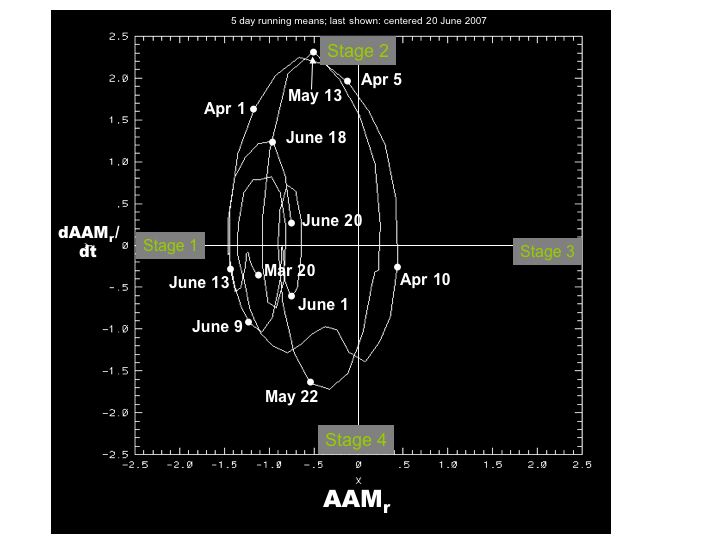
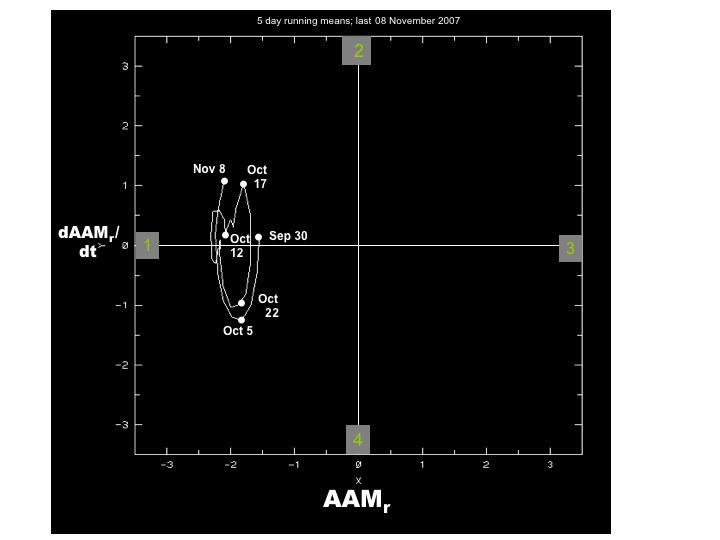
The point is I think a weak mountain-frictional torque index cycle variation has occurred during the last 7-10 days within our low AAM base state. When updated, the ESRL/PSD Global Wind Oscillation (GWO) quasi-phase space plot should present a weak circuit in the direction GSDM Stage 2, before heading “down”. This notion was offered as a possibility in my posting a week ago. Some westerly wind flow has been added to both the northern subtropical and midlatitude atmospheres, and will contribute to a Stage-2 like response across the PNA sector this upcoming week.
Global total and relative AAM remain extremely low, less than 3 atmospheric momentum units (AMUs) below the R1 data climatology (at least 2.5 standard deviations) through 24 August. Deep zonal mean easterly wind anomalies still dominate much of the tropical atmosphere, with the largest magnitudes now just south of the equator near 5S (~10 m/s at 200mb). Worth repeating, the cause of this extremely low AAM, GSDM Stage 1 regime is unclear. I can speculate this all goes back to dynamical forcing-response feedback processes linked to AAM transports and large GWO circuits that started ~ 1 December 2006, when El-Nino was “stopped in its tracks”. In any event, the SSTs themselves do not support this global circulation. The intense zonal mean easterly wind anomalies have been broadening in latitude into the subtropical atmospheres of both hemispheres during the last several weeks. There is still little evidence for these zonal mean easterly wind anomalies to propagate off the equator. Daily monitoring of if/when these zonal mean easterlies do propagate poleward off the equator is critical to determining the most probable future global circulation state. I make a plea to having a diagnostic tool such as the baroclinic CHI problem to see what is going on vertically.
Animations of upper tropospheric daily mean vector wind total/anomaly fields give a loose signal of twin anticyclones ~90E with downstream very weak cyclones just east of the date line. Cross equatorial flow from the Southern Hemisphere remains robust in the region of the date line. In fact, I speculate that the intense RWDs across the Southern Hemisphere leading to this cross equatorial flow may be forcing the zonal mean anomalous easterlies closer to the equator as a feedback.
In any case, there has also been episodic (~every 3-5 days) meridional-zonal-meriodional northeast-southwest (northwest-southeast for the Southern Hemisphere) vacillations of the midlatitude synoptic eddies over the past couple of weeks. It is not unusual to observe this type of behavior during strong GSDM Stage 1 situations. Most importantly, for the first time in at least a couple of months a relatively strong inter-hemispheric symmetric AAM transport signal has appeared. The signal is most robust ~50N and 40S. Hence there is the possibility of a stronger positive mountain-frictional torque index cycle than recently observed over the next couple of weeks.
If there is any truth to the RMM predictions of a weak MJO also during the next couple of weeks, perhaps a larger circuit in GWO quasi-phase space toward Stage 2 will occur. However, this is all speculation, and I do expect an overall GSDM Stage 1 regime to persist until further notice. Only those who do rigorous daily weather-climate monitoring utilizing the GSDM will be the first to catch any kind of a rapid change. It is unlikely any multi-model ensemble prediction scheme will catch an abrupt subseasonal change “until it happens (like ~1 December 2006)”. We also need to remember that predictability with any technique/forecast process is generally quite low during seasonal transitions, which we are about to experience.
There is some model agreement for progressive troughs and ridges across the USA during the next few weeks as seasonal strengthening of the westerlies occur. After this upcoming week’s central/eastern USA trough, I offer a low probability of a stronger event having a Rockies-Plains trough later week 2 into week 3 (~ 7-16 September?). Weather ramifications should be apparent, including the first possible snowfall across the Northern Rockies and an increased likelihood of storminess across the Plains.
In the longer term, should this low AAM regime persist through boreal winter, much of the USA focusing on the western USA into the Plains may have the odds tilted toward a cold and stormy pattern (western trough/southeast states ridge), if there is an Arctic cold air source. Per above, stay tuned.
It is obviously unclear to say where any possible land falling tropical cyclone will go. However, please see the latest statements from the NOAA/NWS/Tropical Prediction Center. At least for week 1, once again relatively stable air is penetrating the deep Tropical North Atlantic Ocean (TNA) basin. Thus tropical cyclone activity for at least the TNA may be suppressed this upcoming week (understanding hybrids and what can occur across the Caribbean).
Locations from the central and eastern equatorial Indian Ocean into China and Southeast Asia are likely to continue with the poundings of intense monsoon rainfall for at least this week into possibly week 2. Perhaps the recent northward shift discussed above may be the last for boreal summer. The likelihood of severe thunderstorms including tropical cyclone activity across the TNWP including the Philippines may increase by week 2. Equatorial North Africa may remain active for at least week 1.
Appendix
An experimental quasi-phase space plot of the GSDM utilizing a time series of normalized relative AAM tendency anomaly (Y-axis) and normalized relative AAM anomaly time series (X-axis) can be found at
http://www.cdc.noaa.gov/map/images/gcm/gsdm_95d.jpg
http://www.cdc.noaa.gov/map/images/gcm/gsdm_40d.jpg
http://www.cdc.noaa.gov/map/clim/gsdm.shtml
We call the behavior of this plot the Global Wind Oscillation (GWO). While the intent of the GSDM is to extend current thinking beyond the MJO, the purpose of the GWO is to illustrate the non-oscillatory component of the GSDM.
These are probabilistic statements, and work is ongoing to quantify in future posts (for example, risk assessment maps and signal to noise ratio plots). We hope that an opportunity will arise for us to have a dedicated web page effort to expedite more objectively, with rigor, thoroughness and verification. The WB (2007) paper on the GSDM has been published in the February issue of MWR. I will try to post an update on about Friday, 31 August.
Ed Berry
Sunday, August 26, 2007

Monday, August 20, 2007
When Will The Atmosphere Go "Up"?
Note: The ESRL/PSD AAM plots now present the “complete” budget (updated through 17 August as of this writing), and will be referred to.
Per NOAA/CPC and NOAA/PMEL/TAO buoy data; there is not much overall change to the spatial distribution of global tropical SSTs. The equatorial Indian Ocean and particularly the west central and northwest Pacific Ocean basins (with the horseshoe into the subtropics/midlatitudes) remain above climatology. Anomaly magnitudes are ~1-1.5C with the former and up to 2c for the latter, with totals in excess of 31C along the equator near 140E. The west Pacific Ocean anomalies are deep extending to at least 400m, suggesting an anomalously warm west Pacific Ocean warm pool. Will some of this warmth strongly shift east “sometime during the future?”
Anomalies across the equatorial East Pacific cold tongue remain below normal with recent 5-day averaged values varying from ~.5C just east of the date line to greater than 2C near 110W (~Nino 3). The cool anomalies still extend to around 150-200m deep in the region of 140-160W, with values less than minus 3C at 150m/140W. However, these cool anomalies are relatively localized. It will be interesting to monitor the persistence of these anomalies going into boreal fall since the seasonal cycle favors cooling. The tropical Atlantic Ocean basin remains near average with totals ~27-28C with plus 1-2C anomalies in the areas of the Caribbean and Gulf of Mexico. Overall, again, while the global circulation is strongly La-Nina like (GSDM Stage 1), the SSTs only weakly support that response.
Enhanced tropical convective forcing continues across the Eastern Hemisphere, extending from the central Indian Ocean into portions of the Tropical Northwest Pacific Ocean (TNWP). During the past few days some consolidation of enhanced rainfall has been occurring near 5N/80E, within this larger envelop. Real-time Multivariate MJO Index (RMM) phase space plots from various operational global weather centers suggest a weak MJO signal may be developing in the region of the Indian Ocean. There is also a hint of this possibility from Hovmoller plots designed to isolate coherent modes of tropical variability. Animations of upper tropospheric daily mean vector wind anomalies indicate fairly well defined twin tropical/subtropical anticyclones ~60-90E with downstream twin cyclones west of the date line. Whether or not this evolves into any real coherent MJO dynamical signal or even a northward propagating mode is unclear. Predictions from the RMMs are inconclusive.
Global total and relative atmospheric angular momentum (AAM) are at the lowest magnitudes in at least a year, with the latter near 4 AMUs (at least 3 standard deviations) below the R1 data climatology through 17 August. In fact, the quasi-phase space plot depicting the Global Wind Oscillation (GWO) is “off the scale”. Deep zonal mean easterly wind anomalies dominate much of the tropical atmosphere, with the largest magnitudes across the Southern Hemisphere near 15S (~10 m/s at 200mb). The cause of this extremely low AAM, GSDM Stage 1 regime is unclear. I can speculate this all goes back to dynamical forcing-response feedback processes linked to AAM transports and large GWO circuits that started ~ 1 December 2006, when El-Nino was “stopped in its tracks”. In any event, the SSTs themselves do not support this global circulation. The intense zonal mean easterly wind anomalies have been broadening in latitude during the last couple of weeks. Daily monitoring of if/when these zonal mean easterlies propagate poleward off the equator are critical to determining the most probable future global circulation state.
In recent days both global surface torques has become positive, with the frictional and mountain torques ~10-15 Hadleys. In addition, global relative AAM tendency is near zero and the earth AAM is slightly positive (please see ESRL/PSD R1 data plots for zonal mean details). I think this may be linked to the Eastern Hemisphere tropical convective forcing discussed above. In other words, we should see increasing trades as a response to the Indian Ocean convection. The latter is starting to occur particularly just south of the equator hence driving up the frictional torque. Additionally, I offer speculation that there may also be downward transport of the easterly wind flow anomalies to the earth’s surface coming both from the synoptic eddies (lots of Rossby wave energy dispersion recently going on linking the tropics to the extratropics) and Hadley circulations. However, a diagnostic tool such as the baroclinic CHI problem is needed in real time to quantify this diagnosis.
My bottom line is that at least some zonal mean subtropical/midlatitude westerly flow should be added to the atmosphere during the next 1-3 weeks. However, at best this will only be reflected as a weak oscillation depicted the GWO within an overall steady state GSDM Stage 1 circulation regime. Interestingly, the seasonal transition into boreal fall will impact the outcome of regional-scale circulation anomalies tied to this global weather-climate situation. For example, a reverse phase of the Pacific-North American teleconnection is most probable during GSDM Stage 1 during the cold season. Should this low AAM regime persist through boreal winter, much of the USA focusing on the western USA into the Plains may have the odds tilted toward a cold and stormy pattern (western trough/southeast states ridge), if there is an Arctic cold air source. Careful daily weather-climate monitoring will be needed this fall on just how steady state our Stage 1 regime will be. For example, should there be 2 regions of Eastern Hemisphere tropical convective forcing with the west Pacific Ocean becoming dominate, a “completely different” and sudden evolution may occur.
Most ensemble prediction schemes from operational global weather centers are coming into general agreement for the western USA trough-southeast states ridge pattern weeks 1-2. Improving model agreement makes sense given our general stationary regime having regular Rossby wave energy dispersions linking the tropics and extratropics. However, there is still large uncertainty per issues discussed above.
There is little change from the outlook I issued nearly a week ago. Cooler and wetter is the most probable trend for particularly the Rockies into the Plains of the USA during the next 1-3 weeks. In fact, portions of the northern Rockies may see their first snowfall. The center part of the country may become increasingly stormy with severe thunderstorms and flooding rainfall (which has already occurred in some areas during the last few days). Some of this activity is likely to extend into the Ohio Valley and eastern states. The southeast is likely to continue with above normal heat and humidity. It is obviously unclear to say where any possible land falling tropical cyclone will go. However, the need to monitor this situation is here, and please see the latest statements from the NOAA/NWS/Tropical Prediction Center.
Locations from the central and eastern equatorial Indian Ocean into China and Southeast Asia are likely to continue with the poundings of intense monsoon rainfall for possibly a few more weeks. This region of intense convection may shift northward week 2. The likelihood of thunderstorm activity across the TNWP including the Philippines during weeks 1-3 is unclear. However, frontal activity coming off of East Asia interacting with the warm SSTs could quickly lead to very active weather across those regions. Equatorial North Africa into the Atlantic may have climatologically active thunderstorm activity including tropical cyclone development.
Appendix
An experimental quasi-phase space plot of the GSDM utilizing a time series of normalized relative AAM tendency anomaly (Y-axis) and normalized relative AAM anomaly time series (X-axis) can be found at
http://www.cdc.noaa.gov/map/images/gcm/gsdm_95d.jpg
http://www.cdc.noaa.gov/map/images/gcm/gsdm_40d.jpg
http://www.cdc.noaa.gov/map/clim/gsdm.shtml
We call the behavior of this plot the Global Wind Oscillation (GWO). While the intent of the GSDM is to extend current thinking beyond the MJO, the purpose of the GWO is to illustrate the non-oscillatory component of the GSDM.
These are probabilistic statements, and work is ongoing to quantify in future posts. We hope that an opportunity will arise for us to have a dedicated web page effort to expedite more objectively, with rigor, thoroughness and verification. The WB (2007) paper on the GSDM has been published in the February issue of MWR. My next update will again be early next week due to travel.
Ed Berry
Per NOAA/CPC and NOAA/PMEL/TAO buoy data; there is not much overall change to the spatial distribution of global tropical SSTs. The equatorial Indian Ocean and particularly the west central and northwest Pacific Ocean basins (with the horseshoe into the subtropics/midlatitudes) remain above climatology. Anomaly magnitudes are ~1-1.5C with the former and up to 2c for the latter, with totals in excess of 31C along the equator near 140E. The west Pacific Ocean anomalies are deep extending to at least 400m, suggesting an anomalously warm west Pacific Ocean warm pool. Will some of this warmth strongly shift east “sometime during the future?”
Anomalies across the equatorial East Pacific cold tongue remain below normal with recent 5-day averaged values varying from ~.5C just east of the date line to greater than 2C near 110W (~Nino 3). The cool anomalies still extend to around 150-200m deep in the region of 140-160W, with values less than minus 3C at 150m/140W. However, these cool anomalies are relatively localized. It will be interesting to monitor the persistence of these anomalies going into boreal fall since the seasonal cycle favors cooling. The tropical Atlantic Ocean basin remains near average with totals ~27-28C with plus 1-2C anomalies in the areas of the Caribbean and Gulf of Mexico. Overall, again, while the global circulation is strongly La-Nina like (GSDM Stage 1), the SSTs only weakly support that response.
Enhanced tropical convective forcing continues across the Eastern Hemisphere, extending from the central Indian Ocean into portions of the Tropical Northwest Pacific Ocean (TNWP). During the past few days some consolidation of enhanced rainfall has been occurring near 5N/80E, within this larger envelop. Real-time Multivariate MJO Index (RMM) phase space plots from various operational global weather centers suggest a weak MJO signal may be developing in the region of the Indian Ocean. There is also a hint of this possibility from Hovmoller plots designed to isolate coherent modes of tropical variability. Animations of upper tropospheric daily mean vector wind anomalies indicate fairly well defined twin tropical/subtropical anticyclones ~60-90E with downstream twin cyclones west of the date line. Whether or not this evolves into any real coherent MJO dynamical signal or even a northward propagating mode is unclear. Predictions from the RMMs are inconclusive.
Global total and relative atmospheric angular momentum (AAM) are at the lowest magnitudes in at least a year, with the latter near 4 AMUs (at least 3 standard deviations) below the R1 data climatology through 17 August. In fact, the quasi-phase space plot depicting the Global Wind Oscillation (GWO) is “off the scale”. Deep zonal mean easterly wind anomalies dominate much of the tropical atmosphere, with the largest magnitudes across the Southern Hemisphere near 15S (~10 m/s at 200mb). The cause of this extremely low AAM, GSDM Stage 1 regime is unclear. I can speculate this all goes back to dynamical forcing-response feedback processes linked to AAM transports and large GWO circuits that started ~ 1 December 2006, when El-Nino was “stopped in its tracks”. In any event, the SSTs themselves do not support this global circulation. The intense zonal mean easterly wind anomalies have been broadening in latitude during the last couple of weeks. Daily monitoring of if/when these zonal mean easterlies propagate poleward off the equator are critical to determining the most probable future global circulation state.
In recent days both global surface torques has become positive, with the frictional and mountain torques ~10-15 Hadleys. In addition, global relative AAM tendency is near zero and the earth AAM is slightly positive (please see ESRL/PSD R1 data plots for zonal mean details). I think this may be linked to the Eastern Hemisphere tropical convective forcing discussed above. In other words, we should see increasing trades as a response to the Indian Ocean convection. The latter is starting to occur particularly just south of the equator hence driving up the frictional torque. Additionally, I offer speculation that there may also be downward transport of the easterly wind flow anomalies to the earth’s surface coming both from the synoptic eddies (lots of Rossby wave energy dispersion recently going on linking the tropics to the extratropics) and Hadley circulations. However, a diagnostic tool such as the baroclinic CHI problem is needed in real time to quantify this diagnosis.
My bottom line is that at least some zonal mean subtropical/midlatitude westerly flow should be added to the atmosphere during the next 1-3 weeks. However, at best this will only be reflected as a weak oscillation depicted the GWO within an overall steady state GSDM Stage 1 circulation regime. Interestingly, the seasonal transition into boreal fall will impact the outcome of regional-scale circulation anomalies tied to this global weather-climate situation. For example, a reverse phase of the Pacific-North American teleconnection is most probable during GSDM Stage 1 during the cold season. Should this low AAM regime persist through boreal winter, much of the USA focusing on the western USA into the Plains may have the odds tilted toward a cold and stormy pattern (western trough/southeast states ridge), if there is an Arctic cold air source. Careful daily weather-climate monitoring will be needed this fall on just how steady state our Stage 1 regime will be. For example, should there be 2 regions of Eastern Hemisphere tropical convective forcing with the west Pacific Ocean becoming dominate, a “completely different” and sudden evolution may occur.
Most ensemble prediction schemes from operational global weather centers are coming into general agreement for the western USA trough-southeast states ridge pattern weeks 1-2. Improving model agreement makes sense given our general stationary regime having regular Rossby wave energy dispersions linking the tropics and extratropics. However, there is still large uncertainty per issues discussed above.
There is little change from the outlook I issued nearly a week ago. Cooler and wetter is the most probable trend for particularly the Rockies into the Plains of the USA during the next 1-3 weeks. In fact, portions of the northern Rockies may see their first snowfall. The center part of the country may become increasingly stormy with severe thunderstorms and flooding rainfall (which has already occurred in some areas during the last few days). Some of this activity is likely to extend into the Ohio Valley and eastern states. The southeast is likely to continue with above normal heat and humidity. It is obviously unclear to say where any possible land falling tropical cyclone will go. However, the need to monitor this situation is here, and please see the latest statements from the NOAA/NWS/Tropical Prediction Center.
Locations from the central and eastern equatorial Indian Ocean into China and Southeast Asia are likely to continue with the poundings of intense monsoon rainfall for possibly a few more weeks. This region of intense convection may shift northward week 2. The likelihood of thunderstorm activity across the TNWP including the Philippines during weeks 1-3 is unclear. However, frontal activity coming off of East Asia interacting with the warm SSTs could quickly lead to very active weather across those regions. Equatorial North Africa into the Atlantic may have climatologically active thunderstorm activity including tropical cyclone development.
Appendix
An experimental quasi-phase space plot of the GSDM utilizing a time series of normalized relative AAM tendency anomaly (Y-axis) and normalized relative AAM anomaly time series (X-axis) can be found at
http://www.cdc.noaa.gov/map/images/gcm/gsdm_95d.jpg
http://www.cdc.noaa.gov/map/images/gcm/gsdm_40d.jpg
http://www.cdc.noaa.gov/map/clim/gsdm.shtml
We call the behavior of this plot the Global Wind Oscillation (GWO). While the intent of the GSDM is to extend current thinking beyond the MJO, the purpose of the GWO is to illustrate the non-oscillatory component of the GSDM.
These are probabilistic statements, and work is ongoing to quantify in future posts. We hope that an opportunity will arise for us to have a dedicated web page effort to expedite more objectively, with rigor, thoroughness and verification. The WB (2007) paper on the GSDM has been published in the February issue of MWR. My next update will again be early next week due to travel.
Ed Berry
Tuesday, August 14, 2007
End of Days
Note: The R1 data ESRL/PSD AAM plots now present the “complete” budget (updated through 11 August as of this writing), and will be referred to.
This posting will be relatively short. The spatial distribution of global tropical and subtropical SSTs is similar to what was discussed on 9 August. There has been cooling across the equatorial East Pacific cold tongue loosely in the Nino 3 region. Recent 5-day averaged anomalies (per TAO buoy data) are ~minus 2.5C at the surface extending to depths ~150m at 140-160W with values ~minus 4C. While the global circulation is strongly La-Nina like, perhaps the equatorial East Pacific may be starting to respond.
The strongest tropical convective forcing remains well entrenched across the Eastern Hemisphere. One anomalous region has been festering across the equatorial Indian Ocean centered ~5S/90E with another focused across the Tropical Northwest Pacific Ocean (TNWP) just east of the Philippines. The South Asian monsoon system has also intensified during the last week. There is also minor enhancement of tropical rainfall around the Americas, and easterly wave activity across northern equatorial Africa has become quite intense.
Some evidence indicates another ~40-day mode of tropical rainfall variability maybe organizing across the equatorial Indian Ocean. However, recent full disk satellite imagery already suggests a quickening of eastward movement of the thunderstorm clusters. We will see if this possible episode organizes into a MJO particularly if it propagates northeast. In any case, we are still stuck in a generally stationary GSDM Stage 1 (more said below) base state having generally weak subseasonal variations. A difference is that our nemesis of 2 regions of Eastern Hemisphere tropical convective forcing may be starting to appear as seasonal transition to the boreal cold season approaches.
Total and relative angular momentum is probably the lowest in at least a year. Both are ~minus 2.5-3 AMUs below the R1 data climatology, and much of the contribution is coming from deep zonal mean easterly wind flow anomalies throughout the tropical and subtropical atmospheres. The largest zonal mean magnitudes are in the Southern Hemisphere (SH), having 200mb easterly wind anomalies ~10m/s. There is also a strong poleward transport signal from the SH tropics into the lower midlatitudes, with a weaker counterpart developing north of the equator. Global relative AAM tendency is ~minus 25 Hadleys as of 11 August and the Global Wind Oscillation (GWO) is as far to left as I have seen it, in the GSDM Stage 4-1 quasi-phase space. The global signal from the surface torques is still weak (for now).
There are currently strong twin upper tropospheric anticyclones with extensive cross-equatorial flow centered ~80E tied to the Indian Ocean (IO) tropical forcing. A weak compensating set of cyclones is present just west of the date line. With the exception of this date line cyclone pair, the entire tropics is dominated by upper tropospheric easterly wind flow, with anomalies ~15-25m/s from Africa into the Atlantic Ocean (favorable for convectively active easterly waves). Rossby wave energy dispersions (RWDs) across the Northern Hemisphere (NH) extratropics interacting with both the IO and TNWP forcing are already impacting North America. Combined with what I expect to be strengthening zonal mean westerly flow across the NH midlatitudes, my notion offered 9 August of the trough-ridge-trough pattern across the USA shifting southeast looks probable. In fact, the western USA may see a return to a barrage of troughs similar to last spring going into September, possibly interacting with a cold air source from Canada.
Week-2 ensemble means from several international operational weather centers are offering varying solutions for North America; however, there has been a recent trend toward a western USA trough with a southeast states ridge. As before, when I see the numerical models trend toward what diagnostic reasoning suggests (per GSDM), my confidence increases. The latter should be the case since I am utilizing a proposed more complete forecast process for subseasonal prediction. Nevertheless, uncertainty is still huge given issues such as the future evolution of the tropical forcing and seasonal transition. The general synoptic pattern across the PNA sector this fall will have some dependency on the GWO. For example, will there be a return to large circuits to GSDM Stage 2, etc. (especially if the warm TNWP stays active)?
Cooler and wetter weather is the most probable trend for particularly the northwest half of the USA during the next 1-3 weeks. The southeast is likely to continue with above normal heat and humidity. It is obviously unclear to say where any possible land falling tropical cyclone will go. However, the need to monitor this situation is likely to increase (see latest statements from the NOAA/NWS/Tropical Prediction Center). The center part of the country is also likely to become increasingly stormy, including severe thunderstorms and flooding rainfall.
Locations from India into China and Southeast Asia are likely to continue with the poundings of intense monsoon rainfall possibly for several more weeks. The TNWP including the Philippines are also probable to stay active with heavy rain and tropical cyclone activity week 1, with perhaps a respite across the west central Pacific for at least week 2. Northern equatorial Africa is likely to stay active through at least week 1, and I think the Atlantic Hurricane Season “is about to get underway”.
Appendix
An experimental quasi-phase space plot of the GSDM utilizing a time series of normalized relative AAM tendency anomaly (Y-axis) and normalized relative AAM anomaly time series (X-axis) can be found at
http://www.cdc.noaa.gov/map/images/gcm/gsdm_95d.jpg
http://www.cdc.noaa.gov/map/images/gcm/gsdm_40d.jpg
http://www.cdc.noaa.gov/map/clim/gsdm.shtml
We call the behavior of this plot the Global Wind Oscillation (GWO). While the intent of the GSDM is to extend current thinking beyond the MJO, the purpose of the GWO is to illustrate the non-oscillatory component of the GSDM.
These are probabilistic statements, and work is ongoing to quantify in future posts. We hope that an opportunity will arise for us to have a dedicated web page effort to expedite more objectively, with rigor, thoroughness and verification. The WB (2007) paper on the GSDM has been published in the February issue of MWR. My next update should be early next week. In general, due to covering shifts and travel, my postings will be irregular through at least the rest of this month.
Ed Berry
This posting will be relatively short. The spatial distribution of global tropical and subtropical SSTs is similar to what was discussed on 9 August. There has been cooling across the equatorial East Pacific cold tongue loosely in the Nino 3 region. Recent 5-day averaged anomalies (per TAO buoy data) are ~minus 2.5C at the surface extending to depths ~150m at 140-160W with values ~minus 4C. While the global circulation is strongly La-Nina like, perhaps the equatorial East Pacific may be starting to respond.
The strongest tropical convective forcing remains well entrenched across the Eastern Hemisphere. One anomalous region has been festering across the equatorial Indian Ocean centered ~5S/90E with another focused across the Tropical Northwest Pacific Ocean (TNWP) just east of the Philippines. The South Asian monsoon system has also intensified during the last week. There is also minor enhancement of tropical rainfall around the Americas, and easterly wave activity across northern equatorial Africa has become quite intense.
Some evidence indicates another ~40-day mode of tropical rainfall variability maybe organizing across the equatorial Indian Ocean. However, recent full disk satellite imagery already suggests a quickening of eastward movement of the thunderstorm clusters. We will see if this possible episode organizes into a MJO particularly if it propagates northeast. In any case, we are still stuck in a generally stationary GSDM Stage 1 (more said below) base state having generally weak subseasonal variations. A difference is that our nemesis of 2 regions of Eastern Hemisphere tropical convective forcing may be starting to appear as seasonal transition to the boreal cold season approaches.
Total and relative angular momentum is probably the lowest in at least a year. Both are ~minus 2.5-3 AMUs below the R1 data climatology, and much of the contribution is coming from deep zonal mean easterly wind flow anomalies throughout the tropical and subtropical atmospheres. The largest zonal mean magnitudes are in the Southern Hemisphere (SH), having 200mb easterly wind anomalies ~10m/s. There is also a strong poleward transport signal from the SH tropics into the lower midlatitudes, with a weaker counterpart developing north of the equator. Global relative AAM tendency is ~minus 25 Hadleys as of 11 August and the Global Wind Oscillation (GWO) is as far to left as I have seen it, in the GSDM Stage 4-1 quasi-phase space. The global signal from the surface torques is still weak (for now).
There are currently strong twin upper tropospheric anticyclones with extensive cross-equatorial flow centered ~80E tied to the Indian Ocean (IO) tropical forcing. A weak compensating set of cyclones is present just west of the date line. With the exception of this date line cyclone pair, the entire tropics is dominated by upper tropospheric easterly wind flow, with anomalies ~15-25m/s from Africa into the Atlantic Ocean (favorable for convectively active easterly waves). Rossby wave energy dispersions (RWDs) across the Northern Hemisphere (NH) extratropics interacting with both the IO and TNWP forcing are already impacting North America. Combined with what I expect to be strengthening zonal mean westerly flow across the NH midlatitudes, my notion offered 9 August of the trough-ridge-trough pattern across the USA shifting southeast looks probable. In fact, the western USA may see a return to a barrage of troughs similar to last spring going into September, possibly interacting with a cold air source from Canada.
Week-2 ensemble means from several international operational weather centers are offering varying solutions for North America; however, there has been a recent trend toward a western USA trough with a southeast states ridge. As before, when I see the numerical models trend toward what diagnostic reasoning suggests (per GSDM), my confidence increases. The latter should be the case since I am utilizing a proposed more complete forecast process for subseasonal prediction. Nevertheless, uncertainty is still huge given issues such as the future evolution of the tropical forcing and seasonal transition. The general synoptic pattern across the PNA sector this fall will have some dependency on the GWO. For example, will there be a return to large circuits to GSDM Stage 2, etc. (especially if the warm TNWP stays active)?
Cooler and wetter weather is the most probable trend for particularly the northwest half of the USA during the next 1-3 weeks. The southeast is likely to continue with above normal heat and humidity. It is obviously unclear to say where any possible land falling tropical cyclone will go. However, the need to monitor this situation is likely to increase (see latest statements from the NOAA/NWS/Tropical Prediction Center). The center part of the country is also likely to become increasingly stormy, including severe thunderstorms and flooding rainfall.
Locations from India into China and Southeast Asia are likely to continue with the poundings of intense monsoon rainfall possibly for several more weeks. The TNWP including the Philippines are also probable to stay active with heavy rain and tropical cyclone activity week 1, with perhaps a respite across the west central Pacific for at least week 2. Northern equatorial Africa is likely to stay active through at least week 1, and I think the Atlantic Hurricane Season “is about to get underway”.
Appendix
An experimental quasi-phase space plot of the GSDM utilizing a time series of normalized relative AAM tendency anomaly (Y-axis) and normalized relative AAM anomaly time series (X-axis) can be found at
http://www.cdc.noaa.gov/map/images/gcm/gsdm_95d.jpg
http://www.cdc.noaa.gov/map/images/gcm/gsdm_40d.jpg
http://www.cdc.noaa.gov/map/clim/gsdm.shtml
We call the behavior of this plot the Global Wind Oscillation (GWO). While the intent of the GSDM is to extend current thinking beyond the MJO, the purpose of the GWO is to illustrate the non-oscillatory component of the GSDM.
These are probabilistic statements, and work is ongoing to quantify in future posts. We hope that an opportunity will arise for us to have a dedicated web page effort to expedite more objectively, with rigor, thoroughness and verification. The WB (2007) paper on the GSDM has been published in the February issue of MWR. My next update should be early next week. In general, due to covering shifts and travel, my postings will be irregular through at least the rest of this month.
Ed Berry
Thursday, August 09, 2007
Still Slaying -- Update
Note: The ESRL/PSD AAM plots now present the “complete” budget (updated through 6 August as of this writing), and will be referred to.
Per CPC and other data sets, global tropical SSTs are generally above average across the Eastern Hemisphere while cooler than normal across the equatorial central and east Pacific and about climatology across the Atlantic Ocean. Anomaly magnitudes vary from ~0.5-2C with the greatest across portions of the equatorial Indian Ocean and west of South America ~110-120W (even ~minus 3 on 8 August). The latter is in the Nino 3 region, and recent enhanced trades have contributed to some cooling during the last week. In fact, subsurface anomalies are as low as roughly minus 3C at 160W/150m per latest 5-day averaged TAO buoy data suggestive of the thermocline being raised. Warmest SST totals remain across the west central-northwest Pacific Ocean and the Caribbean-Gulf of Mexico regions with values ~29-30C. While the global circulation is very much La-Nina like, the SST pattern is only weakly representative of a cold event.
Weather-climate linkage signals continue to be extremely difficult to interpret. The MJO has virtually collapsed. All Wheeler-Hendon type phase space plots from international weather centers have projections less than 1 standard deviation. There is some “tilt” back toward the Indian Ocean, and attention needs to be paid to that for predicting upcoming subseasonal evolution.
As part of a consolidation with an equatorial Rossby mode, about a week ago a northeastward propagating component weakly projecting onto a MJO came out into the Tropical Northwest Pacific Ocean (TNWP). Per coherent modes Hovmollers the signal made it as far east as ~160E. A couple of tropical cyclones have developed in that region since. At this time the most significant tropical forcing remains well back in the Eastern Hemisphere centered at about 15N/120E. There is loose evidence of a tropical convective component moving into the Western Hemisphere. Recent 3-day averaged OLRA present ~minus 70 W/m**2 and lower around the Philippines. There are also negative anomalies north of the equator at the date line (a response to the weak signal moving into the Western Hemisphere) and back across the equatorial Indian Ocean. Notable positive anomalies of OLR are centered on the region of Indonesia.
Full disk satellite imagery nicely shows the convection around the Philippines while extending west and southwest into the Bay of Bengal. This is a change in the orientation discussed late week. Equatorial Africa into the equatorial Indian Ocean is getting more active. I have speculation that in the wake of our recent northward propagating event from the equator into the Southeast Asia, another one may be getting organized. It is possible this may be a form of 20-30 day variability, linked to the extratropics, and within what has been a stationary GSDM Stage 1 base state given boreal summer (discussed below).
Typical of a cold event, global total and relative atmospheric angular momentum (AAM) continues very low, roughly minus 2 Atmospheric Momentum Units (AMUs). The mass term has increased somewhat during the last week. The last MJO event did not add as much zonal mean westerly wind flow to the atmosphere as I previously thought. In fact, the Global Wind Oscillation (GWO) updated through 5 August (5-day average) objectively shows the global circulation solidly in GSDM Stage 1. There was only a pathetic circuit when the MJO came out.
Zonal mean easterly wind flow anomalies have been rapidly increasing throughout the equatorial and subtropical atmospheres over the last few days. At 200mb magnitudes are ~5m/s, flanked by zonal mean westerly wind flow anomalies at the mid and higher latitudes. A meridional distribution of zonal mean zonal wind anomalies such as these supports anomalously strong subtropical ridges from the Devil including the one impacting the USA. Hence global relative AAM tendency is negative (~15 Hadleys) and the surface torques is also trending toward less than zero. Finally, the coriolis torque is also ~minus 10-20 Hadleys when loosely it should be positive at this time.
Animations of upper tropospheric daily mean vector wind anomaly fields suggest twin tropical/subtropical anticyclones redeveloping across the Indian Ocean while the pair across the west central Pacific weakens. There are weak twin cyclones along and just east of the date line. The upper tropospheric Western Hemisphere Pacific Ocean equatorial westerly wind flow anomalies also discussed last week have weakened significantly and are going into the Southern Hemisphere. It was Rossby wave energy dispersions (RWDs) arcing across Asia interacting with the west Pacific anticyclones that contributed to eastward shift of what was the “wicked ridge of the west” (western USA for international readers).I can already see the RWDs coming out of the Indian Ocean that will lead to some retrogression of the Deep South ridge back toward the Plains. This will not be as far west as some numerical ensemble solutions were indicating a week-10 days ago.
Uncertainty remains huge for making any subseasonal forecast, particularly as we start to head into fall. During the last couple of weeks I think have had somewhat better success with what I have believed to be the most probable options. I am going to be bold here and speculate that the MJO dynamical signal, having interactions with the extratropics (forcing-response-feedbacks, etc.), is going to get its act back together across the Indian Ocean during the next week or so and then propagate east-northeast into the TNWP by roughly weeks 3-4. How intense this event may be and its impact on the GWO is unclear. I would like to see the Wheeler-Hendon plots come out of their “1 sigma” circles “soon” across the region of the Indian Ocean. Should this occur, any model, numerical, statistical, etc. is unlikely to predict this possibility right now. It would be interesting to see what “brute force stochastics” might give us right now about MJO and anything else dealing with making predictions in our current lazy GSDM Stage 1 regime. For weeks 1-4, let’s stick with Stage 1 through week 2 possibly getting perturbed a bit to Stage 2 during weeks 3-4.
I think the ramifications for the USA are obvious by now. For much of week 1 deadly intense heat is a good bet centered from the Plains into the Deep South. Severe MCS activity will occur on the northern fringes of this ridge from Hell, likely from the Northern Rockies to the Great Lakes into portions of the eastern USA. This general trough-ridge-trough pattern across the USA should shift southeast weeks 2-4 if the scenario discussed above is realized.
Some respite for portions of India and Bangladesh from the severe storms and flooding may occur during a portion of week 1. However, locations from India into China and Southeast Asia are likely to continue with the poundings of intense monsoon rainfall possibly for several more weeks. As I type a tropical cyclone is trying to develop across the far northern Arabian Sea, which should weaken as it gets inland (but not before causing “problems”). While northern equatorial Africa is getting active, dry stable air from the North Atlantic Ocean has been inhibiting tropical cyclone development of the waves as they move off the West African coast. While I can offer some attribution to this, suffice to say this situation needs to change if there is to be an active Atlantic tropical cyclone season (understanding the Caribbean, etc.). Finally, more strong troughs appear on the horizon for Europe for at least the next couple of weeks.
Stay tuned if we start to observe 2 regions of Eastern Hemisphere tropical convective forcing this fall, the Indian and west central Pacific Oceans. If the former dominates, GSDM Stage 4-1 would be most probable.
Appendix
An experimental quasi-phase space plot of the GSDM utilizing a time series of normalized relative AAM tendency anomaly (Y-axis) and normalized relative AAM anomaly time series (X-axis) can be found at
http://www.cdc.noaa.gov/map/images/gcm/gsdm_95d.jpg
http://www.cdc.noaa.gov/map/images/gcm/gsdm_40d.jpg
http://www.cdc.noaa.gov/map/clim/gsdm.shtml (general link)
We call the behavior of this plot the Global Wind Oscillation (GWO), and one of its purposes is to extend thinking beyond the MJO.
These are probabilistic statements, and work is ongoing to quantify in future posts. We hope that an opportunity will arise for us to have a dedicated web page effort to expedite more objectively, with rigor, thoroughness and verification. The WB (2007) paper on the GSDM has been published in the February issue of MWR. I will try to do an update early next week. In general, due to covering shifts and travel, my postings will be irregular through at least the rest of this month.
Ed Berry
Per CPC and other data sets, global tropical SSTs are generally above average across the Eastern Hemisphere while cooler than normal across the equatorial central and east Pacific and about climatology across the Atlantic Ocean. Anomaly magnitudes vary from ~0.5-2C with the greatest across portions of the equatorial Indian Ocean and west of South America ~110-120W (even ~minus 3 on 8 August). The latter is in the Nino 3 region, and recent enhanced trades have contributed to some cooling during the last week. In fact, subsurface anomalies are as low as roughly minus 3C at 160W/150m per latest 5-day averaged TAO buoy data suggestive of the thermocline being raised. Warmest SST totals remain across the west central-northwest Pacific Ocean and the Caribbean-Gulf of Mexico regions with values ~29-30C. While the global circulation is very much La-Nina like, the SST pattern is only weakly representative of a cold event.
Weather-climate linkage signals continue to be extremely difficult to interpret. The MJO has virtually collapsed. All Wheeler-Hendon type phase space plots from international weather centers have projections less than 1 standard deviation. There is some “tilt” back toward the Indian Ocean, and attention needs to be paid to that for predicting upcoming subseasonal evolution.
As part of a consolidation with an equatorial Rossby mode, about a week ago a northeastward propagating component weakly projecting onto a MJO came out into the Tropical Northwest Pacific Ocean (TNWP). Per coherent modes Hovmollers the signal made it as far east as ~160E. A couple of tropical cyclones have developed in that region since. At this time the most significant tropical forcing remains well back in the Eastern Hemisphere centered at about 15N/120E. There is loose evidence of a tropical convective component moving into the Western Hemisphere. Recent 3-day averaged OLRA present ~minus 70 W/m**2 and lower around the Philippines. There are also negative anomalies north of the equator at the date line (a response to the weak signal moving into the Western Hemisphere) and back across the equatorial Indian Ocean. Notable positive anomalies of OLR are centered on the region of Indonesia.
Full disk satellite imagery nicely shows the convection around the Philippines while extending west and southwest into the Bay of Bengal. This is a change in the orientation discussed late week. Equatorial Africa into the equatorial Indian Ocean is getting more active. I have speculation that in the wake of our recent northward propagating event from the equator into the Southeast Asia, another one may be getting organized. It is possible this may be a form of 20-30 day variability, linked to the extratropics, and within what has been a stationary GSDM Stage 1 base state given boreal summer (discussed below).
Typical of a cold event, global total and relative atmospheric angular momentum (AAM) continues very low, roughly minus 2 Atmospheric Momentum Units (AMUs). The mass term has increased somewhat during the last week. The last MJO event did not add as much zonal mean westerly wind flow to the atmosphere as I previously thought. In fact, the Global Wind Oscillation (GWO) updated through 5 August (5-day average) objectively shows the global circulation solidly in GSDM Stage 1. There was only a pathetic circuit when the MJO came out.
Zonal mean easterly wind flow anomalies have been rapidly increasing throughout the equatorial and subtropical atmospheres over the last few days. At 200mb magnitudes are ~5m/s, flanked by zonal mean westerly wind flow anomalies at the mid and higher latitudes. A meridional distribution of zonal mean zonal wind anomalies such as these supports anomalously strong subtropical ridges from the Devil including the one impacting the USA. Hence global relative AAM tendency is negative (~15 Hadleys) and the surface torques is also trending toward less than zero. Finally, the coriolis torque is also ~minus 10-20 Hadleys when loosely it should be positive at this time.
Animations of upper tropospheric daily mean vector wind anomaly fields suggest twin tropical/subtropical anticyclones redeveloping across the Indian Ocean while the pair across the west central Pacific weakens. There are weak twin cyclones along and just east of the date line. The upper tropospheric Western Hemisphere Pacific Ocean equatorial westerly wind flow anomalies also discussed last week have weakened significantly and are going into the Southern Hemisphere. It was Rossby wave energy dispersions (RWDs) arcing across Asia interacting with the west Pacific anticyclones that contributed to eastward shift of what was the “wicked ridge of the west” (western USA for international readers).I can already see the RWDs coming out of the Indian Ocean that will lead to some retrogression of the Deep South ridge back toward the Plains. This will not be as far west as some numerical ensemble solutions were indicating a week-10 days ago.
Uncertainty remains huge for making any subseasonal forecast, particularly as we start to head into fall. During the last couple of weeks I think have had somewhat better success with what I have believed to be the most probable options. I am going to be bold here and speculate that the MJO dynamical signal, having interactions with the extratropics (forcing-response-feedbacks, etc.), is going to get its act back together across the Indian Ocean during the next week or so and then propagate east-northeast into the TNWP by roughly weeks 3-4. How intense this event may be and its impact on the GWO is unclear. I would like to see the Wheeler-Hendon plots come out of their “1 sigma” circles “soon” across the region of the Indian Ocean. Should this occur, any model, numerical, statistical, etc. is unlikely to predict this possibility right now. It would be interesting to see what “brute force stochastics” might give us right now about MJO and anything else dealing with making predictions in our current lazy GSDM Stage 1 regime. For weeks 1-4, let’s stick with Stage 1 through week 2 possibly getting perturbed a bit to Stage 2 during weeks 3-4.
I think the ramifications for the USA are obvious by now. For much of week 1 deadly intense heat is a good bet centered from the Plains into the Deep South. Severe MCS activity will occur on the northern fringes of this ridge from Hell, likely from the Northern Rockies to the Great Lakes into portions of the eastern USA. This general trough-ridge-trough pattern across the USA should shift southeast weeks 2-4 if the scenario discussed above is realized.
Some respite for portions of India and Bangladesh from the severe storms and flooding may occur during a portion of week 1. However, locations from India into China and Southeast Asia are likely to continue with the poundings of intense monsoon rainfall possibly for several more weeks. As I type a tropical cyclone is trying to develop across the far northern Arabian Sea, which should weaken as it gets inland (but not before causing “problems”). While northern equatorial Africa is getting active, dry stable air from the North Atlantic Ocean has been inhibiting tropical cyclone development of the waves as they move off the West African coast. While I can offer some attribution to this, suffice to say this situation needs to change if there is to be an active Atlantic tropical cyclone season (understanding the Caribbean, etc.). Finally, more strong troughs appear on the horizon for Europe for at least the next couple of weeks.
Stay tuned if we start to observe 2 regions of Eastern Hemisphere tropical convective forcing this fall, the Indian and west central Pacific Oceans. If the former dominates, GSDM Stage 4-1 would be most probable.
Appendix
An experimental quasi-phase space plot of the GSDM utilizing a time series of normalized relative AAM tendency anomaly (Y-axis) and normalized relative AAM anomaly time series (X-axis) can be found at
http://www.cdc.noaa.gov/map/images/gcm/gsdm_95d.jpg
http://www.cdc.noaa.gov/map/images/gcm/gsdm_40d.jpg
http://www.cdc.noaa.gov/map/clim/gsdm.shtml (general link)
We call the behavior of this plot the Global Wind Oscillation (GWO), and one of its purposes is to extend thinking beyond the MJO.
These are probabilistic statements, and work is ongoing to quantify in future posts. We hope that an opportunity will arise for us to have a dedicated web page effort to expedite more objectively, with rigor, thoroughness and verification. The WB (2007) paper on the GSDM has been published in the February issue of MWR. I will try to do an update early next week. In general, due to covering shifts and travel, my postings will be irregular through at least the rest of this month.
Ed Berry
Friday, August 03, 2007
Update from the Slayer
The spatial distribution of global tropical/subtropical SSTs is similar to what was discussed on 31 July. There remains warmth across the Indian and west central Pacific Oceans with cool anomalies across portions of equatorial Indonesia. Impressive warmth remains around the South China Sea and northwest Pacific Ocean with SST totals in excess of 30C. The equatorial East Pacific cool anomalies are ~minus 1-2C while the subsurface continues to moderate.
Tropical convective forcing has become better organized centered ~10-15N/120E while extending in a band from India east-southeast into the west central and northwest Pacific Ocean. Three-day averaged OLRA are roughly minus 50-90W/m**2 with this enhanced rainfall, and there has been a slow east-northeastward shift of this activity toward the Tropical Northwest Pacific Ocean (TNWP). Other somewhat enhanced rainfall continues along the East Pacific ITCZ and Africa north of the equator.
Animations of upper tropospheric daily mean vector wind anomalies do give a nice signal of slow eastward movement across the tropics/subtropics. Since 31 July robust twin anticyclones have appeared ~140E having 150mb anomalies around 15-30 m/s while weaker anticyclones persist across Africa. There are downstream anomalous troughs just west of the date line with equatorial westerlies (15-25 m/s anomalies) across the Western Hemisphere to about South America. Rossby wave energy dispersions from both hemispheres are interacting with these features. Included is a Northern Hemispheric component across the Pacific Ocean to the first in a series of troughs about to dig along the west coast of the USA.
This circulation response working with other dynamical processes such as global frictional and mountain torques is adding westerly flow to the atmosphere. In fact, calculated relative AAM tendency (per R1 data) through 28 July which includes budget terms such as Coriolis torque and transports was ~plus 20 Hadleys. However, total AAM remains very low, roughly 3 AMUs (Atmospheric Momentum Units) below normal, and the Global Wind Oscillation (GWO) updated through 29 July is well to the left. The global circulation continues to behave La-Nina like, solidly in GSDM Stage 1. As the Eastern Hemisphere tropical forcing continues into the TNWP, interactions with the extratropics do include the possibility of a mountain-frictional torque index cycle. The latter would increase zonal mean westerly flow across the subtropical atmospheres of both hemispheres (ideally).
I remain unchanged in my feeling that this GSDM Stage 1 base state should be perturbed enough for the GWO to orbit to GSDM Stage 2. The magnitude and amount of persistence of this perturbation are unclear, particularly considering seasonal cycle issues. Overall, we may see GSDM Stage 1-2 for the next few weeks, then collapse to Stage 4-1 per reasons discussed last posting. Uncertainty remains huge about this specific subseasonal issue. However, at least synoptically for the USA the major circulation pattern reversal with an anomalous western USA trough and Deep South ridge is probable. Furthermore, Rossby wave energy dispersions arcing from the Indian Ocean tropical forcing into the higher latitudes will contribute to an anomalous deep cyclone covering much of western and central Canada. Hence a full latitude trough extending into the western USA is a good forecast meaning the polar westerlies should shift southward. Most numerical ensemble prediction schemes have now captured this change.
There has been some thought from at least one official forecast center based on model output the ridge may return to the Rockies during week 2. While this is an option, I could easily argue a “cold/wet regime” from the east slopes of the Rockies into the Plains weeks 2-3 should the TNWP become extremely active with several typhoons. Again, this emphasizes the uncertainty given the stochastic nature of the atmosphere. Right now there is little if any support from ensembles for a central USA cold/wet pattern weeks 2-3 (for example, like August 2004 as discussed in one of our weather-climate discussions on the ESRL/PSD MJO web site). Should this less probable scenario happen, it is currently outside the envelope range of uncertainty sampled any of the operational global models (multi-model ensemble spread). Again, this emphasizes the need for a weather-climate linkage diagnostic component (the GSDM) including daily monitoring to correctly making subseasonal predictions as part of a complete forecast process. Multi-model ensembles alone are not enough, particularly considering their biases, data assimilation issues, not predicting tropical convection correctly after about day 5, etc…………..
There is little change in my outlooks for weeks 1-3 (through ~24 August). The “wicked ridge of the west” will expand into the Deep South and eastern USA as the westerlies come southward into the Rockies and Plains downstream from the western USA trough. A reversal of the temperature and precipitation anomalies observed across much of the country for the last 4-6 weeks may occur. Severe MCS activity with flooding rainfall is likely from the Northern Plains into the Ohio Valley periodically through at least the middle of this month. This “storm track” should slowly shift south. Intense heat may focus on the south central into the mid-Atlantic states, along with high dewpoints.
Internationally, severe thunderstorms and heavy rainfall are probable from southern China into the Philippines at least weeks 1-2. Additional typhoon activity is probable for the TNWP weeks 1-3, possibly impacting locations such as China and Japan. Finally, tropical waves moving west from Africa have been recently intensifying. However, for numerous reasons I am now unclear about the risk of tropical cyclone development across the North Atlantic Ocean at least through week 2. The latter is yet another example why there is not a linear relationship between La-Nina basic states and an increased risk of North Atlantic tropical cyclone activity, at least subseasonally.
Appendix
An experimental quasi-phase space plot of the GSDM utilizing a time series of normalized relative AAM tendency anomaly (Y-axis) and normalized relative AAM anomaly time series (X-axis) can be found at
http://www.cdc.noaa.gov/map/images/gcm/gsdm_95d.jpg
http://www.cdc.noaa.gov/map/images/gcm/gsdm_40d.jpg
We call the behavior exhibited by this plot the Global Wind Oscillation (GWO), and one of its purposes is to extend thinking beyond the MJO.These are probabilistic statements, and work is ongoing to quantify in future posts. We hope that an opportunity will arise for us to have a dedicated web page effort to expedite more objectively, with rigor, thoroughness and verification. The WB (2007) paper on the GSDM has been published in the February issue of MWR.
My next posting will not be until late next week since I have to cover a set of overnight shifts. In general, due to covering shifts and travel, my discussions will be irregular through at least the end of this month.
Ed Berry
Tropical convective forcing has become better organized centered ~10-15N/120E while extending in a band from India east-southeast into the west central and northwest Pacific Ocean. Three-day averaged OLRA are roughly minus 50-90W/m**2 with this enhanced rainfall, and there has been a slow east-northeastward shift of this activity toward the Tropical Northwest Pacific Ocean (TNWP). Other somewhat enhanced rainfall continues along the East Pacific ITCZ and Africa north of the equator.
Animations of upper tropospheric daily mean vector wind anomalies do give a nice signal of slow eastward movement across the tropics/subtropics. Since 31 July robust twin anticyclones have appeared ~140E having 150mb anomalies around 15-30 m/s while weaker anticyclones persist across Africa. There are downstream anomalous troughs just west of the date line with equatorial westerlies (15-25 m/s anomalies) across the Western Hemisphere to about South America. Rossby wave energy dispersions from both hemispheres are interacting with these features. Included is a Northern Hemispheric component across the Pacific Ocean to the first in a series of troughs about to dig along the west coast of the USA.
This circulation response working with other dynamical processes such as global frictional and mountain torques is adding westerly flow to the atmosphere. In fact, calculated relative AAM tendency (per R1 data) through 28 July which includes budget terms such as Coriolis torque and transports was ~plus 20 Hadleys. However, total AAM remains very low, roughly 3 AMUs (Atmospheric Momentum Units) below normal, and the Global Wind Oscillation (GWO) updated through 29 July is well to the left. The global circulation continues to behave La-Nina like, solidly in GSDM Stage 1. As the Eastern Hemisphere tropical forcing continues into the TNWP, interactions with the extratropics do include the possibility of a mountain-frictional torque index cycle. The latter would increase zonal mean westerly flow across the subtropical atmospheres of both hemispheres (ideally).
I remain unchanged in my feeling that this GSDM Stage 1 base state should be perturbed enough for the GWO to orbit to GSDM Stage 2. The magnitude and amount of persistence of this perturbation are unclear, particularly considering seasonal cycle issues. Overall, we may see GSDM Stage 1-2 for the next few weeks, then collapse to Stage 4-1 per reasons discussed last posting. Uncertainty remains huge about this specific subseasonal issue. However, at least synoptically for the USA the major circulation pattern reversal with an anomalous western USA trough and Deep South ridge is probable. Furthermore, Rossby wave energy dispersions arcing from the Indian Ocean tropical forcing into the higher latitudes will contribute to an anomalous deep cyclone covering much of western and central Canada. Hence a full latitude trough extending into the western USA is a good forecast meaning the polar westerlies should shift southward. Most numerical ensemble prediction schemes have now captured this change.
There has been some thought from at least one official forecast center based on model output the ridge may return to the Rockies during week 2. While this is an option, I could easily argue a “cold/wet regime” from the east slopes of the Rockies into the Plains weeks 2-3 should the TNWP become extremely active with several typhoons. Again, this emphasizes the uncertainty given the stochastic nature of the atmosphere. Right now there is little if any support from ensembles for a central USA cold/wet pattern weeks 2-3 (for example, like August 2004 as discussed in one of our weather-climate discussions on the ESRL/PSD MJO web site). Should this less probable scenario happen, it is currently outside the envelope range of uncertainty sampled any of the operational global models (multi-model ensemble spread). Again, this emphasizes the need for a weather-climate linkage diagnostic component (the GSDM) including daily monitoring to correctly making subseasonal predictions as part of a complete forecast process. Multi-model ensembles alone are not enough, particularly considering their biases, data assimilation issues, not predicting tropical convection correctly after about day 5, etc…………..
There is little change in my outlooks for weeks 1-3 (through ~24 August). The “wicked ridge of the west” will expand into the Deep South and eastern USA as the westerlies come southward into the Rockies and Plains downstream from the western USA trough. A reversal of the temperature and precipitation anomalies observed across much of the country for the last 4-6 weeks may occur. Severe MCS activity with flooding rainfall is likely from the Northern Plains into the Ohio Valley periodically through at least the middle of this month. This “storm track” should slowly shift south. Intense heat may focus on the south central into the mid-Atlantic states, along with high dewpoints.
Internationally, severe thunderstorms and heavy rainfall are probable from southern China into the Philippines at least weeks 1-2. Additional typhoon activity is probable for the TNWP weeks 1-3, possibly impacting locations such as China and Japan. Finally, tropical waves moving west from Africa have been recently intensifying. However, for numerous reasons I am now unclear about the risk of tropical cyclone development across the North Atlantic Ocean at least through week 2. The latter is yet another example why there is not a linear relationship between La-Nina basic states and an increased risk of North Atlantic tropical cyclone activity, at least subseasonally.
Appendix
An experimental quasi-phase space plot of the GSDM utilizing a time series of normalized relative AAM tendency anomaly (Y-axis) and normalized relative AAM anomaly time series (X-axis) can be found at
http://www.cdc.noaa.gov/map/images/gcm/gsdm_95d.jpg
http://www.cdc.noaa.gov/map/images/gcm/gsdm_40d.jpg
We call the behavior exhibited by this plot the Global Wind Oscillation (GWO), and one of its purposes is to extend thinking beyond the MJO.These are probabilistic statements, and work is ongoing to quantify in future posts. We hope that an opportunity will arise for us to have a dedicated web page effort to expedite more objectively, with rigor, thoroughness and verification. The WB (2007) paper on the GSDM has been published in the February issue of MWR.
My next posting will not be until late next week since I have to cover a set of overnight shifts. In general, due to covering shifts and travel, my discussions will be irregular through at least the end of this month.
Ed Berry
Tuesday, July 31, 2007
Slay the Beast
Per CPC data, sea surface temperature anomaly (SSTA) magnitudes throughout much of the global tropics are still generally less than 2C with warmth across the Indian and west central Pacific Oceans and coolness along the east Pacific equatorial cold tongue. Exceptions include ~2-3C just east of Africa and west of South America. Totals across the central Indian and west central Pacific Oceans are ~29-30C. Recent 5-day averaged TAO buoy data suggests considerable warming of subsurface anomalies along the equatorial east Pacific cold tongue, with magnitudes ~minus 1C at roughly 100m. The horseshoe spatial distribution of warm SSTAs across the west Pacific Ocean also persists. The largest anomalies and warmest SSTs are across the tropical northwest Pacific (TNWP) from the region of the South China Sea (SCS) to west of the date line. Totals remain ~30-31C.
As discussed below, the global circulation continues to behave in a La-Nina like manner (which may be traced back to subseasonal events boreal fall 2006). However, as I have been stating for a few weeks, my own feelings are the coolest SST anomalies will remain across the East Pacific and this will not be a basin wide situation. The SSTs across the west central and TWNP as well as much of the Indian Ocean are warmer than normal and will continue to impact the global circulation. The positive SST anomalies across the west Pacific warm pool are deep and have been persistent for at least the past 5-7 years.
In contrast to some past writings, I only want to summarize recent subseasonal forcing-response-feedbacks, etc. for brevity. Several monitoring tools including renditions of Wheeler and Hendon (2004) phase space plots from various international operational weather centers (ESRL/PSD MJO web page) indicate the MJO signal has virtually collapsed. We need to be careful what we are trying to interpret.
A convectively coupled Kelvin wave moved into the west central Pacific Ocean over the last week or so. Extratropical Rossby wave energy dispersions from East Asia interacting with the convection produced a local environment favorable for the development of Typhoon Usagi. I think this Kelvin wave signal is moving across the equatorial Western Hemisphere and may be contributing the recent increase of the Andes Mountain torque to ~plus 20 Hadleys per 28 July R1 data. However, I also think the global circulation component of what may still be a MJO signal remains across the Eastern Hemisphere centered ~90-100E. Various animations of wind fields support this notion, with loosely twin anomalous upper tropospheric tropical/subtropical anticyclones from Africa into the Indian Ocean and twin cyclones across eastern Indonesia to the date line. I think the tropical convection will respond to these circulation anomalies meaning a reorganization and slow east-northeast shift (coherent modes Hovmollers support this).
Full disk satellite imagery presents a nice signal this process is occurring. Intense tropical rainfall currently extends from India east-southeast to the equatorial west central Pacific Ocean, having 3-day averaged OLRA ~minus 50-90 W/m**2 centered near 5-10N/110E. I think it is probable to have very intense tropical convection across the warm SSTs of the northwest Pacific Ocean by roughly week 3. This may involve a consolidation of tropical forcing from both the west central equatorial Pacific and a slowly eastward propagating mode.
Total global AAM (28 July) is ~3 standard deviations below the R1 data climatology. Only around 1 March 2007 may have been lower than this value during the past 12 months. The low AAM is not only for the troposphere but also includes the easterly phase of the QBO and the earth component. Irrelevant of how anyone wants to do a real-time earth-atmosphere AAM budget, deep anomalous zonal mean easterly flow dominates much of the tropical and subtropical atmospheres, with incursions into the midlatitudes during July. From a zonal mean perspective, existing higher latitude westerly wind flow anomalies poleward of the easterlies have supported strong midlatitude ridges, including the wicked ridge of the western USA this summer. This circulation situation is consistent with La-Nina (GSDM Stage 1).
Currently both global frictional and mountain torques are increasing. These dynamical processes are already starting to add westerly flow to the atmosphere. As the tropical convection shifts into the northwest Pacific, I think this behavior through interactions with the extratropics and the earth’s surface will add additional westerly flow to the subtropics. This should result in a strong positive AAM tendency and the Global Wind Oscillation (GWO) should orbit toward GSDM Stage 2 during the time period of weeks 2-3. Again, uncertainty is huge including timing, considering the stochastic nature of the dynamical system we are dealing with. However, after a week of very intensive daily monitoring, my confidence in this scenario is increasing. In fact, more and more ensemble numerical models are becoming supportive (NCEP GFS, ERSL/PSD, etc.). In another manner of speaking, I have been offering this option in these discussions for at least a week, and now the numerical models may be starting to catch-up to what diagnostic reasoning suggests as a more probable scenario.
For the PNA sector this suggests the possibility of a major circulation change for especially the USA, meaning an anomalous western USA trough and southeast states ridge. At least for the subseasonal time scale, perhaps the beastly “wicked ridge of the west” will be “dead”. A reversal of the temperature and precipitation anomalies observed across much of the country for the last 4-6 weeks may occur. Internationally, severe thunderstorms and heavy rainfall are probable from southern China into the Philippines at least weeks 1-2. Additional typhoon activity is probable for the TNWP weeks 2-3, possibly impacting locations such as China and Japan. Finally, tropical waves moving west from Africa have been recently intensifying. The risk of tropical cyclone development across the North Atlantic Ocean may increase above climatology going into week 2.
In a somewhat longer term, ~weeks 3-6, I am getting concerned we may start to observe 2 regions of Eastern Hemisphere tropical convective forcing once again, the Indian and west central Pacific Oceans. If the former dominates, GSDM Stage 4-1 would be most probable. Should the GWO orbit to Stage 2 during the next few weeks, it may quickly circuit to the Stage4-1 quasi phase space plane. Stay tuned.
Appendix
An experimental quasi-phase space plot of the GSDM utilizing a time series of normalized relative AAM tendency anomaly (Y-axis) and normalized relative AAM anomaly time series (X-axis) can be found at
http://www.cdc.noaa.gov/map/images/gcm/gsdm_95d.jpg
http://www.cdc.noaa.gov/map/images/gcm/gsdm_40d.jpg
We call the behavior of this plot the Global Wind Oscillation (GWO), and one of its purposes is to extend thinking beyond the MJO.These are probabilistic statements, and work is ongoing to quantify in future posts. We hope that an opportunity will arise for us to have a dedicated web page effort to expedite more objectively, with rigor, thoroughness and verification. The WB (2007) paper on the GSDM has been published in the February issue of MWR. I will try to at least briefly update this Blog on Friday (3 August). In general, due to covering shifts and travel, my postings will be irregular through at least August.
Ed Berry
As discussed below, the global circulation continues to behave in a La-Nina like manner (which may be traced back to subseasonal events boreal fall 2006). However, as I have been stating for a few weeks, my own feelings are the coolest SST anomalies will remain across the East Pacific and this will not be a basin wide situation. The SSTs across the west central and TWNP as well as much of the Indian Ocean are warmer than normal and will continue to impact the global circulation. The positive SST anomalies across the west Pacific warm pool are deep and have been persistent for at least the past 5-7 years.
In contrast to some past writings, I only want to summarize recent subseasonal forcing-response-feedbacks, etc. for brevity. Several monitoring tools including renditions of Wheeler and Hendon (2004) phase space plots from various international operational weather centers (ESRL/PSD MJO web page) indicate the MJO signal has virtually collapsed. We need to be careful what we are trying to interpret.
A convectively coupled Kelvin wave moved into the west central Pacific Ocean over the last week or so. Extratropical Rossby wave energy dispersions from East Asia interacting with the convection produced a local environment favorable for the development of Typhoon Usagi. I think this Kelvin wave signal is moving across the equatorial Western Hemisphere and may be contributing the recent increase of the Andes Mountain torque to ~plus 20 Hadleys per 28 July R1 data. However, I also think the global circulation component of what may still be a MJO signal remains across the Eastern Hemisphere centered ~90-100E. Various animations of wind fields support this notion, with loosely twin anomalous upper tropospheric tropical/subtropical anticyclones from Africa into the Indian Ocean and twin cyclones across eastern Indonesia to the date line. I think the tropical convection will respond to these circulation anomalies meaning a reorganization and slow east-northeast shift (coherent modes Hovmollers support this).
Full disk satellite imagery presents a nice signal this process is occurring. Intense tropical rainfall currently extends from India east-southeast to the equatorial west central Pacific Ocean, having 3-day averaged OLRA ~minus 50-90 W/m**2 centered near 5-10N/110E. I think it is probable to have very intense tropical convection across the warm SSTs of the northwest Pacific Ocean by roughly week 3. This may involve a consolidation of tropical forcing from both the west central equatorial Pacific and a slowly eastward propagating mode.
Total global AAM (28 July) is ~3 standard deviations below the R1 data climatology. Only around 1 March 2007 may have been lower than this value during the past 12 months. The low AAM is not only for the troposphere but also includes the easterly phase of the QBO and the earth component. Irrelevant of how anyone wants to do a real-time earth-atmosphere AAM budget, deep anomalous zonal mean easterly flow dominates much of the tropical and subtropical atmospheres, with incursions into the midlatitudes during July. From a zonal mean perspective, existing higher latitude westerly wind flow anomalies poleward of the easterlies have supported strong midlatitude ridges, including the wicked ridge of the western USA this summer. This circulation situation is consistent with La-Nina (GSDM Stage 1).
Currently both global frictional and mountain torques are increasing. These dynamical processes are already starting to add westerly flow to the atmosphere. As the tropical convection shifts into the northwest Pacific, I think this behavior through interactions with the extratropics and the earth’s surface will add additional westerly flow to the subtropics. This should result in a strong positive AAM tendency and the Global Wind Oscillation (GWO) should orbit toward GSDM Stage 2 during the time period of weeks 2-3. Again, uncertainty is huge including timing, considering the stochastic nature of the dynamical system we are dealing with. However, after a week of very intensive daily monitoring, my confidence in this scenario is increasing. In fact, more and more ensemble numerical models are becoming supportive (NCEP GFS, ERSL/PSD, etc.). In another manner of speaking, I have been offering this option in these discussions for at least a week, and now the numerical models may be starting to catch-up to what diagnostic reasoning suggests as a more probable scenario.
For the PNA sector this suggests the possibility of a major circulation change for especially the USA, meaning an anomalous western USA trough and southeast states ridge. At least for the subseasonal time scale, perhaps the beastly “wicked ridge of the west” will be “dead”. A reversal of the temperature and precipitation anomalies observed across much of the country for the last 4-6 weeks may occur. Internationally, severe thunderstorms and heavy rainfall are probable from southern China into the Philippines at least weeks 1-2. Additional typhoon activity is probable for the TNWP weeks 2-3, possibly impacting locations such as China and Japan. Finally, tropical waves moving west from Africa have been recently intensifying. The risk of tropical cyclone development across the North Atlantic Ocean may increase above climatology going into week 2.
In a somewhat longer term, ~weeks 3-6, I am getting concerned we may start to observe 2 regions of Eastern Hemisphere tropical convective forcing once again, the Indian and west central Pacific Oceans. If the former dominates, GSDM Stage 4-1 would be most probable. Should the GWO orbit to Stage 2 during the next few weeks, it may quickly circuit to the Stage4-1 quasi phase space plane. Stay tuned.
Appendix
An experimental quasi-phase space plot of the GSDM utilizing a time series of normalized relative AAM tendency anomaly (Y-axis) and normalized relative AAM anomaly time series (X-axis) can be found at
http://www.cdc.noaa.gov/map/images/gcm/gsdm_95d.jpg
http://www.cdc.noaa.gov/map/images/gcm/gsdm_40d.jpg
We call the behavior of this plot the Global Wind Oscillation (GWO), and one of its purposes is to extend thinking beyond the MJO.These are probabilistic statements, and work is ongoing to quantify in future posts. We hope that an opportunity will arise for us to have a dedicated web page effort to expedite more objectively, with rigor, thoroughness and verification. The WB (2007) paper on the GSDM has been published in the February issue of MWR. I will try to at least briefly update this Blog on Friday (3 August). In general, due to covering shifts and travel, my postings will be irregular through at least August.
Ed Berry
Friday, July 27, 2007
Dog Days Update
This will be short. There is not much overall change to my thoughts posted 24 July, including the global hazards mentioned. As was discussed, we are likely to observe variations in both the movement and intensity of our MJO. As indicated by tools such as Hovmoller plots of time-filtered coherent modes of tropical convection, there is a Kelvin wave moving into the west central Pacific Ocean. I would expect this feature to propagate into the Western Hemisphere next week possibly reversing the current strong negative Andes Mountain torque of ~minus 20 Hadleys per R1 data through 23 July.
Meanwhile, I think the dynamical MJO signal is still back in the Indian Ocean ~80E, and it appears to be stalling. The global circulation has been responding to the tropical forcing (in addition to the MJO) with upper tropospheric Indian Ocean anomalous twin anticyclones and down stream twin cyclones over the west central Pacific. In fact, associated with the twin troughs equatorial upper tropospheric westerly wind flow anomalies have been developing. Magnitudes are ~25m/s just west of the date line with weaker anomalies extending almost to the coast of South America. The is also a trade wind surge developing along the equator and is as far east as the date line per TAO data (which may have implications for La-Nina). Rossby wave energy dispersions interacting with these and other circulation anomalies have led to some weakening and progression of the wicked ridge of the western USA.
Most numerical and statistical tools from international weather agencies suggest the MJO to continue weakening. My own feelings are that we have serious predictability issues present no matter what objective technique anyone wants to use. Full disk satellite imagery already shows come evidence of consolidation in the region of 80-120E along the equator. The tropical northwest Pacific Ocean (TNWP) is very warm and I think it is probable to see strong convective forcing from much of China into the TWNP during weeks 2-3. Hence there will be an increasing tropical cyclone threat for locations such as the Philippines and Japan.
The Global Wind Oscillation (GWO) updated through 21 July (5-day average based on R1 data) presents a strong signal for GSDM Stage 1. This is the most robust shift to the left side of this quasi-phase space plot in at least a couple of months. I think it is probable to see a circuit toward GSDM Stage 2 during the next few weeks, especially if the TNWP becomes active, before orbiting back toward Stage 1. Again, uncertainty remains extremely high, including any weeks 2-4 prediction for the PNA sector. However, I do think the dog days of the Devil western USA ridge are waning, and seasonal cycle considerations alone suggest the westerlies to come south into the USA. Excessive heat may spread into the upper midwest and eastern USA weeks 2-3 while the western states cool down with increasing thunderstorm activity. In fact, if the TNWP becomes quite active with a few strong typhoons during the next few weeks, by mid August an anomalously deep trough across the Rockies with a Deep Southeast states ridge will become increasingly probable. Stay tuned.
Appendix
An experimental quasi-phase space plot of the GSDM utilizing a time series of normalized relative AAM tendency anomaly (Y-axis) and normalized relative AAM anomaly time series (X-axis) can be found at
http://www.cdc.noaa.gov/map/images/gcm/gsdm_95d.jpg
http://www.cdc.noaa.gov/map/images/gcm/gsdm_40d.jpg
We call the behavior of this plot the Global Wind Oscillation (GWO), and one of its purposes is to extend thinking beyond the MJO.These are probabilistic statements, and work is ongoing to quantify in future posts. We hope that an opportunity will arise for us to have a dedicated web page effort to expedite more objectively, with rigor, thoroughness and verification. The WB (2007) paper on the GSDM has been published in the February issue of MWR. I will try to issue a discussion next Tuesday, 31 July. In general, due to covering shifts and travel, my postings will be irregular through at least August.
Ed Berry
Meanwhile, I think the dynamical MJO signal is still back in the Indian Ocean ~80E, and it appears to be stalling. The global circulation has been responding to the tropical forcing (in addition to the MJO) with upper tropospheric Indian Ocean anomalous twin anticyclones and down stream twin cyclones over the west central Pacific. In fact, associated with the twin troughs equatorial upper tropospheric westerly wind flow anomalies have been developing. Magnitudes are ~25m/s just west of the date line with weaker anomalies extending almost to the coast of South America. The is also a trade wind surge developing along the equator and is as far east as the date line per TAO data (which may have implications for La-Nina). Rossby wave energy dispersions interacting with these and other circulation anomalies have led to some weakening and progression of the wicked ridge of the western USA.
Most numerical and statistical tools from international weather agencies suggest the MJO to continue weakening. My own feelings are that we have serious predictability issues present no matter what objective technique anyone wants to use. Full disk satellite imagery already shows come evidence of consolidation in the region of 80-120E along the equator. The tropical northwest Pacific Ocean (TNWP) is very warm and I think it is probable to see strong convective forcing from much of China into the TWNP during weeks 2-3. Hence there will be an increasing tropical cyclone threat for locations such as the Philippines and Japan.
The Global Wind Oscillation (GWO) updated through 21 July (5-day average based on R1 data) presents a strong signal for GSDM Stage 1. This is the most robust shift to the left side of this quasi-phase space plot in at least a couple of months. I think it is probable to see a circuit toward GSDM Stage 2 during the next few weeks, especially if the TNWP becomes active, before orbiting back toward Stage 1. Again, uncertainty remains extremely high, including any weeks 2-4 prediction for the PNA sector. However, I do think the dog days of the Devil western USA ridge are waning, and seasonal cycle considerations alone suggest the westerlies to come south into the USA. Excessive heat may spread into the upper midwest and eastern USA weeks 2-3 while the western states cool down with increasing thunderstorm activity. In fact, if the TNWP becomes quite active with a few strong typhoons during the next few weeks, by mid August an anomalously deep trough across the Rockies with a Deep Southeast states ridge will become increasingly probable. Stay tuned.
Appendix
An experimental quasi-phase space plot of the GSDM utilizing a time series of normalized relative AAM tendency anomaly (Y-axis) and normalized relative AAM anomaly time series (X-axis) can be found at
http://www.cdc.noaa.gov/map/images/gcm/gsdm_95d.jpg
http://www.cdc.noaa.gov/map/images/gcm/gsdm_40d.jpg
We call the behavior of this plot the Global Wind Oscillation (GWO), and one of its purposes is to extend thinking beyond the MJO.These are probabilistic statements, and work is ongoing to quantify in future posts. We hope that an opportunity will arise for us to have a dedicated web page effort to expedite more objectively, with rigor, thoroughness and verification. The WB (2007) paper on the GSDM has been published in the February issue of MWR. I will try to issue a discussion next Tuesday, 31 July. In general, due to covering shifts and travel, my postings will be irregular through at least August.
Ed Berry
Tuesday, July 24, 2007
Dog Days (Dobermans from the Devil) are a Real Drag!!!
Sea surface temperatures anomalies (SSTA) throughout much of the global tropics are generally less than 2C with warmth across the Indian Ocean and west central Pacific Ocean and coolness along the East Pacific equatorial cold tongue. Totals across the former are ~29-30C. At depth negative anomalies less than minus 3C remain ~140W/100m per latest TAO buoy data. Interestingly, the largest anomalies and warmest SSTs as of 23 July per CPC data are present across much of the Tropical Northwest Pacific (TNWP) from west of the date line to the South China Sea. Anomalies are in excess of 2C with totals 30-31C. The latter is part of the horseshoe spatial distribution of warm SSTAs across the west Pacific Ocean into the extratropics.
Most numerical and statistical forecast tools continue to suggest La-Nina conditions (ocean forcing-circulation response, etc.) to be probable through at least boreal fall. As I stated a week ago, my own feelings are the coolest anomalies will remain across the East Pacific and this will not be a basin wide situation. The positive SST anomalies across the west Pacific warm pool are deep and have been persistent for at least the past 5-7 years.
Full disk satellite imagery have presented a nice signal of expanding tropical convection centered ~80-90E on the equator for the past several days. Latest 3-day averaged OLRA are ~minus 50-90W/m**2. This region of very intense tropical rainfall has been surging northward into India and southern China (tied to both the monsoon and severe thunderstorm frontal band activity) during the last few days. Meanwhile, strong suppression has been present from the west central Pacific into the Philippines, allowing the SSTs to warm across those regions. Satellite imagery as of this writing shows tropical forcing expanding along the equator to at least 150E, with a contribution coming from a convectively coupled Kelvin wave. These satellite, OLR and signals from numerous other diagnostic tools (a few discussed below) tell us a MJO is in the early stages of developing. In fact, this may be the strongest MJO signal since the December 2006-January 2007 event.
Over the last week this enlarging region of Eastern Hemisphere tropical convective forcing has started to slowly move east along the equator. Accounting for the Kelvin wave, I computed a phase speed of roughly 5m/s (4 deg long/day). However, there have been too many events of recent tropical forcing that shift east quickly, then stall, etc. How this latest situation will behave is still unclear (more said below). Statistical tools such as the multivariate Wheeler and Hendon (2004) technique currently suggest a strong MJO projection of ~2 standard deviations. While not unreasonable, these and other similar techniques from various global operational weather centers tend to both lose the signal and eastward motion after about a week.
There is some recent research (Jiang et. al. 2007) which suggests a “predictability barrier” exists for MJO evolution as the moist convection emerges from Africa into the Indian Ocean. It is possible we are currently seeing this impact. However, my own thoughts to all of this are: 1) predictability of this MJO should start to improve; and 2) I think it is probable for very intense convective forcing to shift into Southeast Asia while extending through the TNWP during the next few weeks.
The global circulation is dynamically responding. Animations of fields such as operational data upper tropospheric daily mean vector wind anomalies suggests a reversal in wind patterns across the tropical atmosphere during the last week or so. Twin anticyclones are developing across the western Indian Ocean ~60E with downstream lows ~120E. Additionally, the twin tropical/subtropical anticylones that were ~140E roughly 10 days ago have been displaced poleward into the central Pacific Ocean of both hemispheres. I hope this will be a “good thing” for the western USA during the next few weeks. However, feedback processes from the extratropics are still supporting Rossby wave energy dispersions across the North Pacific that is maintaining the wicked western USA ridge.
Zonal mean easterly wind flow anomalies are strengthening throughout the subtropics particularly around 15N, where magnitudes of ~5-10m/s at 200mb are now present. The equatorward propagation of zonal mean zonal wind anomaly bands discussed last week appears to have ceased. In the lower levels there is a trade wind surge along the equator with anomalies ~5-10m/s west of the date line as a response. How far east this trade surge spreads along the equator may be important for additional La-Nina development.
ESRL/PSD R1 data AAM plots updated through 21 July do not (yet) present strong torque and transport signals. The global frictional and mountain torques are slightly negative with the largest contribution to the latter coming from East Asia (~minus 10 Hadleys). A negative East Asian mountain torque, meaning below normal mean sea level pressures along the east slopes of the topography, is probable as MJO convection organizes across the Indian Ocean. The global AAM tendency is close to minus 20 Hadleys with actual AAM (including the QBO) ~minus 1.5 standard deviations. Updated through 15 July (5-day average), the Global Wind Oscillation (GWO) clearly suggests GSDM Stage 4-1.
Before going into the forecast, I want to make some comments about this summer’s western USA ridge from Hell. First, I have done a very poor job (in my view) with predicting the magnitude and extent of the anomalies (unprecedented excessive heat, drought, etc.) associated with it. During the last several weeks I have offered this ridge would shift off the USA west coast, and that has only occurred maybe once or twice for very brief periods. While this option may have been the "right" forecast, the atmosphere choose to take a different path given its stochastic nature. One of the premises of numerical ensemble weather prediction is to offer these alternate trajectories through phase space since it is a dynamical systems approach. An interesting study in itself would be to see how many, if any, ensemble members captured this alternate evolution.
In retrospect, I am not surprised by the magnitude of the ridge. In fact, there were comments made in past Blog postings during the late spring expressing concerns over a western USA ridge this summer. However, I did not think the situation would get as bad as it has. A message from all of this is the need for us to express subseasonal predictive information making use of probability shifts while having a complete forecast process including the GSDM and the numerical models. Any lesser effort is not scientifically and practically fair.
There has been past modeling work that suggests summer western USA drought patterns with a warm and convectively active Indian Ocean (~GSDM Stage 1). The trend for anomalously intense ridges to be shifted northwest from climatology across western North America during summer has been an unfortunate occurrence during roughly last 5 years. Again, to make better use of, and intelligent evaluation, of any numerical model output a diagnostic weather-climate linkage framework such as the GSDM is needed to allow attribution efforts as presented here. The information learned will translate to better subseasonal forecasts.
Uncertainty remains very high and my confidence is in the toilet for any week 1-4 prediction. That said, I am not changing my forecast reasoning from a week ago. It still looks on track, which is “something”. As discussed above, I think we have a MJO dynamical signal, and tropical forcing spreading into the TNWP weeks 2-3 is probable. The South Asian monsoon system still represents a stationary component forcing the global circulation. The GWO should undergo a slow decent orbit through GSDM Stage 1 and possibly Stage 2 by week 3. Of course, other faster variations are likely to contribute to smaller quasi-phase space circuits, and the GWO amplitude due to the MJO is unclear. However, similar to large variations seen from March-May 2007, the orbits are probable to be tilted toward GSDM Stage 1. For the PNA sector I think this will translate to a “net” retrogression of the western North American ridge to possibly ~140W by week 3. After all, I am bound to get this “right” eventually. Deliberately continuing to beat a dead bull, the truth of the matter is this effort needs to be properly supported to allow expression of these predictions probabilistically, with appropriate and fair verification.
International ramifications include locations from the Indian Ocean into Southeast Asia and southern China getting repeatedly pounded with severe thunderstorms and flooding rainfall. Areas that have been hit hard during much of this summer are likely not to see much relief for at least weeks 1-2. In fact, I would not rule out tropical cyclone activity for the Arabian Sea week 1 and Bay of Bengal week 2. Rainfall should slowly increase from west to east across Indonesia weeks 1-2. The current suppression across the TNWP should give way to active convection weeks 2-3. This includes tropical cyclone activity perhaps threatening the Philippines and Japan. Finally, the environment for tropical cyclone development across the Atlantic Ocean basin looks to be more favorable later week 1 and week 2.
Impacts across the global extratropics include the continuation of the parade of intense storm systems hammering much of Europe and more strong troughs for western and southwestern South America, weeks 1 and 2. The latter is the Southern Hemisphere analog to western North American troughs during boreal winter GSDM Stage 1 situations.
For the USA, we still have to deal with predictability issues caused by the shorter wavelengths, existing zonal mean and circulation anomalies from past “events”, and seasonal cycle matters going into August. Week-two ensemble means from various centers are starting to exhibit more disagreement; no surprise given the above. The ESRL/PSD ensemble mean actually shows a spatial distribution of 500mb geopotential height anomalies consistent with the proposed retrogression scenario favoring a central USA trough. Other models do not support this notion very well. Quoting from my 17 July posting, “In fact, more consistent with GSDM Stage 1 and possibly Stage 2 working with the seasonal cycle heading into August, the ridge may shift into the east Pacific Ocean (~140W) leading to trough development across the Rockies and western Plains with a Southeast states ridge. This may allow some reversal of the temperature and precipitation anomalies seen for the past several weeks”. Hey, at least I am being consistent!
Appendix
An experimental quasi-phase space plot of the GSDM utilizing a time series of normalized relative AAM tendency anomaly (Y-axis) and normalized relative AAM anomaly time series (X-axis) can be found at
http://www.cdc.noaa.gov/map/images/gcm/gsdm_95d.jpg
http://www.cdc.noaa.gov/map/images/gcm/gsdm_40d.jpg
We call the behavior of this plot the Global Wind Oscillation (GWO), and one of its purposes is to extend thinking beyond the MJO.
These are probabilistic statements, and work is ongoing to quantify in future posts. We hope that an opportunity will arise for us to have a dedicated web page effort to expedite more objectively, with rigor, thoroughness and verification. The WB (2007) paper on the GSDM has been published in the February issue of MWR. I will try to at least briefly update this Blog on Friday (27 July). In general, due to covering shifts and travel, my postings will be irregular through at least August.
Ed Berry
Most numerical and statistical forecast tools continue to suggest La-Nina conditions (ocean forcing-circulation response, etc.) to be probable through at least boreal fall. As I stated a week ago, my own feelings are the coolest anomalies will remain across the East Pacific and this will not be a basin wide situation. The positive SST anomalies across the west Pacific warm pool are deep and have been persistent for at least the past 5-7 years.
Full disk satellite imagery have presented a nice signal of expanding tropical convection centered ~80-90E on the equator for the past several days. Latest 3-day averaged OLRA are ~minus 50-90W/m**2. This region of very intense tropical rainfall has been surging northward into India and southern China (tied to both the monsoon and severe thunderstorm frontal band activity) during the last few days. Meanwhile, strong suppression has been present from the west central Pacific into the Philippines, allowing the SSTs to warm across those regions. Satellite imagery as of this writing shows tropical forcing expanding along the equator to at least 150E, with a contribution coming from a convectively coupled Kelvin wave. These satellite, OLR and signals from numerous other diagnostic tools (a few discussed below) tell us a MJO is in the early stages of developing. In fact, this may be the strongest MJO signal since the December 2006-January 2007 event.
Over the last week this enlarging region of Eastern Hemisphere tropical convective forcing has started to slowly move east along the equator. Accounting for the Kelvin wave, I computed a phase speed of roughly 5m/s (4 deg long/day). However, there have been too many events of recent tropical forcing that shift east quickly, then stall, etc. How this latest situation will behave is still unclear (more said below). Statistical tools such as the multivariate Wheeler and Hendon (2004) technique currently suggest a strong MJO projection of ~2 standard deviations. While not unreasonable, these and other similar techniques from various global operational weather centers tend to both lose the signal and eastward motion after about a week.
There is some recent research (Jiang et. al. 2007) which suggests a “predictability barrier” exists for MJO evolution as the moist convection emerges from Africa into the Indian Ocean. It is possible we are currently seeing this impact. However, my own thoughts to all of this are: 1) predictability of this MJO should start to improve; and 2) I think it is probable for very intense convective forcing to shift into Southeast Asia while extending through the TNWP during the next few weeks.
The global circulation is dynamically responding. Animations of fields such as operational data upper tropospheric daily mean vector wind anomalies suggests a reversal in wind patterns across the tropical atmosphere during the last week or so. Twin anticyclones are developing across the western Indian Ocean ~60E with downstream lows ~120E. Additionally, the twin tropical/subtropical anticylones that were ~140E roughly 10 days ago have been displaced poleward into the central Pacific Ocean of both hemispheres. I hope this will be a “good thing” for the western USA during the next few weeks. However, feedback processes from the extratropics are still supporting Rossby wave energy dispersions across the North Pacific that is maintaining the wicked western USA ridge.
Zonal mean easterly wind flow anomalies are strengthening throughout the subtropics particularly around 15N, where magnitudes of ~5-10m/s at 200mb are now present. The equatorward propagation of zonal mean zonal wind anomaly bands discussed last week appears to have ceased. In the lower levels there is a trade wind surge along the equator with anomalies ~5-10m/s west of the date line as a response. How far east this trade surge spreads along the equator may be important for additional La-Nina development.
ESRL/PSD R1 data AAM plots updated through 21 July do not (yet) present strong torque and transport signals. The global frictional and mountain torques are slightly negative with the largest contribution to the latter coming from East Asia (~minus 10 Hadleys). A negative East Asian mountain torque, meaning below normal mean sea level pressures along the east slopes of the topography, is probable as MJO convection organizes across the Indian Ocean. The global AAM tendency is close to minus 20 Hadleys with actual AAM (including the QBO) ~minus 1.5 standard deviations. Updated through 15 July (5-day average), the Global Wind Oscillation (GWO) clearly suggests GSDM Stage 4-1.
Before going into the forecast, I want to make some comments about this summer’s western USA ridge from Hell. First, I have done a very poor job (in my view) with predicting the magnitude and extent of the anomalies (unprecedented excessive heat, drought, etc.) associated with it. During the last several weeks I have offered this ridge would shift off the USA west coast, and that has only occurred maybe once or twice for very brief periods. While this option may have been the "right" forecast, the atmosphere choose to take a different path given its stochastic nature. One of the premises of numerical ensemble weather prediction is to offer these alternate trajectories through phase space since it is a dynamical systems approach. An interesting study in itself would be to see how many, if any, ensemble members captured this alternate evolution.
In retrospect, I am not surprised by the magnitude of the ridge. In fact, there were comments made in past Blog postings during the late spring expressing concerns over a western USA ridge this summer. However, I did not think the situation would get as bad as it has. A message from all of this is the need for us to express subseasonal predictive information making use of probability shifts while having a complete forecast process including the GSDM and the numerical models. Any lesser effort is not scientifically and practically fair.
There has been past modeling work that suggests summer western USA drought patterns with a warm and convectively active Indian Ocean (~GSDM Stage 1). The trend for anomalously intense ridges to be shifted northwest from climatology across western North America during summer has been an unfortunate occurrence during roughly last 5 years. Again, to make better use of, and intelligent evaluation, of any numerical model output a diagnostic weather-climate linkage framework such as the GSDM is needed to allow attribution efforts as presented here. The information learned will translate to better subseasonal forecasts.
Uncertainty remains very high and my confidence is in the toilet for any week 1-4 prediction. That said, I am not changing my forecast reasoning from a week ago. It still looks on track, which is “something”. As discussed above, I think we have a MJO dynamical signal, and tropical forcing spreading into the TNWP weeks 2-3 is probable. The South Asian monsoon system still represents a stationary component forcing the global circulation. The GWO should undergo a slow decent orbit through GSDM Stage 1 and possibly Stage 2 by week 3. Of course, other faster variations are likely to contribute to smaller quasi-phase space circuits, and the GWO amplitude due to the MJO is unclear. However, similar to large variations seen from March-May 2007, the orbits are probable to be tilted toward GSDM Stage 1. For the PNA sector I think this will translate to a “net” retrogression of the western North American ridge to possibly ~140W by week 3. After all, I am bound to get this “right” eventually. Deliberately continuing to beat a dead bull, the truth of the matter is this effort needs to be properly supported to allow expression of these predictions probabilistically, with appropriate and fair verification.
International ramifications include locations from the Indian Ocean into Southeast Asia and southern China getting repeatedly pounded with severe thunderstorms and flooding rainfall. Areas that have been hit hard during much of this summer are likely not to see much relief for at least weeks 1-2. In fact, I would not rule out tropical cyclone activity for the Arabian Sea week 1 and Bay of Bengal week 2. Rainfall should slowly increase from west to east across Indonesia weeks 1-2. The current suppression across the TNWP should give way to active convection weeks 2-3. This includes tropical cyclone activity perhaps threatening the Philippines and Japan. Finally, the environment for tropical cyclone development across the Atlantic Ocean basin looks to be more favorable later week 1 and week 2.
Impacts across the global extratropics include the continuation of the parade of intense storm systems hammering much of Europe and more strong troughs for western and southwestern South America, weeks 1 and 2. The latter is the Southern Hemisphere analog to western North American troughs during boreal winter GSDM Stage 1 situations.
For the USA, we still have to deal with predictability issues caused by the shorter wavelengths, existing zonal mean and circulation anomalies from past “events”, and seasonal cycle matters going into August. Week-two ensemble means from various centers are starting to exhibit more disagreement; no surprise given the above. The ESRL/PSD ensemble mean actually shows a spatial distribution of 500mb geopotential height anomalies consistent with the proposed retrogression scenario favoring a central USA trough. Other models do not support this notion very well. Quoting from my 17 July posting, “In fact, more consistent with GSDM Stage 1 and possibly Stage 2 working with the seasonal cycle heading into August, the ridge may shift into the east Pacific Ocean (~140W) leading to trough development across the Rockies and western Plains with a Southeast states ridge. This may allow some reversal of the temperature and precipitation anomalies seen for the past several weeks”. Hey, at least I am being consistent!
Appendix
An experimental quasi-phase space plot of the GSDM utilizing a time series of normalized relative AAM tendency anomaly (Y-axis) and normalized relative AAM anomaly time series (X-axis) can be found at
http://www.cdc.noaa.gov/map/images/gcm/gsdm_95d.jpg
http://www.cdc.noaa.gov/map/images/gcm/gsdm_40d.jpg
We call the behavior of this plot the Global Wind Oscillation (GWO), and one of its purposes is to extend thinking beyond the MJO.
These are probabilistic statements, and work is ongoing to quantify in future posts. We hope that an opportunity will arise for us to have a dedicated web page effort to expedite more objectively, with rigor, thoroughness and verification. The WB (2007) paper on the GSDM has been published in the February issue of MWR. I will try to at least briefly update this Blog on Friday (27 July). In general, due to covering shifts and travel, my postings will be irregular through at least August.
Ed Berry
Friday, July 20, 2007
Tune in Early Next Week
Due to a having to perform a civic duty today, my next posting will not be until around next Tuesday. My thoughts from the 7/17 discussion remain reasonable.
Full disk satellite imagery shows tropical convective forcing slowly organizing across the Indian Ocean centered ~5S/80E while extending through the Bay of Bengal into China. If indeed we do have a real MJO organizing, we think it is in the early stages. The global circulation remains in GSDM Stage 1 as shown by the Global Wind Oscillation (GWO). Just like a mystery movie, tune in early next week as I attempt to offer reasonable insight into what may be a critical subseasonal period concerning weather-climate linkage.
Appendix
An experimental quasi-phase space plot of the GSDM utilizing a time series of normalized relative AAM tendency anomaly (Y-axis) and normalized relative AAM anomaly time series (X-axis) can be found at
http://www.cdc.noaa.gov/map/images/gcm/gsdm_95d.jpg
http://www.cdc.noaa.gov/map/images/gcm/gsdm_40d.jpg
We call the behavior of this plot the Global Wind Oscillation (GWO), and one of its purposes is to extend thinking beyond the MJO.
These are probabilistic statements, and work is ongoing to quantify in future posts. We hope that an opportunity will arise for us to have a dedicated web page effort to expedite more objectively, with rigor and thoroughness. The WB (2007) paper on the GSDM has been published in the February issue of MWR. I will try to update this Blog next week around Tuesday (7/24). In general, due to covering shifts and travel, my postings on this Blog will be irregular through at least August.
Ed Berry
Full disk satellite imagery shows tropical convective forcing slowly organizing across the Indian Ocean centered ~5S/80E while extending through the Bay of Bengal into China. If indeed we do have a real MJO organizing, we think it is in the early stages. The global circulation remains in GSDM Stage 1 as shown by the Global Wind Oscillation (GWO). Just like a mystery movie, tune in early next week as I attempt to offer reasonable insight into what may be a critical subseasonal period concerning weather-climate linkage.
Appendix
An experimental quasi-phase space plot of the GSDM utilizing a time series of normalized relative AAM tendency anomaly (Y-axis) and normalized relative AAM anomaly time series (X-axis) can be found at
http://www.cdc.noaa.gov/map/images/gcm/gsdm_95d.jpg
http://www.cdc.noaa.gov/map/images/gcm/gsdm_40d.jpg
We call the behavior of this plot the Global Wind Oscillation (GWO), and one of its purposes is to extend thinking beyond the MJO.
These are probabilistic statements, and work is ongoing to quantify in future posts. We hope that an opportunity will arise for us to have a dedicated web page effort to expedite more objectively, with rigor and thoroughness. The WB (2007) paper on the GSDM has been published in the February issue of MWR. I will try to update this Blog next week around Tuesday (7/24). In general, due to covering shifts and travel, my postings on this Blog will be irregular through at least August.
Ed Berry
Tuesday, July 17, 2007
Will there be Synchronicity (Blog from Hell!)?
Eastern Hemisphere equatorial SSTs remain above average across the Indian and west central Pacific Oceans with magnitudes ~1-2C and totals around 29-30C. There has been cooling along the Pacific Ocean cool tongue east of ~160W during the last week. Anomalies vary from ~minus 0.5 to at least minus 2C with the coldest west of South America. At depth negative anomalies lower than minus 4C is present ~140W/100m per latest 5-day averaged TAO buoy data through 16 July. These at depth negative anomalies were generated when the East Pacific oceanic thermocline was raised by the strong trade wind surge nearly a month ago. In response to increasing tropical convection across the Eastern Hemisphere (discussed below), surface easterlies are increasing west of the equatorial date line which may contribute to another trade wind surge farther east. This dynamic process may upwell the colder water to the surface and intensify La-Nina.
Whatever the case, and as shown by most numerical and statistical forecast tools, La-Nina conditions (ocean forcing-circulation response, etc.) are probable through at least boreal fall. My own feelings are the coolest anomalies will remain across the East Pacific and this will not be a basin wide situation. The positive SST anomalies across the west Pacific warm pool are deep and have been persistent for at least the past 5-7 years. The latter is one of my reasons for the possibility of a decent El-Nino “sometime in the future”.
There is still the horseshoe spatial pattern of anomalous warmth from the west central Pacific Ocean into the extratropics. Per latest CPC data through 14 July totals in excess of 30C were observed at 20N. Warmth also continues from the tropical East Pacific (10-20N) Ocean into the Caribbean while slightly below normal SSTs are generally the rule across the equatorial Atlantic. In fact, totals are only around 27-28C (still warm enough for tropical cyclone development) northeast of South America in contrast to above 30C across the Gulf of Mexico.
Now that we have some understanding of recent SST trends, discussion can move onto tropical convective forcing. Again, it is fundamental to remember that tropical ocean forcing onto the atmosphere is bridged through tropical convection. After the June weak-moderate MJO, a dynamical signal best observed in the upper tropospheric velocity potential field has been propagating through the Western Hemisphere at ~15-20m/s. Even though this signal decoupled from the MJO convection, it remained relatively coherent through dynamic interactions with various feedback anomalies including extratropical processes such as Rossby wave trains. About a week ago there was an intensification of convection (with tropical cyclones) across the East Pacific. Currently the dynamical signal is centered on Africa, and is about to emerge into the India Ocean.
Full disk satellite imagery shows intense equatorial convection centered ~70E having 3-day averaged OLRA ~minus 50-70 W/m**2. In the wake Typhoon Man-Yi, tropical forcing is suppressed from the west central into the northwest Pacific. Hence we are already starting to observe a spatial pattern of equatorial Indian Ocean enhanced rainfall with west central Pacific suppression. There are still large clusters of strong/severe thunderstorms from northern India into Southeast Asia, with another region of suppression across the portions of central India into the Bay of Bengal. In addition to the unusually strong South Asian monsoon system, the current China convection also had a contribution due to northward propagation from the June MJO.
Given how far south the Indian Ocean convection is, I think it is probable another MJO signal is evolving across this region. I feel I can defend this notion based on some of the circulation responses I am seeing. Per animations of ESRL/PSD operational data upper tropospheric daily mean vector wind anomalies there is increasing divergence with developing twin tropical/subtropical anticyclones ~60E with some hint of twin cyclones near the date line. Additionally, weak easterlies are starting to appear locally around Africa and west of South America and even in the zonal mean particularly north of the equator. The R1 data AAM tendency plot (only through 13 July) also supports a weak negative zonal mean tendency around the equator of roughly 1-2 Hadleys.
The global circulation remains painfully complicated to write about particularly in terms of attribution of events during the past month or so. Per Global Wind Oscillation (GWO) phase space plot updated through 11 July (5-day average), 2 circuits have been completed during the past 40 days tilted toward GSDM Stage 1. The physical processes responsible were not only circulation responses from the MJO, but perhaps more importantly from extratropical processes such mountain-frictional torque index cycle variations. Adding to the complexity is there has not only been poleward propagation of zonal mean zonal wind anomalies (already discussed in previous posts), but also equatorward across the Northern Hemisphere.
In a valiant attempt to be brief and understanding the relevant terms of the AAM budget, I think the earlier June orbit had an important contribution from the East Asian mountain torque. I can see evidence of this from the animations (recall the past 2 pairs of twin anticyclones and cyclones), and I think this orographic forcing played a role in initiating equatorward propagation of anomalous zonal mean westerly flow (~10 m/s at 200mb) from the higher latitudes (~60N) into eventually the midlatitudes (~30-40N). In fact, there were also other anomalous zonal mean bands of westerlies and easterlies moving south. I think the second more recent circuit was tied to intensification of the west central Pacific Ocean tropical convection that eventually spun-off Typhoon May-Yi. My point is this equatorward propagating zonal mean anomalous westerly wind flow contributed to the recently observed anomalous North Pacific Jet (~25 m/s anomalies at 250mb per recent weekly mean) that led to the current positive projection onto the Pacific-North American teleconnection (PNA).
Working with shorter wavelengths due to boreal summer, this is actually a regional response to complicated global and zonal mean dynamical tropical-extratropical forcing. What I termed as a “Stage 3 circulation with Stage 1 convection” in my 13 July posting was in terms of this regional response. As I type there is another very strong Rossby wave energy dispersion emanating from the west central Pacific that will amplify the current western states “wicked” ridge. Finally, the synoptic pattern seen across the USA during the last week-10 days has been roughly 10-15 degrees farther east than I thought to be most probable in postings a few weeks ago.
Like a broken record, I once again make it clear that uncertainty is huge for any week 1-4 prediction. I am going with the notion there is another MJO signal developing across the Indian Ocean, and this will augment the South Asian monsoon system during the next few weeks. In fact, there is some statistical support for a MJO coming not only from the Wheeler phase space plot, but also from the plot produced by United Kingdom Meteorological Office. Again, tied to our weak La-Nina, there is a stationary component dynamically forcing the global circulation and the enhanced Eastern Hemisphere monsoon system is a response to that. MJO and other variability that is probable to occur will be superimposed upon this base state. In other words, there will be additional circuits in GWO phase space tilted toward GSDM Stage 1 but whose amplitudes are unclear. As this MJO organizes it should propagate east and northeast similar to the June event.
International ramifications include an intensification of rainfall from the equatorial Indian Ocean into India and much of Indo-China particularly ~week 2. Intense frontal precipitation including severe thunderstorms may extend from this tropical convection into portions of China. Meanwhile the tropical northwest Pacific Ocean should be relatively suppressed at least week 1 only to get quite active by ~week 3. Tropical cyclone concerns are unclear after the week 1 East Pacific activity. Given the warm SSTs across the Gulf of Mexico and the Caribbean, I do have some concerns for a “hybrid system” weeks 2-3 in that region. One source may come from anticyclonically wave breaking lows as the eastern USA trough weakens. Locations such as the Philippines and Japan may see an increasing threat from tropical cyclones weeks 3-4.
Finally, Rossby wave energy dispersion into the austral winter Southern Hemisphere may favor another strong trough for western and southwestern South America later week 1 into week 2. This is the Southern Hemisphere analog to a western North American trough during boreal winter GSDM Stage 1 situations. Hence another possibility exists for an exceptionally cold and wet pattern for locations such as Argentina by week 2.
For the USA, we have to deal with predictability issues caused by the shorter wavelengths and existing zonal mean and circulation anomalies from past “events”. I think the models are reasonable with the slow eastward shift of the anomalous large amplitude trough-ridge-trough pattern week 1. The Pacific Northwest is cooling down and the Great Lakes and eastern states should do the same by this weekend. Afterwards, very warm air is probable to spread back into particularly the Northern Plains and Upper Mississippi Valley. Mainly diurnal thunderstorm activity should persist from the Deep South into the Rockies.
It is during weeks 2-4 (going into mid August) I think our part of the world will feel impacts from the possible MJO and other complicated circulation variations linked to the tropics, etc., as described by the GSDM. Most numerical ensembles show deamplification and progression of the current pattern during week 2. I think this idea is reasonable. However, I am holding the line that whatever synoptic evolution occurs, it is probable there will be a net retrogression of the sick USA synoptic pattern that has featured the “wicked ridge of the west” for about the past week. In fact, more consistent with GSDM Stage 1 and possibly Stage 2 working with the seasonal cycle heading into August, the ridge may shift into the east Pacific Ocean (~140W) leading to trough development across the Rockies and western Plains with a Southeast states ridge. This may allow some reversal of the temperature and precipitation anomalies seen for the past several weeks.
Appendix
An experimental phase space plot of the GSDM (which we call a Global Wind Oscillation (GWO)) utilizing normalized relative AAM time tendency anomaly (Y-axis) and normalized relative AAM anomaly (X-axis) can be found at
http://www.cdc.noaa.gov/map/images/gcm/gsdm_95d.jpg
http://www.cdc.noaa.gov/map/images/gcm/gsdm_40d.jpg
These are probabilistic statements, and work is ongoing to quantify in future posts. We hope that an opportunity will arise for us to have a dedicated web page effort to expedite more objectively, with rigor and thoroughness. The WB (2007) paper on the GSDM has been published in the February issue of MWR. I will try to update this Blog by around Friday. In general, due to covering shifts and travel, my postings on this Blog will be irregular through at least August.
Ed Berry
Whatever the case, and as shown by most numerical and statistical forecast tools, La-Nina conditions (ocean forcing-circulation response, etc.) are probable through at least boreal fall. My own feelings are the coolest anomalies will remain across the East Pacific and this will not be a basin wide situation. The positive SST anomalies across the west Pacific warm pool are deep and have been persistent for at least the past 5-7 years. The latter is one of my reasons for the possibility of a decent El-Nino “sometime in the future”.
There is still the horseshoe spatial pattern of anomalous warmth from the west central Pacific Ocean into the extratropics. Per latest CPC data through 14 July totals in excess of 30C were observed at 20N. Warmth also continues from the tropical East Pacific (10-20N) Ocean into the Caribbean while slightly below normal SSTs are generally the rule across the equatorial Atlantic. In fact, totals are only around 27-28C (still warm enough for tropical cyclone development) northeast of South America in contrast to above 30C across the Gulf of Mexico.
Now that we have some understanding of recent SST trends, discussion can move onto tropical convective forcing. Again, it is fundamental to remember that tropical ocean forcing onto the atmosphere is bridged through tropical convection. After the June weak-moderate MJO, a dynamical signal best observed in the upper tropospheric velocity potential field has been propagating through the Western Hemisphere at ~15-20m/s. Even though this signal decoupled from the MJO convection, it remained relatively coherent through dynamic interactions with various feedback anomalies including extratropical processes such as Rossby wave trains. About a week ago there was an intensification of convection (with tropical cyclones) across the East Pacific. Currently the dynamical signal is centered on Africa, and is about to emerge into the India Ocean.
Full disk satellite imagery shows intense equatorial convection centered ~70E having 3-day averaged OLRA ~minus 50-70 W/m**2. In the wake Typhoon Man-Yi, tropical forcing is suppressed from the west central into the northwest Pacific. Hence we are already starting to observe a spatial pattern of equatorial Indian Ocean enhanced rainfall with west central Pacific suppression. There are still large clusters of strong/severe thunderstorms from northern India into Southeast Asia, with another region of suppression across the portions of central India into the Bay of Bengal. In addition to the unusually strong South Asian monsoon system, the current China convection also had a contribution due to northward propagation from the June MJO.
Given how far south the Indian Ocean convection is, I think it is probable another MJO signal is evolving across this region. I feel I can defend this notion based on some of the circulation responses I am seeing. Per animations of ESRL/PSD operational data upper tropospheric daily mean vector wind anomalies there is increasing divergence with developing twin tropical/subtropical anticyclones ~60E with some hint of twin cyclones near the date line. Additionally, weak easterlies are starting to appear locally around Africa and west of South America and even in the zonal mean particularly north of the equator. The R1 data AAM tendency plot (only through 13 July) also supports a weak negative zonal mean tendency around the equator of roughly 1-2 Hadleys.
The global circulation remains painfully complicated to write about particularly in terms of attribution of events during the past month or so. Per Global Wind Oscillation (GWO) phase space plot updated through 11 July (5-day average), 2 circuits have been completed during the past 40 days tilted toward GSDM Stage 1. The physical processes responsible were not only circulation responses from the MJO, but perhaps more importantly from extratropical processes such mountain-frictional torque index cycle variations. Adding to the complexity is there has not only been poleward propagation of zonal mean zonal wind anomalies (already discussed in previous posts), but also equatorward across the Northern Hemisphere.
In a valiant attempt to be brief and understanding the relevant terms of the AAM budget, I think the earlier June orbit had an important contribution from the East Asian mountain torque. I can see evidence of this from the animations (recall the past 2 pairs of twin anticyclones and cyclones), and I think this orographic forcing played a role in initiating equatorward propagation of anomalous zonal mean westerly flow (~10 m/s at 200mb) from the higher latitudes (~60N) into eventually the midlatitudes (~30-40N). In fact, there were also other anomalous zonal mean bands of westerlies and easterlies moving south. I think the second more recent circuit was tied to intensification of the west central Pacific Ocean tropical convection that eventually spun-off Typhoon May-Yi. My point is this equatorward propagating zonal mean anomalous westerly wind flow contributed to the recently observed anomalous North Pacific Jet (~25 m/s anomalies at 250mb per recent weekly mean) that led to the current positive projection onto the Pacific-North American teleconnection (PNA).
Working with shorter wavelengths due to boreal summer, this is actually a regional response to complicated global and zonal mean dynamical tropical-extratropical forcing. What I termed as a “Stage 3 circulation with Stage 1 convection” in my 13 July posting was in terms of this regional response. As I type there is another very strong Rossby wave energy dispersion emanating from the west central Pacific that will amplify the current western states “wicked” ridge. Finally, the synoptic pattern seen across the USA during the last week-10 days has been roughly 10-15 degrees farther east than I thought to be most probable in postings a few weeks ago.
Like a broken record, I once again make it clear that uncertainty is huge for any week 1-4 prediction. I am going with the notion there is another MJO signal developing across the Indian Ocean, and this will augment the South Asian monsoon system during the next few weeks. In fact, there is some statistical support for a MJO coming not only from the Wheeler phase space plot, but also from the plot produced by United Kingdom Meteorological Office. Again, tied to our weak La-Nina, there is a stationary component dynamically forcing the global circulation and the enhanced Eastern Hemisphere monsoon system is a response to that. MJO and other variability that is probable to occur will be superimposed upon this base state. In other words, there will be additional circuits in GWO phase space tilted toward GSDM Stage 1 but whose amplitudes are unclear. As this MJO organizes it should propagate east and northeast similar to the June event.
International ramifications include an intensification of rainfall from the equatorial Indian Ocean into India and much of Indo-China particularly ~week 2. Intense frontal precipitation including severe thunderstorms may extend from this tropical convection into portions of China. Meanwhile the tropical northwest Pacific Ocean should be relatively suppressed at least week 1 only to get quite active by ~week 3. Tropical cyclone concerns are unclear after the week 1 East Pacific activity. Given the warm SSTs across the Gulf of Mexico and the Caribbean, I do have some concerns for a “hybrid system” weeks 2-3 in that region. One source may come from anticyclonically wave breaking lows as the eastern USA trough weakens. Locations such as the Philippines and Japan may see an increasing threat from tropical cyclones weeks 3-4.
Finally, Rossby wave energy dispersion into the austral winter Southern Hemisphere may favor another strong trough for western and southwestern South America later week 1 into week 2. This is the Southern Hemisphere analog to a western North American trough during boreal winter GSDM Stage 1 situations. Hence another possibility exists for an exceptionally cold and wet pattern for locations such as Argentina by week 2.
For the USA, we have to deal with predictability issues caused by the shorter wavelengths and existing zonal mean and circulation anomalies from past “events”. I think the models are reasonable with the slow eastward shift of the anomalous large amplitude trough-ridge-trough pattern week 1. The Pacific Northwest is cooling down and the Great Lakes and eastern states should do the same by this weekend. Afterwards, very warm air is probable to spread back into particularly the Northern Plains and Upper Mississippi Valley. Mainly diurnal thunderstorm activity should persist from the Deep South into the Rockies.
It is during weeks 2-4 (going into mid August) I think our part of the world will feel impacts from the possible MJO and other complicated circulation variations linked to the tropics, etc., as described by the GSDM. Most numerical ensembles show deamplification and progression of the current pattern during week 2. I think this idea is reasonable. However, I am holding the line that whatever synoptic evolution occurs, it is probable there will be a net retrogression of the sick USA synoptic pattern that has featured the “wicked ridge of the west” for about the past week. In fact, more consistent with GSDM Stage 1 and possibly Stage 2 working with the seasonal cycle heading into August, the ridge may shift into the east Pacific Ocean (~140W) leading to trough development across the Rockies and western Plains with a Southeast states ridge. This may allow some reversal of the temperature and precipitation anomalies seen for the past several weeks.
Appendix
An experimental phase space plot of the GSDM (which we call a Global Wind Oscillation (GWO)) utilizing normalized relative AAM time tendency anomaly (Y-axis) and normalized relative AAM anomaly (X-axis) can be found at
http://www.cdc.noaa.gov/map/images/gcm/gsdm_95d.jpg
http://www.cdc.noaa.gov/map/images/gcm/gsdm_40d.jpg
These are probabilistic statements, and work is ongoing to quantify in future posts. We hope that an opportunity will arise for us to have a dedicated web page effort to expedite more objectively, with rigor and thoroughness. The WB (2007) paper on the GSDM has been published in the February issue of MWR. I will try to update this Blog by around Friday. In general, due to covering shifts and travel, my postings on this Blog will be irregular through at least August.
Ed Berry
Friday, July 13, 2007
Friday the 13th Circulation!!!
This posting will be somewhat less detailed. I will try to post a more complete discussion around Tuesday next week.
Our global circulation state is seemingly appropriate for Friday 13th. R1 AAM data plots show a recent negative global tendency of ~20 Hadleys, suggestive of GSDM Stage 1. Without the QBO global relative AAM is ~ near normal with inter hemispheric symmetry of zonal mean zonal wind anomalies. There are zonal mean anomalous westerlies along the equator (~5-7 m/s at 200mb) flanked subtropical easterlies with westerlies then easterlies poleward. Much of the negative global AAM tendency has come from the mountain and frictional torques as well as the transport signal. The latter has been most pronounced in the Southern Hemisphere.
Tropical convective forcing remains quite active from the central Indian Ocean into the west central Pacific, centered ~10N/90E per full disk satellite imagery. An intense band having three-day averaged OLRA ~minus 50-90W/m**2 extends from the far west Pacific to Typhoon Man-Yi which is starting to impact Japan. Meanwhile, there is a weak dynamical signal of tropical forcing moving through the Western Hemisphere centered on the Americas. A loose phase speed calculation gives me ~17m/s, and it does project onto a convectively coupled Kelvin wave. I think this Western Hemisphere signal is a remnant of the recent MJO. A possibility is for this signal to come back into the Eastern Hemisphere during week 2 and re-invigorate convection across Africa into the very warm western equatorial Indian Ocean (SST anomalies 1-2C). In any event, I think it is probable for our stationary tropical forcing tied to the South Asian Monsoon system to persist for at least the next 2-3 weeks as faster components interact with it. This is consistent with our tilt toward weak La-Nina in terms of ocean forcing and Eastern Hemisphere tropical rainfall distributions.
So, all the above makes a good case for the weather-climate situation to be in GSDM Stage 1, right??? Animations of various wind fields including upper tropospheric and surface daily mean vector wind anomalies support an on-going circulation evolution from GSDM Stage 2 to Stage 3. This observation again demonstrates the need to understand the dynamics of forcing-response-feedbacks/subsequent interactions processes within a weather-climate linkage framework as part of any subseasonal prediction effort.
I think we are finally seeing a more “typical” global circulation response to the past extended period of strongly anomalous Western Hemisphere upper tropospheric equatorial westerly wind flow. These westerly wind anomalies are still present, but with magnitudes of ~5m/s in contrast to ~40m/s a couple of weeks ago. The equatorial westerly wind flow anomalies have been slowly propagating poleward and downward, particularly into the Southern Hemisphere. Nevertheless, the current ~5-10m/s surface west wind anomalies across the North Pacific Ocean ~35N are a response to this dynamic process. Remembering how the Wheeler phase space plot is derived (15N-S domain only), it is these kinds of wind anomaly signals which are leading to its greater than 1 standard deviation MJO projection currently across the Western Hemisphere. However, I argue that any real MJO signal is very weak.
There are weakly anomalous upper tropospheric tropical/subtropical cyclones across the Indian Ocean with downstream anticyclones ~140E. Loosely, this is a reversal of Eastern Hemisphere circulation anomalies from a couple of weeks ago. In fact, map plots of the latest daily mean 150mb vector wind anomalies gives a nice signal of Rossby wave energy dispersions (RWDs) from these west central Pacific anticyclones into the extratropics of both hemispheres. The current western USA ridge is directly linked to the RWD arcing across the North Pacific Ocean from the twin anomalous subtropical anticyclones.
Cutting to the chase, as I type the North Pacific Jet is strengthening (for this time of year). The numerical model ensembles have captured this response. Hence the prediction of a trough-ridge-trough pattern west-east across the USA in about a week looks reasonable. However, even for week 1 uncertainty remains huge in regards to position and amplitude. Other predictions from operational centers may be too over confident in their week 1-2 outlooks. After all, why would that not be the case since we are seeing (in a sense) a Stage 3 circulation with Stage 1 tropical convection! My offering for weeks 2-4 would be for a retrogression of this pattern (again) as tropical forcing remains anomalously strong across the Eastern Hemisphere. It is also probable for the tropics and extratropics to become in-sync as the GWO orbits around GSDM Stage 1 during this time.
Global temperature and precipitation anomalies/high impact weather concerns include the following. Locations from India into Southeast Asia are likely to experience recurrent poundings of severe storms and flooding rainfall. In fact, this situation may worsen weeks 2-4. After Typhoon Man-Yi goes by Japan, tropical cyclogenesis looks less favorable through at least week 2 for the northwest Pacific. The East Pacific should be favorable for tropical cyclogenesis week 1 while the tropical Atlantic stays relatively tranquil ~weeks 1-2. The record cold that has been occuring over much of Argentina and Chile should moderate during week 1.
During week 1 the western USA heat is probable to expand into the Northern Plains/Upper Mississippi Valley while the Pacific Northwest gets welcome cooling. Wet conditions are likely to persist across Texas while thunderstorm activity increases across the Rockies. This situation may last through much of week 2, with temperature anomalies then reversing week 3 due to retrogression. Intense/severe MCS activity may focus on the northern/central Plains later week 2 and week 3 as the process of retrogression occurs.
Appendix
An experimental phase space plot of the GSDM (which we call a Global Wind Oscillation (GWO)) utilizing normalized relative AAM time tendency (Y-axis) and normalized relative AAM (X-axis) can be found at
http://www.cdc.noaa.gov/map/images/gcm/gsdm_95d.jpg
http://www.cdc.noaa.gov/map/images/gcm/gsdm_40d.jpg
These are probabilistic statements, and work is ongoing to quantify in future posts. We hope that an opportunity will arise for us to have a dedicated web page effort to expedite more objectively, with rigor and thoroughness. The WB (2007) paper on the GSDM has been published in the February issue of MWR. I hope to post a decent discussion ~Tuesday next week. In general, due to covering shifts and travel, my postings on this Blog will be irregular through at least August.
Ed Berry
Our global circulation state is seemingly appropriate for Friday 13th. R1 AAM data plots show a recent negative global tendency of ~20 Hadleys, suggestive of GSDM Stage 1. Without the QBO global relative AAM is ~ near normal with inter hemispheric symmetry of zonal mean zonal wind anomalies. There are zonal mean anomalous westerlies along the equator (~5-7 m/s at 200mb) flanked subtropical easterlies with westerlies then easterlies poleward. Much of the negative global AAM tendency has come from the mountain and frictional torques as well as the transport signal. The latter has been most pronounced in the Southern Hemisphere.
Tropical convective forcing remains quite active from the central Indian Ocean into the west central Pacific, centered ~10N/90E per full disk satellite imagery. An intense band having three-day averaged OLRA ~minus 50-90W/m**2 extends from the far west Pacific to Typhoon Man-Yi which is starting to impact Japan. Meanwhile, there is a weak dynamical signal of tropical forcing moving through the Western Hemisphere centered on the Americas. A loose phase speed calculation gives me ~17m/s, and it does project onto a convectively coupled Kelvin wave. I think this Western Hemisphere signal is a remnant of the recent MJO. A possibility is for this signal to come back into the Eastern Hemisphere during week 2 and re-invigorate convection across Africa into the very warm western equatorial Indian Ocean (SST anomalies 1-2C). In any event, I think it is probable for our stationary tropical forcing tied to the South Asian Monsoon system to persist for at least the next 2-3 weeks as faster components interact with it. This is consistent with our tilt toward weak La-Nina in terms of ocean forcing and Eastern Hemisphere tropical rainfall distributions.
So, all the above makes a good case for the weather-climate situation to be in GSDM Stage 1, right??? Animations of various wind fields including upper tropospheric and surface daily mean vector wind anomalies support an on-going circulation evolution from GSDM Stage 2 to Stage 3. This observation again demonstrates the need to understand the dynamics of forcing-response-feedbacks/subsequent interactions processes within a weather-climate linkage framework as part of any subseasonal prediction effort.
I think we are finally seeing a more “typical” global circulation response to the past extended period of strongly anomalous Western Hemisphere upper tropospheric equatorial westerly wind flow. These westerly wind anomalies are still present, but with magnitudes of ~5m/s in contrast to ~40m/s a couple of weeks ago. The equatorial westerly wind flow anomalies have been slowly propagating poleward and downward, particularly into the Southern Hemisphere. Nevertheless, the current ~5-10m/s surface west wind anomalies across the North Pacific Ocean ~35N are a response to this dynamic process. Remembering how the Wheeler phase space plot is derived (15N-S domain only), it is these kinds of wind anomaly signals which are leading to its greater than 1 standard deviation MJO projection currently across the Western Hemisphere. However, I argue that any real MJO signal is very weak.
There are weakly anomalous upper tropospheric tropical/subtropical cyclones across the Indian Ocean with downstream anticyclones ~140E. Loosely, this is a reversal of Eastern Hemisphere circulation anomalies from a couple of weeks ago. In fact, map plots of the latest daily mean 150mb vector wind anomalies gives a nice signal of Rossby wave energy dispersions (RWDs) from these west central Pacific anticyclones into the extratropics of both hemispheres. The current western USA ridge is directly linked to the RWD arcing across the North Pacific Ocean from the twin anomalous subtropical anticyclones.
Cutting to the chase, as I type the North Pacific Jet is strengthening (for this time of year). The numerical model ensembles have captured this response. Hence the prediction of a trough-ridge-trough pattern west-east across the USA in about a week looks reasonable. However, even for week 1 uncertainty remains huge in regards to position and amplitude. Other predictions from operational centers may be too over confident in their week 1-2 outlooks. After all, why would that not be the case since we are seeing (in a sense) a Stage 3 circulation with Stage 1 tropical convection! My offering for weeks 2-4 would be for a retrogression of this pattern (again) as tropical forcing remains anomalously strong across the Eastern Hemisphere. It is also probable for the tropics and extratropics to become in-sync as the GWO orbits around GSDM Stage 1 during this time.
Global temperature and precipitation anomalies/high impact weather concerns include the following. Locations from India into Southeast Asia are likely to experience recurrent poundings of severe storms and flooding rainfall. In fact, this situation may worsen weeks 2-4. After Typhoon Man-Yi goes by Japan, tropical cyclogenesis looks less favorable through at least week 2 for the northwest Pacific. The East Pacific should be favorable for tropical cyclogenesis week 1 while the tropical Atlantic stays relatively tranquil ~weeks 1-2. The record cold that has been occuring over much of Argentina and Chile should moderate during week 1.
During week 1 the western USA heat is probable to expand into the Northern Plains/Upper Mississippi Valley while the Pacific Northwest gets welcome cooling. Wet conditions are likely to persist across Texas while thunderstorm activity increases across the Rockies. This situation may last through much of week 2, with temperature anomalies then reversing week 3 due to retrogression. Intense/severe MCS activity may focus on the northern/central Plains later week 2 and week 3 as the process of retrogression occurs.
Appendix
An experimental phase space plot of the GSDM (which we call a Global Wind Oscillation (GWO)) utilizing normalized relative AAM time tendency (Y-axis) and normalized relative AAM (X-axis) can be found at
http://www.cdc.noaa.gov/map/images/gcm/gsdm_95d.jpg
http://www.cdc.noaa.gov/map/images/gcm/gsdm_40d.jpg
These are probabilistic statements, and work is ongoing to quantify in future posts. We hope that an opportunity will arise for us to have a dedicated web page effort to expedite more objectively, with rigor and thoroughness. The WB (2007) paper on the GSDM has been published in the February issue of MWR. I hope to post a decent discussion ~Tuesday next week. In general, due to covering shifts and travel, my postings on this Blog will be irregular through at least August.
Ed Berry
Thursday, July 05, 2007
Crossroads Update
There is no change from the information discussed 3 July. This posting is only a very short update.
Tropical convective forcing continues to slowly increase across the warm west central Pacific Ocean centered ~0/145E while the intense rainfall persists with the South Asian Monsoon system. The MJO signal is very weak. Surface westerly winds having anomalies ~5m/s have developed west of the date line on the equator and will provide a source of cyclonic relative vorticity for upcoming TNWP tropical cyclones during the next few weeks.
It is now a case where we have 2 regions of intense Eastern Hemisphere tropical forcing. The enhanced South Asian Monsoon system favors GSDM Stage 1 while the west central-TNWP favors GSDM Stage 2. The latter has been recently dominating and circulation anomalies across the PNA sector are retrograding. However, global AAM tendency is barely positive (through 2 July per R1 data) with a contribution from the global frictional torque which has become weakly negative. Global mountain torque is still positive but decreasing. Thus the GWO is likely looping around on the left-hand (“La-Nina”) side of the phase space plot.
We may see this “tug of war” between the 2 regions of tropical forcing and subsequent circulation interactions the remainder of this summer. Which area will dominate is unclear. At least for the next week or so the central USA cool/wet regime is quite probable. There is another region of strong tropical convection developing southwest of India, and this area may propagate northeast replenishing the intense and severe thunderstorm activity now pounding regions from Pakistan into Southeast Asia. Meanwhile some consolidation of tropical forcing may occur weeks 2-3 as convective clusters shift toward the Asian Mainland from the west central Pacific. This speculation suggests additional retrogression of the ~west coast ridge-central USA trough- Deep South ridge wave train may occur.
Finally, Linear Inverse Modeling (LIM) work, a statistical technique used to predict variations in the ENSO cycle, suggests an evolution toward a well defined La-Nina by the October-December 2007 (3-month mean) period. See
http://www.cdc.noaa.gov/forecast1/IndoPacific.frcst.html
for details. The recent trade wind surge has contributed to a large negative projection onto the optimal initial structure for anomaly growth. It remains to be seen how well this forecast will perform.
Appendix
An experimental phase space plot of the GSDM (which we call a Global Wind Oscillation (GWO)) utilizing normalized relative AAM time tendency (Y-axis) and normalized relative AAM (X-axis) can be found at
http://www.cdc.noaa.gov/map/images/gcm/gsdm_95d.jpg
http://www.cdc.noaa.gov/map/images/gcm/gsdm_40d.jpg
These are probabilistic statements, and work is ongoing to quantify in future posts. We hope that an opportunity will arise for us to have a dedicated web page effort to expedite more objectively. The WB (2007) paper on the GSDM has been published in the February issue of MWR. It is likely I will not be able to post another discussion until early the week of 16 July due to travel. However, please check. In general, due to covering shifts and travel, my postings on this Blog will be irregular through at least August.
Ed Berry
Tropical convective forcing continues to slowly increase across the warm west central Pacific Ocean centered ~0/145E while the intense rainfall persists with the South Asian Monsoon system. The MJO signal is very weak. Surface westerly winds having anomalies ~5m/s have developed west of the date line on the equator and will provide a source of cyclonic relative vorticity for upcoming TNWP tropical cyclones during the next few weeks.
It is now a case where we have 2 regions of intense Eastern Hemisphere tropical forcing. The enhanced South Asian Monsoon system favors GSDM Stage 1 while the west central-TNWP favors GSDM Stage 2. The latter has been recently dominating and circulation anomalies across the PNA sector are retrograding. However, global AAM tendency is barely positive (through 2 July per R1 data) with a contribution from the global frictional torque which has become weakly negative. Global mountain torque is still positive but decreasing. Thus the GWO is likely looping around on the left-hand (“La-Nina”) side of the phase space plot.
We may see this “tug of war” between the 2 regions of tropical forcing and subsequent circulation interactions the remainder of this summer. Which area will dominate is unclear. At least for the next week or so the central USA cool/wet regime is quite probable. There is another region of strong tropical convection developing southwest of India, and this area may propagate northeast replenishing the intense and severe thunderstorm activity now pounding regions from Pakistan into Southeast Asia. Meanwhile some consolidation of tropical forcing may occur weeks 2-3 as convective clusters shift toward the Asian Mainland from the west central Pacific. This speculation suggests additional retrogression of the ~west coast ridge-central USA trough- Deep South ridge wave train may occur.
Finally, Linear Inverse Modeling (LIM) work, a statistical technique used to predict variations in the ENSO cycle, suggests an evolution toward a well defined La-Nina by the October-December 2007 (3-month mean) period. See
http://www.cdc.noaa.gov/forecast1/IndoPacific.frcst.html
for details. The recent trade wind surge has contributed to a large negative projection onto the optimal initial structure for anomaly growth. It remains to be seen how well this forecast will perform.
Appendix
An experimental phase space plot of the GSDM (which we call a Global Wind Oscillation (GWO)) utilizing normalized relative AAM time tendency (Y-axis) and normalized relative AAM (X-axis) can be found at
http://www.cdc.noaa.gov/map/images/gcm/gsdm_95d.jpg
http://www.cdc.noaa.gov/map/images/gcm/gsdm_40d.jpg
These are probabilistic statements, and work is ongoing to quantify in future posts. We hope that an opportunity will arise for us to have a dedicated web page effort to expedite more objectively. The WB (2007) paper on the GSDM has been published in the February issue of MWR. It is likely I will not be able to post another discussion until early the week of 16 July due to travel. However, please check. In general, due to covering shifts and travel, my postings on this Blog will be irregular through at least August.
Ed Berry
Tuesday, July 03, 2007
Crossroads
Global equatorial SSTs (per CPC) are generally above average with the exception of weak cool anomalies (~minus 1C) west of South America. The warmest waters with totals of ~29-31C are still present from the west central into the Northwest Pacific Ocean extending to 25 deg. N latitude. Totals across the Indian Ocean are ~29C while the tropical Atlantic Ocean has warmed to roughly 28C. The spatial horseshoe pattern of anomalous warmth continues to emanate out of the west central Pacific into the extratropics of both of hemispheres, with magnitudes in excess of 2 deg C across the Tropical Northwest Pacific (TNWP).
East of the date line along the equator, latest 5-day averaged TAO buoy data shows respectable negative anomalies at depths of approximately 100-250m, with ~minus 5C at about 150m/150W. This is an imprint from the trade wind surge of a couple of weeks ago when the oceanic thermocline was lifted. Weak warm anomalies remain just above that cool layer, and it is unclear whether or not these cool anomalies will surface. Whatever the case, for now, a tilt toward weak La-Nina conditions with respect to the interactions between the tropical oceans and circulation responses for the next 1-3 months is probable.
Tropical convective forcing has increased significantly along the equatorial west central Pacific Ocean during the last few days, with OLRA ~minus 50 W/m**2 centered ~140-150E. The MJO discussed in past writings has contributed to this increase. However, as will be discussed, I think we are losing our MJO signal. Tied to a much stronger than normal South Asian monsoon system, other intense areas of rainfall remains from the northern Arabian Sea into Southeast Asia centered ~15N. In fact, there has been a rapid increase of convection southwest of India that is probable to move north and contribute to additional flooding and other related hazards for that region. Finally, there has been a reasonably coherent convectively coupled Kelvin wave moving through the Western Hemisphere during the last week or so. I think this Kelvin wave may have contributed to the recent Andes Mountain torque of ~20 Hadleys and may also be adding to the local increase of thunderstorm activity across both the African Highlands and the Southwest Indian Ocean. Overall, one can state that the dominate region of tropical convective forcing is across the Eastern Hemisphere extending from the region of Pakistan east-southeast into the west central Pacific Ocean.
So, does the above sufficiently describe current situation of tropical convective forcing? I do not think so. I am leaning toward the notion of an emerging stationary pattern of enhanced tropical rainfall having 2 regions (as discussed in previous posts): the South Asian monsoon system and the TNWP. I think we are going to be hard pressed to see any real coherent MJOs the rest of this boreal summer. Yes, there will likely be more convectively coupled Kelvin waves bleeding into the Western Hemisphere enhancing rainfall around the Americas at times. The current flare-up of west central Pacific tropical convection is likely to shift northwest during the next 1-3 weeks, and a few tropical cyclones are probable as this occurs. There are already weak surface westerly wind anomalies along and just north of the equator in this region, with anomalous twin upper tropospheric subtropical anticyclones developing.
The global circulation response is complicated. It is only from detailed daily monitoring within the GSDM framework I think I can make some sense of it. I do want to be brief describing it. From the animations of fields such as ESRL/PSD 150mb and 250mb daily mean vector wind anomalies and totals during the last several weeks, anomalous upper tropospheric westerly wind flow of ~15-25m/s still persists across the Western Hemisphere. The largest magnitudes of these westerly anomalies are from the date line to South America, with weekly mean anomalies in excess of 25m/s. There are 2 pairs of subtropical anticylones and cyclones not only linked to the tropical forcing discussed above, but also from extratropical feedbacks. One pair of anticylones (cyclones) is ~40-60E (~80E) with the other ~140-150E (just east of the date line). Interacting with the extratropics, Rossby wave energy dispersions from the Indian Ocean (west central Pacific) pair have led to the observed strong ridges across the North Pacific (North Atlantic) during the last couple of weeks. Both of these regions of forcing, with a wet Indian Ocean and a dry west Pacific, have contributed to the intense North America ridge.
These complex interactions have allowed propagation of the well above average equatorial zonal mean upper tropospheric westerly wind flow into the subtropical and extratropical atmospheres, particularly the Southern Hemisphere given austral winter. In fact, during the last week very intense storm track activity has occurred from Australia into the South Pacific. Other ramifications has included an anomalously intense North Atlantic Jet (NAJ) with daily mean anomalies ~40m/s at times. This NAJ has contributed to the recent storminess much of the United Kingdom has experienced. Finally, the added westerly flow has also intensified the jet across southern Asia, which is now interacting with the intensifying tropical convection across the west central Pacific. It is probable that the latter will lead to a retrogression of the North American ridge possibly into the east Pacific during the next few weeks.
Including the contribution from the current easterly phase of the stratospheric Quasi-Biennial Oscillation (QBO), global relative AAM through 30 June per R1 data was slightly below normal, while just above climatology without the QBO. AAM tendency was roughly plus 20 Hadleys with a global mountain torque of ~15 Hadleys giving some contribution. With reduced trades and increased zonal mean surface westerly flow tied to intensified storm track activity across both hemispheres, global frictional torque was near average.
Summing up, I see the intensification of the west central Pacific tropical convection as a major development. This is helping to maintain some of the anomalous upper tropospheric zonal mean westerly wind flow anomalies, hence the recent positive AAM tendency. The Global Wind Oscillation (GWO) is orbiting toward GSDM Stage 2, and I would agree the current weather-climate situation is best described by that Stage. Given 10-30 day mountain-frictional torque index cycles (not discussed today) and the likelihood of additional Western Hemisphere convectively coupled Kelvin waves, a GWO circuit (magnitude unclear) through Stages 3-4 then 1 is a possibility during the next 1-3 weeks. However, I think a stationary to slowly evolving component of the global circulation will dominate until further notice. Additionally, as we go into boreal fall and the South Asian monsoon systems shut down, unlike fall 2006 when the Indian Ocean forcing was the strongest, the west central Pacific Ocean tropical convective forcing may start to dominate given the anomalous expanse and depth of the warm pool ocean water. That may start an evolution to El-Nino at some point. However, I want to emphasize that uncertainty remains huge, not only for the possibility of El-Nino development, but even the subseasonal predictions I am offering today.
There is little change from my previous 2 discussions to the international ramifications of the current weather-climate situation. Tropical cyclone risks will remain for the Bay of Bengal and even the Arabian Sea for at least the next couple of weeks. The west central and TNWP is already starting to fester with development, and could become a major concern by weeks 2-3 possibly threatening Japan ~week 3. Kelvin waves may periodically excite the East Pacific and even the Atlantic at times. In fact, there is currently an area of disturbed weather about 1500 miles east of Windward Islands per TPC that could become a depression during the next day or so. While drought persists across western Indonesia, severe thunderstorms and flooding rainfall are likely to rake areas from Pakistan into Southeast Asia and China.
The discontinuous retrogression of the North American Ridge into possibly the East Pacific Ocean (~140W) by week 3 should bring some relief from the intense heat across the Interior West. More and more ensemble prediction schemes from various global operational centers are catching on to this notion. However, much of that region particularly west of the Continental Divide looks generally dry. The Northern Plains into the Great Lakes are likely to see increasing intense to possibly severe MCS activity starting early next week. Some of this thunderstorm activity may spread southward during week 2 with trough development across roughly the Plains. For locations around Texas, slow relief from the recent flooding rainfall should occur starting next week, maybe sooner. However, for anywhere across the Plains between the Front Range of the Rockies and Mississippi River, severe flooding rainfall events could occur almost “anytime” given the persistent above average moisture transport through the Gulf of Mexico. Temperatures are most probable to tilt toward near-below normal across the middle of country with above normal summertime heat across the Deep Southeast.
Appendix
An experimental phase space plot of the GSDM (which we call a Global Wind Oscillation (GWO)) utilizing normalized relative AAM time tendency (Y-axis) and normalized relative AAM (X-axis) can be found at
http://www.cdc.noaa.gov/map/images/gcm/gsdm_95d.jpg
These are probabilistic statements, and work is ongoing to quantify in future posts. We hope that an opportunity will arise for us to have a dedicated web page effort to expedite more objectively. The WB (2007) paper on the GSDM has been published in the February issue of MWR. I may not be able to post another discussion until late next week or early on the following week due to travel. Please check. In general, due to covering shifts and travel, my postings on this Blog will be irregular through at least August.
Ed Berry
East of the date line along the equator, latest 5-day averaged TAO buoy data shows respectable negative anomalies at depths of approximately 100-250m, with ~minus 5C at about 150m/150W. This is an imprint from the trade wind surge of a couple of weeks ago when the oceanic thermocline was lifted. Weak warm anomalies remain just above that cool layer, and it is unclear whether or not these cool anomalies will surface. Whatever the case, for now, a tilt toward weak La-Nina conditions with respect to the interactions between the tropical oceans and circulation responses for the next 1-3 months is probable.
Tropical convective forcing has increased significantly along the equatorial west central Pacific Ocean during the last few days, with OLRA ~minus 50 W/m**2 centered ~140-150E. The MJO discussed in past writings has contributed to this increase. However, as will be discussed, I think we are losing our MJO signal. Tied to a much stronger than normal South Asian monsoon system, other intense areas of rainfall remains from the northern Arabian Sea into Southeast Asia centered ~15N. In fact, there has been a rapid increase of convection southwest of India that is probable to move north and contribute to additional flooding and other related hazards for that region. Finally, there has been a reasonably coherent convectively coupled Kelvin wave moving through the Western Hemisphere during the last week or so. I think this Kelvin wave may have contributed to the recent Andes Mountain torque of ~20 Hadleys and may also be adding to the local increase of thunderstorm activity across both the African Highlands and the Southwest Indian Ocean. Overall, one can state that the dominate region of tropical convective forcing is across the Eastern Hemisphere extending from the region of Pakistan east-southeast into the west central Pacific Ocean.
So, does the above sufficiently describe current situation of tropical convective forcing? I do not think so. I am leaning toward the notion of an emerging stationary pattern of enhanced tropical rainfall having 2 regions (as discussed in previous posts): the South Asian monsoon system and the TNWP. I think we are going to be hard pressed to see any real coherent MJOs the rest of this boreal summer. Yes, there will likely be more convectively coupled Kelvin waves bleeding into the Western Hemisphere enhancing rainfall around the Americas at times. The current flare-up of west central Pacific tropical convection is likely to shift northwest during the next 1-3 weeks, and a few tropical cyclones are probable as this occurs. There are already weak surface westerly wind anomalies along and just north of the equator in this region, with anomalous twin upper tropospheric subtropical anticyclones developing.
The global circulation response is complicated. It is only from detailed daily monitoring within the GSDM framework I think I can make some sense of it. I do want to be brief describing it. From the animations of fields such as ESRL/PSD 150mb and 250mb daily mean vector wind anomalies and totals during the last several weeks, anomalous upper tropospheric westerly wind flow of ~15-25m/s still persists across the Western Hemisphere. The largest magnitudes of these westerly anomalies are from the date line to South America, with weekly mean anomalies in excess of 25m/s. There are 2 pairs of subtropical anticylones and cyclones not only linked to the tropical forcing discussed above, but also from extratropical feedbacks. One pair of anticylones (cyclones) is ~40-60E (~80E) with the other ~140-150E (just east of the date line). Interacting with the extratropics, Rossby wave energy dispersions from the Indian Ocean (west central Pacific) pair have led to the observed strong ridges across the North Pacific (North Atlantic) during the last couple of weeks. Both of these regions of forcing, with a wet Indian Ocean and a dry west Pacific, have contributed to the intense North America ridge.
These complex interactions have allowed propagation of the well above average equatorial zonal mean upper tropospheric westerly wind flow into the subtropical and extratropical atmospheres, particularly the Southern Hemisphere given austral winter. In fact, during the last week very intense storm track activity has occurred from Australia into the South Pacific. Other ramifications has included an anomalously intense North Atlantic Jet (NAJ) with daily mean anomalies ~40m/s at times. This NAJ has contributed to the recent storminess much of the United Kingdom has experienced. Finally, the added westerly flow has also intensified the jet across southern Asia, which is now interacting with the intensifying tropical convection across the west central Pacific. It is probable that the latter will lead to a retrogression of the North American ridge possibly into the east Pacific during the next few weeks.
Including the contribution from the current easterly phase of the stratospheric Quasi-Biennial Oscillation (QBO), global relative AAM through 30 June per R1 data was slightly below normal, while just above climatology without the QBO. AAM tendency was roughly plus 20 Hadleys with a global mountain torque of ~15 Hadleys giving some contribution. With reduced trades and increased zonal mean surface westerly flow tied to intensified storm track activity across both hemispheres, global frictional torque was near average.
Summing up, I see the intensification of the west central Pacific tropical convection as a major development. This is helping to maintain some of the anomalous upper tropospheric zonal mean westerly wind flow anomalies, hence the recent positive AAM tendency. The Global Wind Oscillation (GWO) is orbiting toward GSDM Stage 2, and I would agree the current weather-climate situation is best described by that Stage. Given 10-30 day mountain-frictional torque index cycles (not discussed today) and the likelihood of additional Western Hemisphere convectively coupled Kelvin waves, a GWO circuit (magnitude unclear) through Stages 3-4 then 1 is a possibility during the next 1-3 weeks. However, I think a stationary to slowly evolving component of the global circulation will dominate until further notice. Additionally, as we go into boreal fall and the South Asian monsoon systems shut down, unlike fall 2006 when the Indian Ocean forcing was the strongest, the west central Pacific Ocean tropical convective forcing may start to dominate given the anomalous expanse and depth of the warm pool ocean water. That may start an evolution to El-Nino at some point. However, I want to emphasize that uncertainty remains huge, not only for the possibility of El-Nino development, but even the subseasonal predictions I am offering today.
There is little change from my previous 2 discussions to the international ramifications of the current weather-climate situation. Tropical cyclone risks will remain for the Bay of Bengal and even the Arabian Sea for at least the next couple of weeks. The west central and TNWP is already starting to fester with development, and could become a major concern by weeks 2-3 possibly threatening Japan ~week 3. Kelvin waves may periodically excite the East Pacific and even the Atlantic at times. In fact, there is currently an area of disturbed weather about 1500 miles east of Windward Islands per TPC that could become a depression during the next day or so. While drought persists across western Indonesia, severe thunderstorms and flooding rainfall are likely to rake areas from Pakistan into Southeast Asia and China.
The discontinuous retrogression of the North American Ridge into possibly the East Pacific Ocean (~140W) by week 3 should bring some relief from the intense heat across the Interior West. More and more ensemble prediction schemes from various global operational centers are catching on to this notion. However, much of that region particularly west of the Continental Divide looks generally dry. The Northern Plains into the Great Lakes are likely to see increasing intense to possibly severe MCS activity starting early next week. Some of this thunderstorm activity may spread southward during week 2 with trough development across roughly the Plains. For locations around Texas, slow relief from the recent flooding rainfall should occur starting next week, maybe sooner. However, for anywhere across the Plains between the Front Range of the Rockies and Mississippi River, severe flooding rainfall events could occur almost “anytime” given the persistent above average moisture transport through the Gulf of Mexico. Temperatures are most probable to tilt toward near-below normal across the middle of country with above normal summertime heat across the Deep Southeast.
Appendix
An experimental phase space plot of the GSDM (which we call a Global Wind Oscillation (GWO)) utilizing normalized relative AAM time tendency (Y-axis) and normalized relative AAM (X-axis) can be found at
http://www.cdc.noaa.gov/map/images/gcm/gsdm_95d.jpg
These are probabilistic statements, and work is ongoing to quantify in future posts. We hope that an opportunity will arise for us to have a dedicated web page effort to expedite more objectively. The WB (2007) paper on the GSDM has been published in the February issue of MWR. I may not be able to post another discussion until late next week or early on the following week due to travel. Please check. In general, due to covering shifts and travel, my postings on this Blog will be irregular through at least August.
Ed Berry
Subscribe to:
Posts (Atom)